
Notas
Humans and Climate Change

Conteúdo das notas (5)
Página 1
Human Causes of Climate Change
Fossil Fuels:
The burning of fossil fuels releases carbon dioxide and contributed to the greenhouse affect and is one of humans' main contributions to climate change.
Fossil fuels are used in almost every aspect of our lives, from transport to food.
As world population grows, more fossil fuels are being burned, which is adding to the warming effect.
Agriculture in particular releases huge amounts of carbon dioxide, but also huge amounts of methane gas into the atmosphere. Methane has a much stronger greenhouse effect than carbon dioxide.
Agriculture:
Agriculture accounts for about 20% of the greenhouse gas emissions in the world.
As the world's population dramatically increases, food production needs to increase also.
Countries in Asia in particular are experiencing a growth in the demand for rice, which is very intensive to farm and causes a lot of emissions.
When countries increase their standard of living, there is an increased demand for meat production.
Cattle farming is the biggest source of methane gas emissions and continues to grow as an industry. Cattle represent 1/3 of farming emissions.
Deforestation:
Deforestation is the clearing of forested areas for timber production and to create space for other industries such as mining, agriculture, and manufacturing.
The process of removing forest ecosystems itself causes emissions of greenhouse gas; but it also stops the process of photosynthesis, which is responsible for removing carbon dioxide from the atmosphere.
The slash and burn method of deforestation emits huge amounts of carbon into the atmosphere as it releases the stored carbon dioxide from within the plants.
Página 2
Evidence of Climate Change since the Late-19th Century
Increases in Global Temperatures:
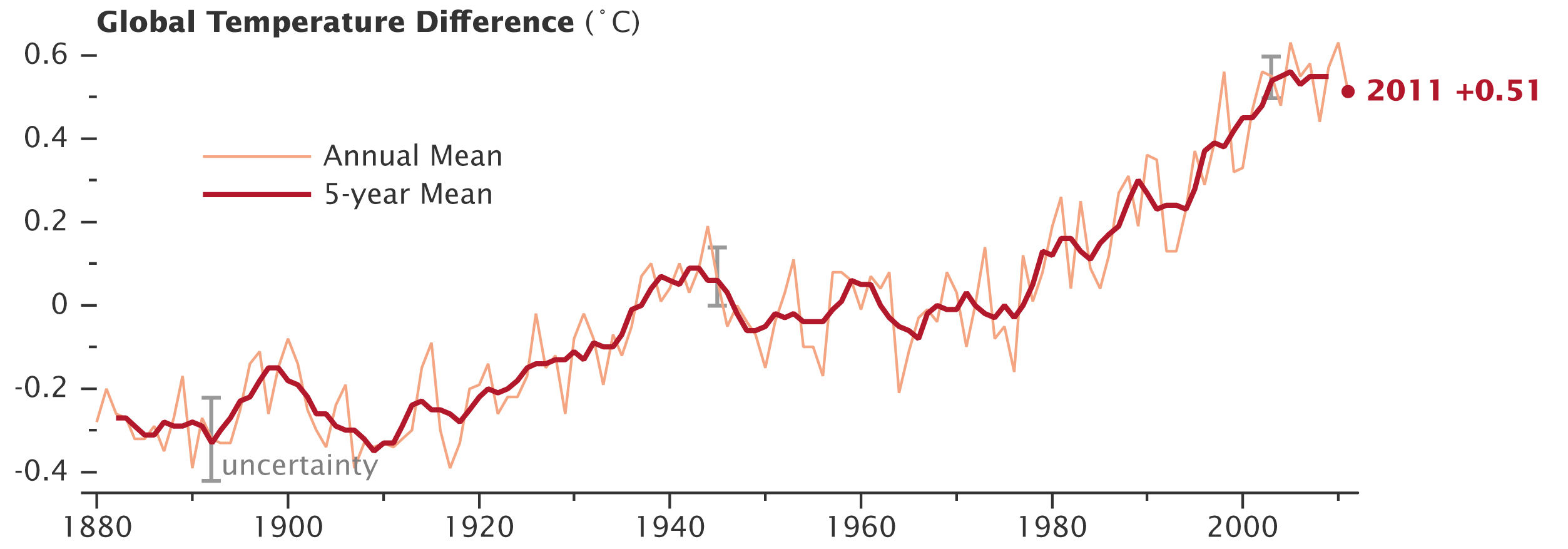
Over the last 40 years in particular, there has been a significant rise in global temperatures.
2014 was the warmest year on record for both land and ocean temperatures since records began in the 19th Century.
The graph below shows the global average temperatures since 1880.
Retreating Glaciers:
The world's glaciers are beginning to retreat.
Up to 90% of the glaciers in Antarctica are facing destruction in the coming years.
The melting of the glaciers at the poles will cause a shift in current ocean currents, which will affect global temperatures.
It is believed that the melting of Northern glaciers will cause the gulf stream to migrate south. This could cause dramatic cooling in the UK.
Rising Sea Levels:
The global mean sea level has risen by 10-20cm in the past 100 years.
It is estimated that this adds up to 3mm per year since the 1990's.
Predicting this change into the future is difficult and it is unknown how much of an impact this process will have.
If sea level were to rise by 1 meter, many major cities such as New York would be underwater.
The melting of the Greenland ice sheet would cause sea level to rise by up to 7 meters, which would cause cities like London to be lost also.
This could lead to huge devastation worldwide.
Increasing Atmospheric Water Vapour:
Water vapor is known to be Earth’s most abundant greenhouse gas, but the extent of its contribution to global warming has been debated.
Atmospheric humidity increases with temperature.
However, the addition of water vapour to the atmosphere, for the most part, cannot be directly attributed to human generated activities.
Página 3
Causes for the Increase in Anthropogenic Activity
Population Growth:
The global population has risen from 1 billion in 1800 to 7.5 billion in 2017.
A higher population brings higher demands for food and energy, increasing emissions.
With the global population expected to surpass nine billion over the next 50 years, environmentalists are worried about the ability of the planet to withstand the added load of greenhouse gases entering the atmosphere.
Development:
Development brings advances in technology and infrastructure. This increases the demand for energy to fuel modern lives.
In the past, energy was used for heating homes, whereas today it is used for almost everything.
Developments in manufacturing and transport are particularly prone to increases in energy demand.
Land-Use Change:
Humans are draining wetlands and removing forests in search of resources and extra land for agriculture.
New uses for this land increase emissions.

Página 4
Distribution of Anthropogenic Emissions
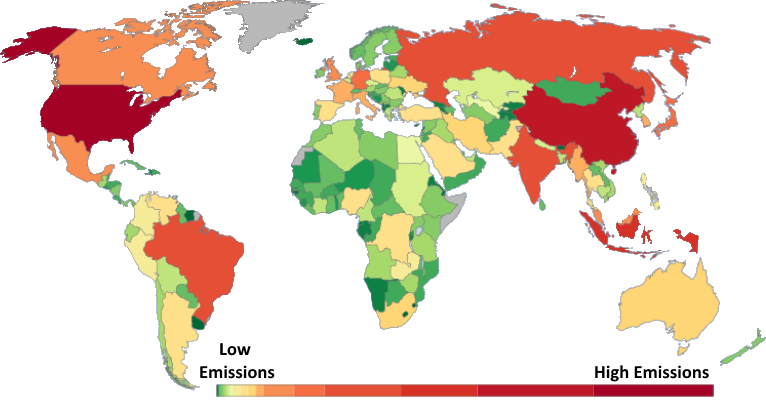
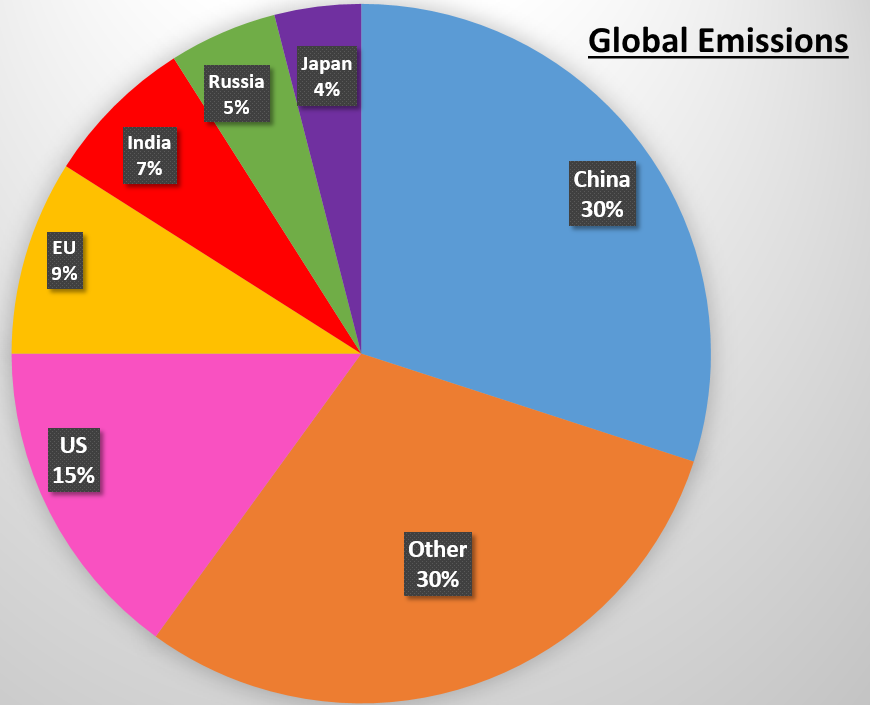
The countries with the highest emissions are generally those that have high levels of development or high levels of manufacturing.
The highest emissions in the world come from China, whose main industry is manufacturing.
Página 5
Human Influence on Mean Energy Balance
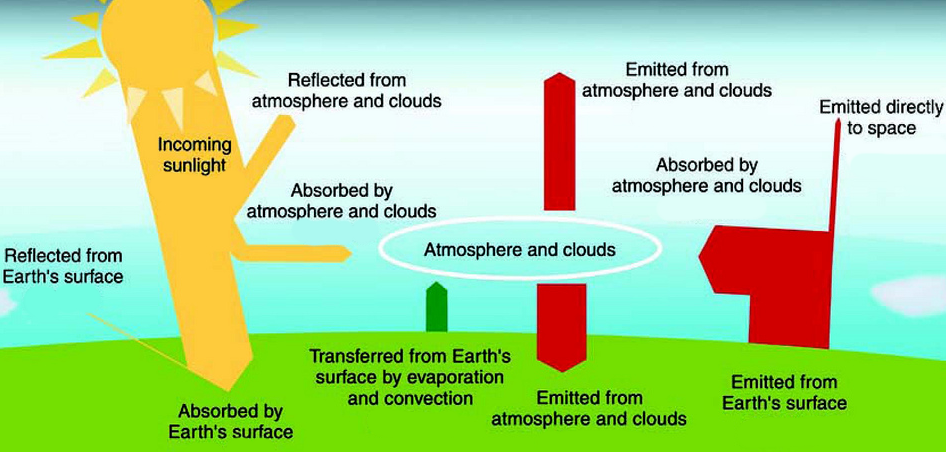
The global energy balance is the balance between incoming energy from the Sun and outgoing heat from the Earth.
The Earth's atmosphere is a closed system. When the inputs and outputs of the system are equal, the system is in balance.
Mean energy balance is controlled by how much of the suns radiation leaves the atmosphere through reflection.
Greenhouse gases trap radiation in the atmosphere, causing an imbalance in the system.
Humans are increasing the amount of these gases in the atmosphere, causing more heat to be trapped over time.
Informações
- Descrição
- O usuário eliminou as informações de disciplina Notas sobre Humans and Climate Change, criado por Usuário eliminado em 25-08-2017.
- Criado por
- Usuário eliminado
- Visualizações
- 88
- Histórico
-
- Criado por Antonia Blankenberg · 25 ago 2017
- Copiado por Antonia Blankenberg · 25 ago 2017
- Avaliação