
Quiz
AMS 588 - Exam 1 (Midterm)
Este quiz tem tempo limite, por isso abre no player de sempre.
Perguntas do quiz (51)
1One of the core teams of product development is:
- Amarketing
- Btechnician
- Csales
- Dproduct support
- Eall of the above
2One of the core teams of product development is:
- AMarketing
- BDesign
- CManufacturing
- Dall of the above
3Sustainable product development demands:
- AEcologically sound use of resources
- BReduction of hazardous waste byproducts
- CReduction of development costs
- DIncrease in purchase price
- EBoth A and B
- FAll of the Above
4Sustainable product development demands:
- AEcologically sound use of resources
- BReduction of hazardous waste byproducts
- CReduction of development costs
- DIncrease in product purchase price
5Product development is an interdisciplinary activity with three central functions. These are:
- AMarketing, Design, and Sales
- BMarketing, Design, and Manufacturing
- CMarketing, Sales, and Manufacturing
- DDesign, Manufacturing, and Sales
6Characteristics of a dysfunctional product development team includes:
- ALack of empowerment of the team
- BFunctional allegiances transcending project goals
- CInadequate resources
- DLack of cross-functional representation on the project team
7The Finance Division provides planning goals during the [blank_start]planning[blank_end] phase and economic analysis during the [blank_start]concept development[blank_end] phase.
- Aplanning
- Bconcept development
8Restaurant services are:
- Afranchise business models
- Bdecision support systems
- Cproduct-service systems
- Dsourcing business models
9Pharmaceuticals are an example of low risk products.
- AVerdadeiro
- BFalso
10Gore-tex rainwear is an example of a [blank_start]technology[blank_end]-[blank_start]push[blank_end] product.
- Atechnology
- Bpush
11Developing promising opportunities involves:
- APursuing a few screened opportunities or one ideal opportunity
- Bpursuing the opportunities which do not have any uncertainties
- Clisting uncertainties, write task used to solve uncertainty, and cost/time to resolve it
- Dinternet searches, customer interviews, testing of existing products, concept generation, quick prototypes, estimation of market sizes and growth rates
- Enone of the above
12During the detail design phase, the Manufacturing division:
- Adefines piece-part production processes
- Bdesign tooling
- Cdefine quality assurance processes
- Dbegin procurement of long-lead tooling
- Enone of the above
13Driving an innovation "down market" can be a source for generating opportunities based on the "imitate but better" approach.
- AVerdadeiro
- BFalso
14A narrow charter allows teams:
- Ato eliminate the existence of the project
- Bto avoid wasting effort generating opportunities unlikely to be pursued
- Cto broaden the scope of the project
- Dto pursue uncertain opportunities generated to use maximum team effort
- Eall of the above
15Generating opportunities using the "mine your sources" approach could involve:
- Alead users
- Brepresentation in social networks
- Cuniversities and government labs
- Donline idea submission
- Eall of the above
- Fnone of the above
16The second step of the product planning process is to:
- Adevelop the product (new product ideas take shape, prototype is made)
- Bevaluate acceptance (evaluate customer response after product has been introduced to the market)
- Cscreen ideas (select most promising projects to pursue)
- Dgenerate ideas (from competitors, current customers, anyone who works with you)
- Enone of the above
17Frequent changes in the directions of projects may occur due to efficiencies of the product planning process of the organization.
- AVerdadeiro
- BFalso
18A product technology roadmap
- Alife cycles of available technology
- BThe expected availability of various technologies relevant to the product being considered
- CThe future use of various technologies relevant to the product being considered
- DAll of the above
19Label the following steps in the Product Planning Process:
[blank_start]Step 4[blank_end]: develop the product (new product idea takes physical shape, prototype is made)
[blank_start]Step 2[blank_end]: Screen ideas (ideas evolve at focus groups and brainstorming sessions)
[blank_start]Step 7[blank_end]: evaluate acceptance (evaluate customer response after product has been introduced and on the market)
[blank_start]Step 3[blank_end]: develop a business plan/proposal (product is evaluated and proposal written)
[blank_start]Step 5[blank_end]: test the product (takes place after lab testing. Test consumer response to the product through focus groups, taste tests, etc.)
[blank_start]Step 6[blank_end]: introduce the product (introduced to consumers: advertising, live demonstrations, coupons, give-aways and other incentives)
[blank_start]Step 1[blank_end]: generate ideas (from competitors, current customers, anyone who works with you)- AStep 1
- BStep 4
- CStep 2
- DStep 7
- EStep 3
- FStep 5
- GStep 6
20A product segment map shows:
- Aproducts that are used in different market segments
- Bproducts that are used in competitors' market segments
- COpportunities that best address weaknesses in its own product line
- DOpportunities that exploit weaknesses in the offerings of competitors
- Eall of the above
21Fundamentally new products are based on:
- ARadically different product or production technologies
- BProducts that may help to address new and unfamiliar markets
- CProduct technologies that may help to address new and unfamiliar markets
- DNone of the above
22Raw data can be gathered from consumers commonly by:
- AInterviewing
- BFacilitating Focus groups
- CObserving products in use
- DNone of the above
23The step-by-step process to create a hierarchical list for customer needs include:
- APrint or write each statement on a separate card or self-stick note
- BEliminate redundant statements
- CGroup the cards according to similarity of needs they express (3-7 cards)
- DFor each group, choose a label (consider supergroups)
- EAll of the above
24One of the fundamental guidelines to interpret raw customer data is:
Express the need in terms of WHAT the product has to do, and not in terms of HOW it might do it.- AVerdadeiro
- BFalso
25One of the fundamental guidelines to interpret raw customer data is:
Express the need in terms of [blank_start]WHAT[blank_end] the product has to do, and not in terms of HOW it might do it.- AWHAT
26The latent customer needs are those which:
- AMany customers recognize as being important in the final product but do not or cannot articulate in advance
- BMay be more important than explicit needs in determining customer satisfaction
- CMay be surprising or unusual needs
- DNone of the above
27Which of the following is a technique to gather data by watching customers to use the product in their natural environment?
- AConducting face-to-face interviews
- BObserving the product in use
- CLeading focus groups
- DPerforming surveys by phone or online
28The first step of Establishing Target Specifications includes:
- ACollect competitive benchmarking information
- BPrepare the list of metrics
- CReflect on the results of the process
- DSet ideal and marginally acceptable target values
29The first step of the setting final specifications includes:
- ADevelop a cost model of the product
- BDevelop technical models of the product
- Cflow down the specifications as appropriate
- DRefine the specifications, making trade-offs where necessary
30A conjoint analysis is a statistical technique which uses customer data to construct a model of customer preference.
- AVerdadeiro
- BFalso
31Developing a technical model may include building [blank_start]analytical[blank_end] and physical approximations of the product.
- Aanalytical
32The list of specification metrics should include [blank_start]dependent[blank_end] variables.
- Adependent
33One of the ways to set ideal and marginally acceptable target values for the metrics is to combine data found to actually set the target values.
- AVerdadeiro
- BFalso
34Let M be the gross profit margin of a stage in the distribution channel. M = (P - C) / P Which of the following variables are included in the formula for gross profit margin (M)
- AP = price this site charges its customers
- BP = price paid by the site for materials
- CC = Cost this stage pays for the product it sells
- DC = cost this stage pays for the product development only
35Target cost, C, is given by the expression shown here. Which of the following describe the variables in solving for target cost (C)
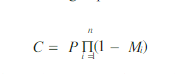
- AP = the price paid by the end user
- BP = the price paid by the product development team
- Cn = the number of stages in the distribution channel
- Dn = the number of individuals in the target cost market
- EM (sub) i = the margin of the ith stage
36Concept generation is a five step method, which breaks a complex problem into simpler subproblems in the first step. Which is the first step this method?
- ASearch externally
- BSearch internally
- CExplore systematically
- DReflect on the solutions and the process
- ENone of the above
37Which of the following methods are used in step 4 "explore systematically" of the Concept Generation Method
- ALead users and experts
- BClassification tree
- Cbenchmarking and literature
- Dcombination table
- Eall of the above
38Step 3: Search Internally, in the concept generation method, the internal search is the use of personal and team knowledge and creativity to generate solution concepts. Guidelines useful for improving both individual and group internal search include:
- ASuspend judgment
- Bgenerate a lot of ideas
- Cwelcome ideas that may seem infeasible
- Duse graphical and physical media
- Eall of the above
- Fnone of the above
39Which of the following hints are helpful for generating solution concepts:
- Amake analogies
- Bwish and wonder
- Cuse related stimuli
- Duse unrelated stimuli
- Eset qualitative goals
- Fset quantitative goals
- Guse the gallery method
- Hall of the above
40Concept generation is not an inherently creative process.
- AVerdadeiro
- BFalso
41Although concept generation is an inherently creative process, teams can benefit from using a structured method.
- AVerdadeiro
- BFalso
42Concept generation is a linear process, in which the team will not likely return to each step of the process several times.
- AVerdadeiro
- BFalso
43Professionals who are good at concept generation seem to be in low demand as team members.
- AVerdadeiro
- BFalso
44Where do the majority of opportunities come from?
- Asales force
- Binternally generated
- Cindependent partner
- Duniversity
45Fill in the blank below to label each step of the Concept Testing Process (using only numbers 1-7, with one number in each blank):
[blank_start]7[blank_end] Reflect on the results and process
[blank_start]5[blank_end] Measure customer response
[blank_start]3[blank_end] Choose a survey format
[blank_start]1[blank_end] Define the purpose of the concept test
[blank_start]2[blank_end] Choose a survey population
[blank_start]4[blank_end] Communicate the concept
[blank_start]6[blank_end] Interpret the results- A7
- B5
- C3
- D1
- E2
- F4
- G6
46When choosing a survey format, in the concept testing process, which format is recommended when presenting multiple concept alternatives or when soliciting ideas for improving a concept?
- AInternet or email surveys
- Btelephone surveys
- Cpostal mail surveys
- Dface-to-face interaction
47Concept selection is applied not only during concept development but throughout the subsequent design and development process.
- AVerdadeiro
- BFalso
48Concept selection is a group process that:
- Afacilitates the selection of a winning concept
- Bhelps build team consensus
- Ccreates a record of the decision-making
process - Dall of the above
49Concept selection is the process of
- Aevaluating concepts with respect to customer needs and other criteria
- Bcomparing the relative strengths and weaknesses of the concepts
- Cselecting one or more concepts for further investigation or development
- Dall of the above
50All teams use some method for selecting concepts. Decision techniques employed for selecting concepts range from intuitive approaches to structured methods. The methods teams use are _____________________ .
- Aimplicit
- Bexplicit
- Cimplicit or explicit
- Dnone of the above
51Successful design is facilitated by structured concept selection. We recommend a two-stage process: concept ____________ and concept ___________.
- Ascreening, scoring
- Bscreening, testing
- Cscoring, development
- Dnone of the above
Informações
- Descrição
- Product Design and Development
- Autor
- Jenna Williams
- Idioma
- English
- Visualizações
- 63
- Etiquetas
- Avaliação
- Ainda sem avaliações Avalie este quiz