
Quiz
Manipulating Data (Section 3)
Crie uma conta grátis para terminar este quiz
Salve seu progresso e veja sua nota final.
Já tem uma conta? Inicie sessão
Perguntas do quiz (15)
1Which of the following is true of the SQL statement?

- AThe statement will result in an implicit commit.
- BThe statement will remove all data from any INDEX objects associated with that table.
- CThe statement will not fire any DML triggers on the table.
- DThe statement will fail.
2The CASCADE keyword, when used with TRUNCATE:
- AIs required if the table has any dependent child tables
- BWill ensure that future attempts to insert rows to the table will be rejected if they satisfy the TRUNCATE table’s WHERE clause
- CCan be used with the optional DEPENDENCY keyword
- DNone of these
3TRUNCATE TABLE:
- ACannot be used within a valid SQL statement
- BIs a valid set of keywords to be used within a DDL statement
- CDoes not require the DROP_ANY_TABLE privilege
- DIs a valid statement that will truncate a table called TABLE
4The table will create successfully. What will result from the INSERT statement?
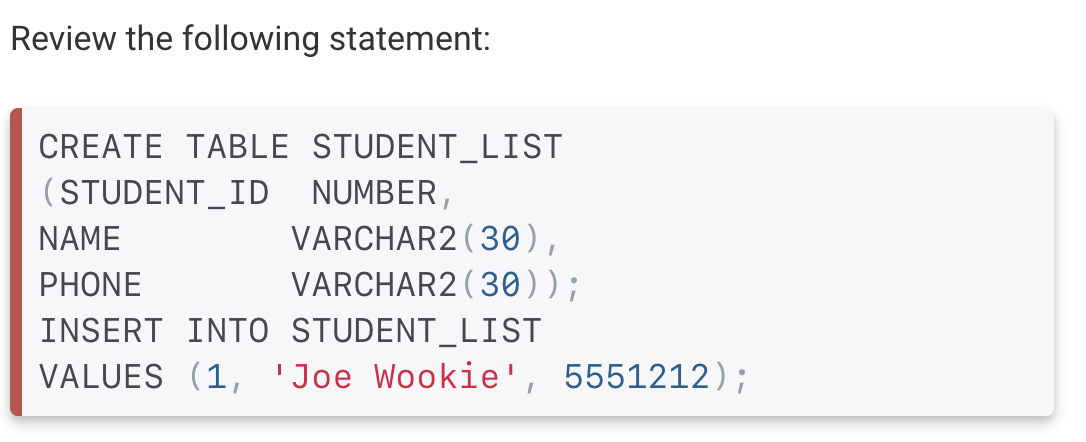
- AThe INSERT will fail because there is no list of columns after STUDENT_LIST.
- BThe INSERT will fail because the literal value for PHONE is numeric and PHONE is a character data type.
- CThe INSERT will execute—the table will contain one row of data.
- DNone of these.
5The table will create successfully. What will be the result of the two INSERT statements?
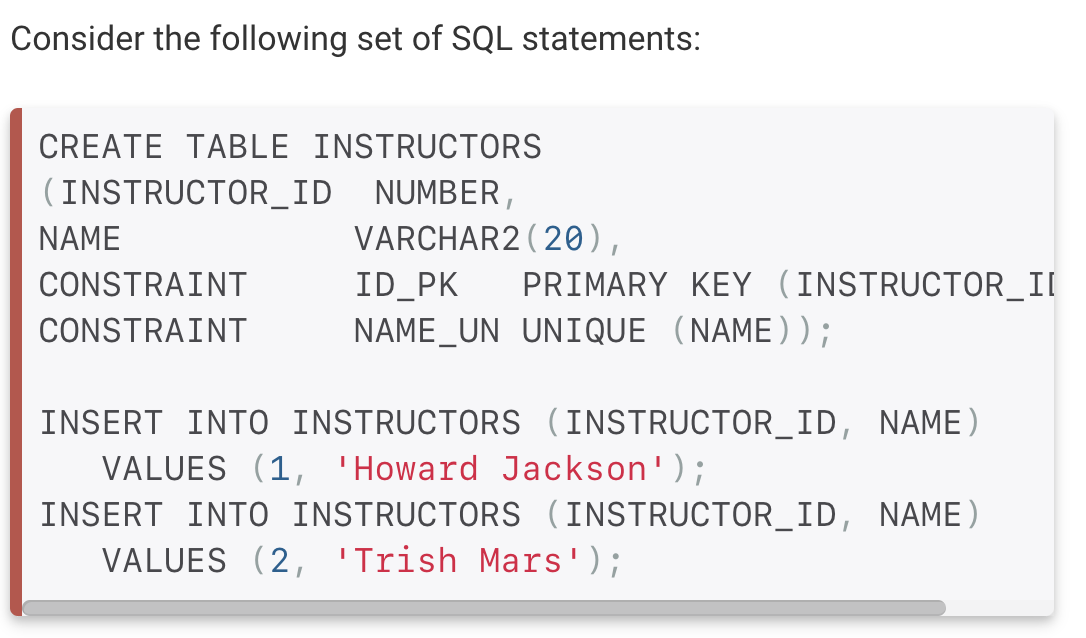
- ANeither will execute.
- BThe first will execute, but the second will fail.
- CThe first will fail, but the second will execute.
- DBoth will execute successfully.
6What will be the result of the INSERT statement?
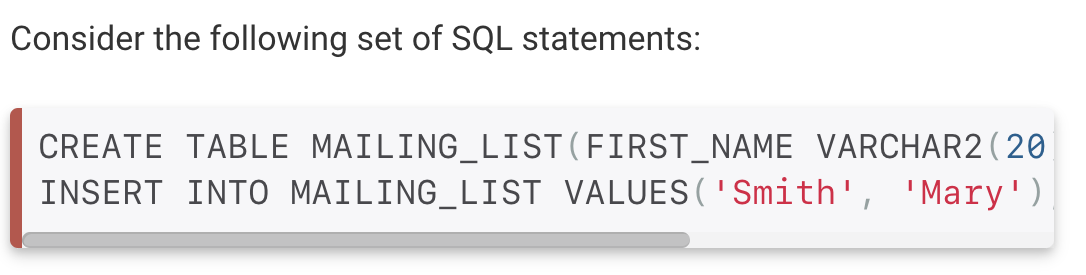
- AIt will fail because there is no column list in the INSERT statement.
- BIt will fail because there is no PRIMARY KEY in the table.
- CIt will execute and create a new row in the table.
- DIt will fail because the last name and first name values are reversed.
7Which of the following reserved words is not required in order to form a syntactically correct UPDATE statement?
- AUPDATE
- BSET
- CWHERE
- DNone of these
8Assume a table LAMPS that has no constraints. Which of the following is true about the UPDATE statement and the LAMPS table? (Choose all that apply.)This
- AUPDATE can be used to add rows to LAMPS by setting values to all the columns.
- BUPDATE can be used to remove a row from LAMPS by setting all of the row’s columns to a value of NULL.
- CFor existing rows in LAMPS, UPDATE can add values to any column with a NULL value.
- DFor existing rows in LAMPS, UPDATE can remove values from any column by changing its value to NULL.
9What can be said of the statements listed here?
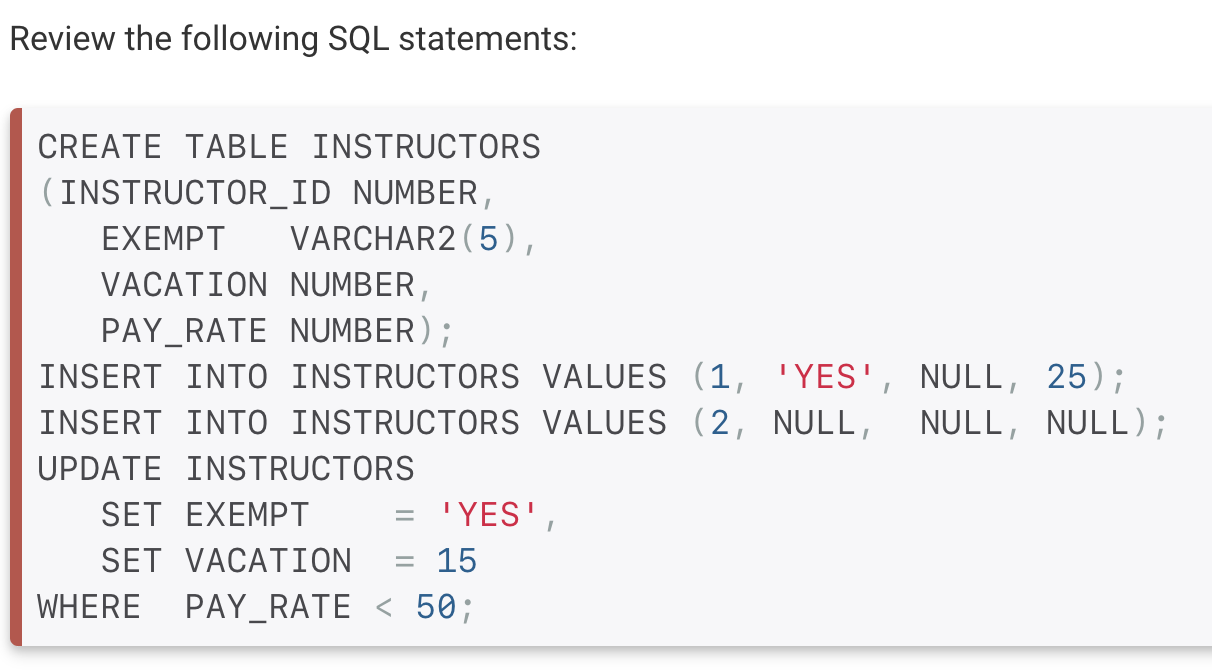
- AOne row will be updated.
- BTwo rows will be updated.
- CAt least one of the statements will not execute.
- DNone of these.
10What is the end result of the SQL statements listed here?
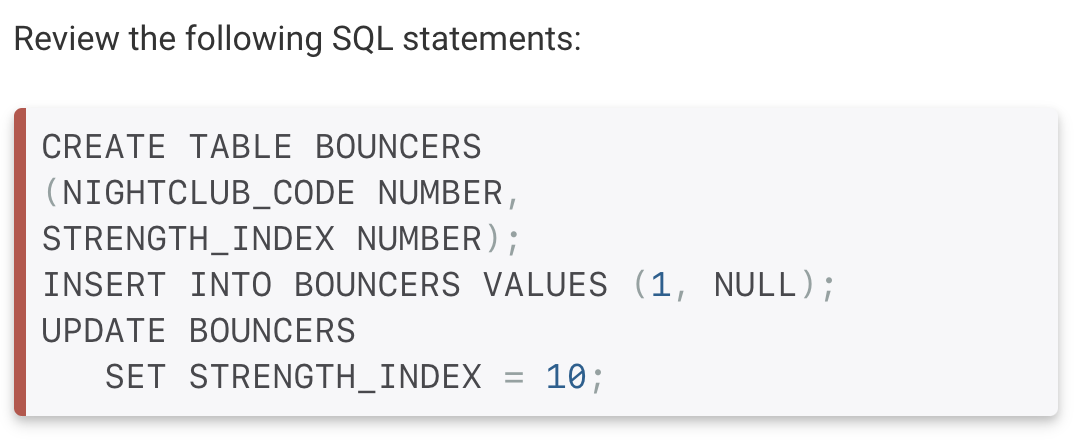
- AThe BOUNCERS table will contain one row.
- BThe BOUNCERS table will contain two rows.
- CThe UPDATE will fail because there is no WHERE clause.
- DNone of these.
11Which of the following reserved words is/are optional in a complete DELETE statement? (Choose all that apply)
- AFROM
- BWHERE
- CDELETE
- DREMOVE
12Which of the following SQL statements will remove the word VALID from row 1, resulting in one row with a status of NULL and two rows with a status of PENDING?
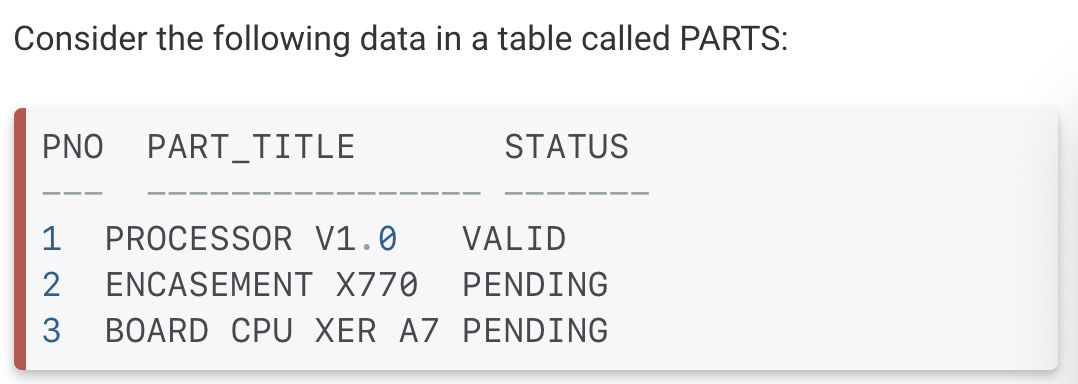
- ADELETE FROM PARTS
WHERE STATUS = 'VALID' ; - BDELETE PARTS
WHERE PNO = 1 ; - CDELETE FROM PARTS
SET STATUS = NULL
WHERE PNO = 1 ; - DNone of these
- ADELETE FROM PARTS
13Which of the following best describes the results of attempting to execute the DELETE statement?
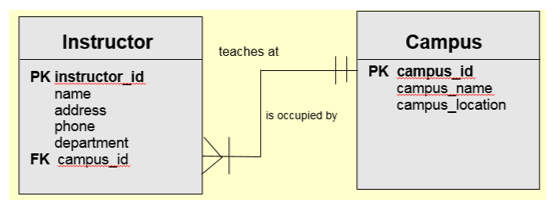
- AThe DELETE statement will fail because it is missing a column list between the word DELETE and the name of the table AB_INVOICES.
- BThe DELETE statement will execute, but no rows in the table will be removed.
- CThe DELETE statement will produce a syntax error because it is referencing a row that does not exist in the database.
- DNone of these.
14In this series of SQL statements, which line represents the first commit event?
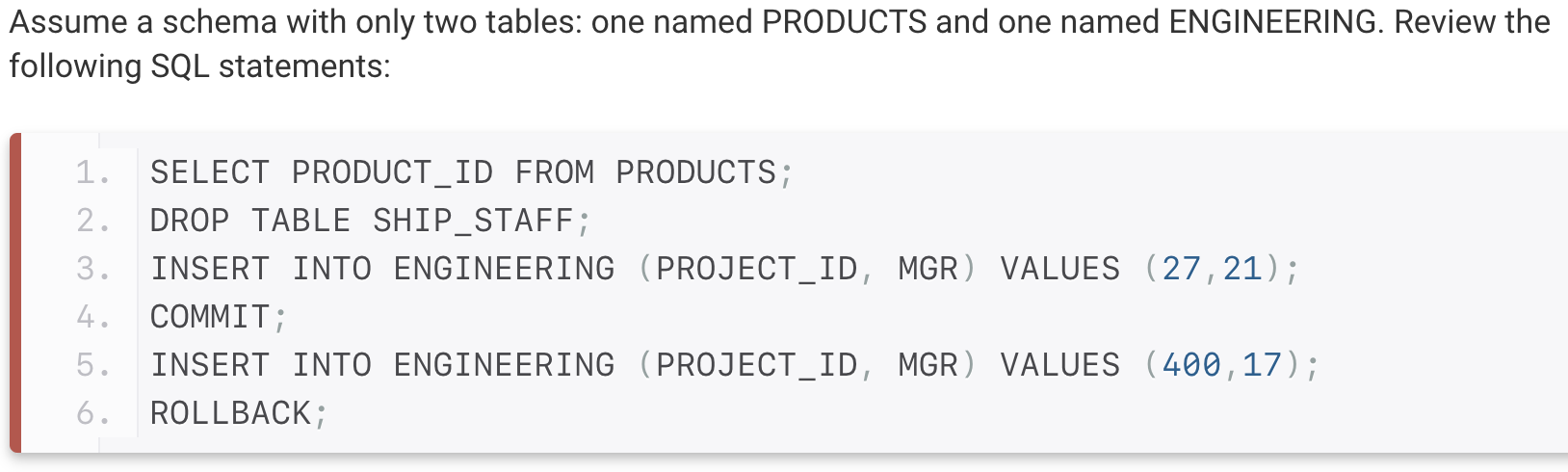
- ALine 1
- BLine 2
- CLine 4
- DLine 5
- ELine 6
15What will be the result of the execution of the SQL statements shown here?This
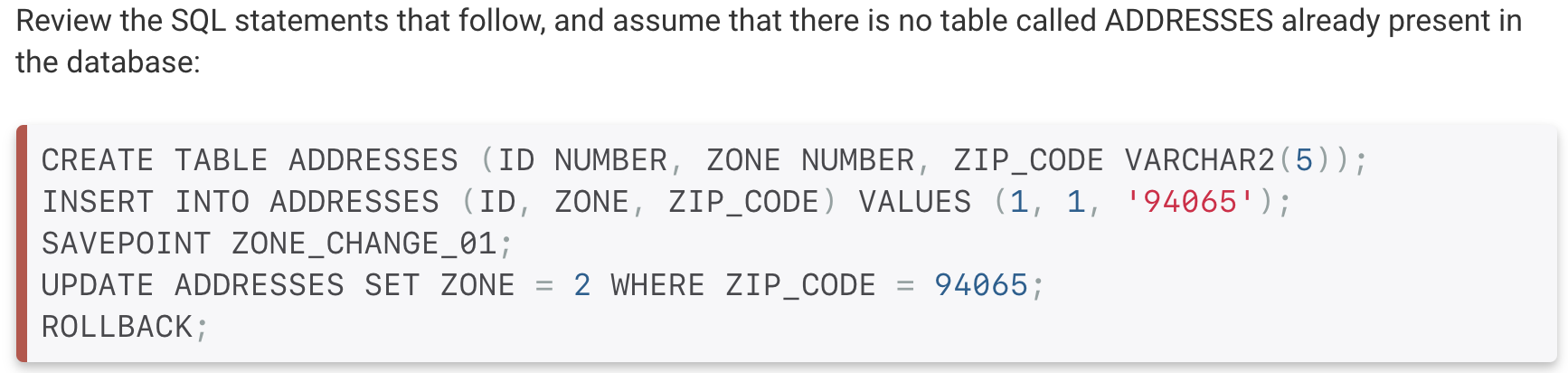
- AThe ADDRESSES table will have one row with a value of 1 for ZONE.
- BThe ADDRESSES table will have one row with a value of 2 for ZONE.
- CThe ADDRESSES table will have no rows.
- DNone of these.
Informações
- Descrição
- Databases
- Autor
- Craig Willey
- Idioma
- English
- Visualizações
- 46
- Etiquetas
- Avaliação
- Ainda sem avaliações Avalie este quiz