
Quiz
SANS
Perguntas do quiz (20)
1A patient presents with a classic type II odontoid fracture. A magnetic resonance image and flexion-extension dynamic radiographs of the cervical spine are consistent with disruption of the transverse ligament. The MOST appropriate
treatment is:- AHard cervical collar
- BHalo immobilization
- CAnterior odontoid screw fixation
- DPosterior C1-C2 fixation
- EOccipital-cervical fusion
2A 43 year old male with metastatic lung cancer presents with subacute thoracic myelopathy. Imaging studies demonstrate a metastatic lesion at T7 with ventral spinal cord compression and 30 degrees of focal kyphosis. The treatment associated with the BEST outcome is:
- AHigh dose steroids
- BConventional radiation therapy
- CDecompressive laminectomy
- DTransthoracic vertebrectomy
- EStereotactic radiosurgery
3Static plain radiographs after a posterolateral lumbar fusion are MOST useful to assess which clinical feature:
- AFunctional outcome
- BFusion status
- CPain relief
- DResting alignment
4A 36 y/o restrained driver presented after an MVC. He complained of weakness and a numb feeling in his legs. Examination showed 4-/5 strength in his proximal and 3/5 strength in his distal lower extremities and an L1 sensory level. Lumbar spine radiographs and axial CT through the level of injury are shown below. What is the spinal injury type:
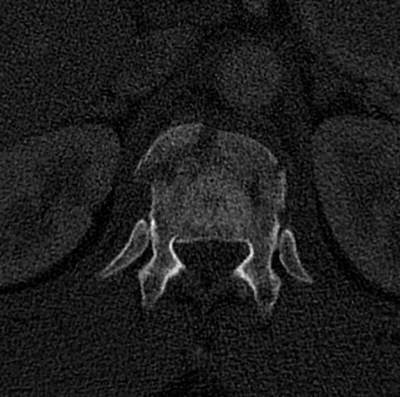
- ACompression fracture
- BBurst fracture
- CTeardrop fracture
- DFracture dislocation
- EChance fracture
5A 47 year old dentist presents with a 5 year history of intractable low back pain refractory to several courses of physical therapy and numerous medications. He has recently developed bilateral L5 radiculopathy. MR imaging demonstrates grade II anterolisthesis of L4 on L5 with resulting L4-5 central canal stenosis and bilateral neuroforaminal stenosis. The BEST treatment option is:
- ALaminectomy with facetectomy
- BAnterior lumbar interbody cage fusion
- CLaminectomy and pedicle screw fusion
- DEpidural steroid injection
- EDorsal column stimulator
6What are the current evidence-based guidelines regarding posterolateral lumbar fusion for patients with radiculopathy due to intervertebral disc herniation?
- AA. Recommended for patients who fail to improve with six to eight weeks of conservative management.
- BNot recommended because simple decompression is associated with better outcomes
- CRecommended in patients with recurrent disc herniations without evidence of instability,
deformity, or chronic low back pain - DNot recommended because interbody fusions are associated with better outcomes
- ERecommended for patients with large para-central disc herniations
7Lumbar orthosis use is MOST effective to:
- APredict the success of subsequent lumbar fusion for patients with chronic low back pain
- BImprove functional outcome following lumbar fusion in patients with chronic low back pain
- CImprove fusion rate following lumbar fusion in patients with chronic low back pain
- DReduce the symptoms reported by patients with chronic low back pain due to back injury
- EReduce the numbers of sick days used by workers with a history of back injury
8A normal intraoperative electromyographic study during lumbar fusion surgery has been shown to BEST correlate with:
- APedicle fracture
- BLack of a neurological injury
- CImproved patient outcomes
- DImproved fusion rates
9The use of recombinant bone morphogenetic protein in the performance of a lumbar fusion is currently supported by randomized controlled clinical trials for which fusion approach/type:
- AAnterior lumbar interbody fusion procedures
- BPosterior lumbar interbody fusion procedures
- CNon-instrumented posterolateral lumbar fusion procedures
- DInstrumented posterolateral lumbar fusion procedures
10A 51 year-old woman presents to the ED with a subcutaneous fluid collection in the lumbar area two days after undergoing a redo L4-5 laminectomy/discectomy at another institution. She is afebrile and has no neurological deficits but complains of headache when she sits up or stands. What is the MOST likely etiology of her fluid collection:
- Awound infection
- Bwound seroma
- Cwound hematoma
- Dcerebrospinal fluid leak
- Esubcutaneous foreign body
11A 32 year-old I.V. drug user presents with severe low back pain. Lumbar MR imaging demonstrates L4-5 discitis and early osteomyelitis. Blood cultures grow staphylococcus. The MOST appropriate treatment is:
- AOral cephalexin
- BObservation with imaging
- CSurgical debridement and fusion
- DIntravenous vancomycin
- EOral or intravenous steroids
12A 33 year-old woman with known metastatic breast carcinoma presents with a one day history of paraparesis and bladder incontinence. Her lower extremity motor strength is 2/5 in all groups. An MRI of her thoracic spine reveals dorsal cord compression at T9-T10 with preserved alignment. The MOST appropriate course of treatment is:
- Aoral steroids
- Bspinal radiation
- Cno treatment
- DT9-10 laminectomy
- ET9-10 spondylectomy/instrumentation
13A 45 year-old man fell from a horse 2 hours ago. He is neurologically intact but complains of neck pain. X-rays reveal a well aligned type 3 dens fracture. The MOST appropriate initial management of this patient is:
- Ano treatment
- Bexternal orthosis or halo
- Canterior odontoid screw fixation
- Dposterior C1-2 fusion
- Eoccipito-cervical fusion
14A 61 year old previously healthy man presents with progressive hand weakness, tingling in his fingers, and gait instability. Examination reveals atrophy and weakness of the hands, impaired rapid alternating movements, diminished pinprick sensation in the fingers, diffuse hyper-reflexia, and lower extremity spasticity. What is the MOST likely diagnosis:
- AAmytrophic Lateral Sclerosis
- BSubacute Combined System Disease
- CNormal Pressure Hydrocephalus
- DCervical Spondylotic Myelopathy
- EMultiple Sclerosis
15An isolated posterior approach is contraindicated in the presence of:
- ASubluxation at C3/4 and C4/5
- BCompressive pathology across multiple levels
- CFixed kyphotic deformity
- DPosterior ligamentous hypertrophy
- EVentral compressive pathology
16A 48 year old women presents with progressive complaints of hand paresthesias, loss of fine motor control, gait instability, and urinary urgency (MR imaging is shown below). She undergoes a posterior decompression via an open-door laminoplasty from C3 to C7. On post-operative day number 3, she complains of bilateral shoulder pain and demonstrates mild weakness of her right deltoid. The MOST appropriate next step in the management of this patient is:
- AEmergent surgery for laminectomy/foraminotomy
- BAdministration of corticosteroids
- CBilateral selective nerve root injections
- DBilateral upper extremity EMG
- EOrthopedic/Physiatry consult for "frozen shoulder."
17A 35 year old man presents to your office with an insidious 6 month history of declining ability to walk, leg weakness, stumbling, and shooting pains down both legs. He denies an inciting event. He admits to axial, non-mechanical, thoracic pain that is most prominent at night, especially in the supine position. Physical exam reveals 4-/5 symmetric strength in his lower extremities and decreased sensation to both light touch and pin prick in the lower extremities and trunk up to the umbilicus. Proprioception is absent in the left lower extremity and present in the right. Reflexes are
3+ at the patella and Achilles tendon bilaterally with increased lower extremity tone. Babinski responses are extensor and rectal tone is present. The MOST appropriate initial management step is:- APrescribe non-steroidal anti-inflammatory medications
- BObtain a contrasted MRI of the thoracic spine
- CObtain plain radiographs and CT scan of the thoracic spine
- DPrescribe a course of physical therapy
- EObtain a spinal angiogram from T2 through T12
18A patient presents complaining of an 8 month history of axial cervical pain, worse when supine and at night, plus leg weakness requiring a walker. Physical exam reveals myelopathy. T1-weighted MRI demonstrates an enlargement of her cervical spinal cord by a hypointense mass in the dorsal cord, which intensely enhances on post-gadolinium images. T2-weighted MRI reveals peritumoral edema and syringomyelia. The neuroradiologist describes the tumor as most consistent with hemangioblastoma. The MOST appropriate first management step is:
- AExternal beam radiotherapy
- BMRI of the brain and lumbar puncture
- CAbdominal CT scan and 24 hour urinary catacholamines and metanephrines
- DBiopsy and post-operative radiotherapy
- E6 month follow-up MRI
19A 43 year old man with a 3 month history of numbness and tingling in bilateral lower extremities, difficulty ambulating, and weakness in both hands and arms undergoes MR imaging of his cervical spine revealing a homogeneously enhancing intramedullary spinal cord tumor. The tumor diffusely and symmetrically enlarges the involved portion of the spinal cord without cyst formation. At surgery, intraoperative frozen section yields ependymoma. The MOST appropriate treatment strategy is:
- ATumor debulking and duraplasty
- BBiopsy and external beam radiation
- CAttempted gross total resection
- DSubtotal resection and radiotherapy
20A 54 year-old female presents 18 months after undergoing instrumented ACDF at C5-6 via a left-sided approach. She has neck pain and radiculopathy with pseudoarthrosis and instrumentation failure. She denies hoarseness or swallowing difficulties with the initial surgery. Being right-handed, you prefer a right-sided approach for her recommended revision surgery. What is the MOST appropriate management of the surgical approach in this case:
- ARight-sided approach without further work-up
- BModified barium swallow prior to surgery
- CLaryngoscopic screening prior to surgery
- DIntra-operative EMG monitoring of the laryngeal muscles
Informações
- Descrição
- Professional Neurosurgery Review Quiz sobre SANS, criado por Mohammed Al-Dhahir em 21-11-2015.
- Autor
- Mohammed Al-Dhahir
- Idioma
- English
- Visualizações
- 94
- Etiquetas
- Avaliação
- 4,2 de 5 · 5 avaliações Avalie este quiz