
Quiz
Passive design- Passive cooling
Este quiz tem tipos de pergunta que abrem no player de sempre.
Perguntas do quiz (27)
1Passive cooling has 2 main objectives
1. eliminate [blank_start]unwanted heat gains[blank_end] as much as possible
2. [blank_start]generate passive cooling[blank_end] potential wherever possible- Aunwanted heat gains
- Bgenerate passive cooling
2Eliminate heat gains
1. [blank_start]heat gain in summer[blank_end] can be due to
- [blank_start]solar radiation[blank_end]
- [blank_start]high ambient air temp outside[blank_end]
- [blank_start]internal heat gain[blank_end] from [blank_start]occupancy, equipment and lighting[blank_end]
2. [blank_start]solar[blank_end] [blank_start]radiation[blank_end]
-through [blank_start]windows[blank_end]
-[blank_start]opaque[blank_end] (non-transparent) elements via [blank_start]heat transfer (walls)[blank_end]
3. best and simplest way [blank_start]to keep heat gains low[blank_end] is [blank_start]prevent solar radiation[blank_end] to [blank_start]reach windows[blank_end] and [blank_start]opaque elements[blank_end] in the first place this can be achieve by
[blank_start]-shading devices[blank_end] [blank_start]-double skin system[blank_end]
[blank_start]-surface colouring[blank_end]
[blank_start]-insulation[blank_end]
-[blank_start]thermal mass[blank_end]- Aheat gain in summer
- Bsolar radiation
- Chigh ambient air temp outside
- Dinternal heat gain
- Eoccupancy, equipment and lighting
- Fsolar
- Gradiation
- Hwindows
- Iopaque
- Jheat transfer (walls)
- Kto keep heat gains low
- Lprevent solar radiation
- Mreach windows
- Nopaque elements
- O-shading devices
- P-double skin system
- Q-surface colouring
- R-insulation
- Sthermal mass
3Protection [blank_start]against solar radiation[blank_end]
1. [blank_start]shading devices[blank_end]
- [blank_start]building shapes[blank_end]
-[blank_start]roof overhangs[blank_end]
-[blank_start]fins[blank_end]
-[blank_start]louvres[blank_end]
- [blank_start]vegetation[blank_end]
-[blank_start]external shutters[blank_end] to protect window and wall surfaces- Ashading devices
- Bagainst solar radiation
- Cbuilding shapes
- Droof overhangs
- Efins
- Flouvres
- Gvegetation
- Hexternal shutters
4Protection [blank_start]against solar radiation[blank_end]
2. [blank_start]Double skin systems[blank_end]
-uses [blank_start]ventilated air gap between[blank_end] and extern [blank_start]exposed wall[blank_end] or [blank_start]roof[blank_end] and a [blank_start]internal protected wall or roof[blank_end]
-similar to [blank_start]trombe wall[blank_end] but [blank_start]heat[blank_end] is [blank_start]removed to outside[blank_end] rather than [blank_start]inside[blank_end]
-most [blank_start]solar gain[blank_end] from [blank_start]external leaf[blank_end] is carried away by [blank_start]air[blank_end] [blank_start]before[blank_end] it passes into [blank_start]internal leaf[blank_end]- Aagainst solar radiation
- BDouble skin systems
- Cventilated air gap between
- Dexposed wall
- Eroof
- Finternal protected wall or roof
- Gtrombe wall
- Hheat
- Iremoved to outside
- Jinside
- Ksolar gain
- Lexternal leaf
- Mair
- Nbefore
- Ointernal leaf
5Protection [blank_start]against solar radiation[blank_end]
3. [blank_start]Surface colouring[blank_end]
-for [blank_start]cooling surfaces[blank_end] kept [blank_start]white[blank_end] or [blank_start]reflective colours[blank_end] ([blank_start]high albedo value[blank_end])
-[blank_start]dark colours absorb[blank_end] the [blank_start]heat[blank_end] and [blank_start]raise[blank_end] the [blank_start]tempreture[blank_end] around them
-[blank_start]increasing reflectance level[blank_end] of the [blank_start]surface[blank_end] the [blank_start]solar load[blank_end] is [blank_start]decreased[blank_end]- Aagainst solar radiation
- BSurface colouring
- Ccooling surfaces
- Dwhite
- Ereflective colours
- Fhigh albedo value
- Gdark colours absorb
- Hheat
- Iraise
- Jtempreture
- Kincreasing reflectance level
- Lsurface
- Msolar load
- Ndecreased
6[blank_start]Albedo Values[blank_end]
Black built-up roof [blank_start]0.04-0.05[blank_end]
[blank_start]Built-up roof (whit gravel)[blank_end] 0.30-0.50
[blank_start]Asphalt[blank_end] 0.04-0.15
Light gray asphalt [blank_start]0.25-0.27[blank_end]
Dark concrete tiles [blank_start]0.05-0.35[blank_end]
White concrete tiles [blank_start]0.70[blank_end]
[blank_start]Metal roof unpainted, corrugated[blank_end] 0.30-0.50- AAlbedo Values
- B0.04-0.05
- CBuilt-up roof (whit gravel)
- DAsphalt
- E0.25-0.27
- F0.05-0.35
- GMetal roof unpainted, corrugated
- H0.70
7Protection [blank_start]against solar radiation[blank_end]
4. [blank_start]Insulation[blank_end]
-any [blank_start]surface exposed[blank_end] to levels of [blank_start]solar radiation[blank_end] in [blank_start]summer[blank_end] should be [blank_start]well insulated[blank_end] to [blank_start]reduce the transfer of heat[blank_end]
-best [blank_start]location for insulation[blank_end] is on the [blank_start]outside surface[blank_end]- Aagainst solar radiation
- BInsulation
- Csurface exposed
- Dsolar radiation
- Esummer
- Fwell insulated
- Greduce the transfer of heat
- Hlocation for insulation
- Ioutside surface
8Protection [blank_start]against solar radiation[blank_end]
4. [blank_start]Thermal mass[blank_end] - same as [blank_start]passive heating[blank_end]
- [blank_start]time lag[blank_end]
-[blank_start]peak reduction[blank_end]
- [blank_start]leveling out temperature fluctuations[blank_end]
- [blank_start]heat sink[blank_end] to [blank_start]store[blank_end] the [blank_start]heat[blank_end] over the period of a [blank_start]hot day[blank_end] and in then [blank_start]emptied[blank_end] during [blank_start]night time[blank_end]- Aagainst solar radiation
- BThermal mass
- Cpassive heating
- Dtime lag
- Epeak reduction
- Fleveling out temperature fluctuations
- Gheat sink
- Hstore
- Iheat
- Jhot day
- Kemptied
- Lnight time
9Case study - [blank_start]Eastgate building[blank_end] [blank_start]Pearce partnership, Harare, Zimbabwe[blank_end]
-[blank_start]natural exhaust in roof[blank_end] from offices, [blank_start]ventilation[blank_end]
- [blank_start]solar panels[blank_end]
Case study- [blank_start]Library square[blank_end], [blank_start]Moshe Safdie with Keen Engineering[blank_end] [blank_start]Vancouver, B.C[blank_end]
1. [blank_start]thermal mass features[blank_end]
-[blank_start]exposed concrete floor and ceiling[blank_end], heat slowly absorbs and releases
-purging with [blank_start]cool night air[blank_end]
-[blank_start]time delay shifts reduces peak cooling[blank_end] load (peak saving)
-[blank_start]smaller mechanical equipment, less cost[blank_end]
[blank_start]Night-time cooling (water and ice)[blank_end]- case study
-[blank_start]Hewlett foundation LEED gold[blank_end]
-B.H. Bocook, [blank_start]Architects Menlo Park[blank_end], California
- ice storage system - [blank_start]creates ice during off-peak hours[blank_end] at [blank_start]night[blank_end]
case study- [blank_start]Carnegie Center for Global Ecology[blank_end], [blank_start]EHDD Architects Stanford,[blank_end] Californina
-[blank_start]roof spray system[blank_end]
-use [blank_start]radiant cooling to chill the water[blank_end] at night- AEastgate building
- BPearce partnership, Harare, Zimbabwe
- Cnatural exhaust in roof
- Dventilation
- Esolar panels
- FLibrary square
- GMoshe Safdie with Keen Engineering
- HVancouver, B.C
- Ithermal mass features
- Jexposed concrete floor and ceiling
- Kcool night air
- Ltime delay shifts reduces peak cooling
- Msmaller mechanical equipment, less cost
- NNight-time cooling (water and ice)
- OHewlett foundation LEED gold
- PArchitects Menlo Park
- Qcreates ice during off-peak hours
- Rnight
- SCarnegie Center for Global Ecology
- TEHDD Architects Stanford,
- Uroof spray system
- Vradiant cooling to chill the water
10Eliminate [blank_start]heat gains[blank_end]
1. [blank_start]high ambient temp outside[blank_end] can influence the [blank_start]internal climate[blank_end] in 2 way
- [blank_start]infiltration[blank_end]
- [blank_start]conduction[blank_end]
2. [blank_start]same as minimising heat loss[blank_end]
-heat [blank_start]gain[blank_end] and heat [blank_start]loss[blank_end] same thing [blank_start]reversed[blank_end]
3. [blank_start]dealing with internal gains[blank_end], if heat generated by a room cannot be removed it can be minimised by
-[blank_start]maximising daylighting[blank_end], [blank_start]cut down on artifical lighting[blank_end]
- [blank_start]zoning[blank_end], can be used to [blank_start]separate high-gain spaces[blank_end] from [blank_start]low-gain spaces[blank_end] so [blank_start]ventilation[blank_end] and strategies can be [blank_start]applied[blank_end] to a different degree to [blank_start]remove heat generated by internal gains[blank_end]- Aheat gains
- Bhigh ambient temp outside
- Cinternal climate
- Dinfiltration
- Econduction
- Fsame as minimising heat loss
- Greversed
- Hgain
- Iloss
- Jdealing with internal gains
- Kmaximising daylighting
- Lcut down on artifical lighting
- Mzoning
- Nseparate high-gain spaces
- Olow-gain spaces
- Pventilation
- Qapplied
- Rremove heat generated by internal gains
11Passive [blank_start]cooling strategies[blank_end]
1. [blank_start]ventilation[blank_end]
2. [blank_start]radiant cooling[blank_end] (including [blank_start]thermal mass[blank_end])
3.[blank_start]evaporative[blank_end] cooling
4. [blank_start]soil or earth[blank_end] cooling
dependent on [blank_start]local conditions[blank_end]- Acooling strategies
- Bventilation
- Cradiant cooling
- Dthermal mass
- Eevaporative
- Fsoil or earth
- Glocal conditions
12Ventilation
difference in [blank_start]temp[blank_end]
-[blank_start]heated up[blank_end]
-[blank_start]cooled down[blank_end]
difference in [blank_start]pressure[blank_end]
-[blank_start]pushed[blank_end]
-[blank_start]pulled[blank_end]- Atemp
- Bheated up
- Ccooled down
- Dpressure
- Epushed
- Fpulled
13[blank_start]Ventilation[blank_end]- design considerations
1. determine the [blank_start]direction of the prevailing wind[blank_end] and your requirements
2. install [blank_start]openable windows[blank_end]
-use [blank_start]landscaping elements[blank_end] to [blank_start]channel breezes[blank_end]
-[blank_start]reduce internal barriers to ventilation[blank_end] (walls)
-properly [blank_start]locate and size windows[blank_end] for [blank_start]cross ventilation[blank_end]
3. use [blank_start]wing walls/fin walls[blank_end] to [blank_start]guide the wind[blank_end] through [blank_start]pressure[blank_end] differentials
4. use [blank_start]roof outlets[blank_end] to [blank_start]guide the wind through[blank_end] [blank_start]pressure differentials[blank_end]
5. use roof outlets to guided the wind through pressure differentials
6. use [blank_start]stack ventilation[blank_end] to create a [blank_start]chimney affect[blank_end]
- [blank_start]two openings on opposite[blank_end] external faces of a space, [blank_start]one[blank_end] of which is [blank_start]connected to a vertical rise[blank_end] (chimney or atrium)
-effective to depth up to 5 times the room height- AVentilation
- Bdirection of the prevailing wind
- Copenable windows
- Dlandscaping elements
- Echannel breezes
- Freduce internal barriers to ventilation
- Glocate and size windows
- Hcross ventilation
- Iwing walls/fin walls
- Jguide the wind
- Kpressure
- Lroof outlets
- Mpressure differentials
- Nguide the wind through
- Ostack ventilation
- Pchimney affect
- Qtwo openings on opposite
- Rconnected to a vertical rise
- Sone
14Ventilation- [blank_start]solar chimney[blank_end]
example: [blank_start]The building research establishment[blank_end] (BRE), office building, [blank_start]Feilden Clegg Bradley Architects[blank_end]- Asolar chimney
- BThe building research establishment
- CFeilden Clegg Bradley Architects
15Ventilation: [blank_start]stack effect, atrium[blank_end]
example: [blank_start]Heelis[blank_end], [blank_start]The national trust central office[blank_end], UK, [blank_start]Feilden Clegg Bradley[blank_end] Architects- Astack effect, atrium
- BHeelis
- CThe national trust central office
- DFeilden Clegg Bradley
16Two kinds of ventilation offer the option for [blank_start]cooling[blank_end]
1. [blank_start]comfort[blank_end] ventilation
2. [blank_start]night purge[blank_end] ventilation- Acooling
- Bcomfort
- Cnight purge
17[blank_start]Comfort[blank_end] ventilation
-in [blank_start]summer[blank_end] when internal temp get to hot, [blank_start]open the window[blank_end] to allow for [blank_start]air to flow across ocupants[blank_end]
- [blank_start]ventilation[blank_end] can [blank_start]raise effectiveness[blank_end] of [blank_start]weating and cooling the body down[blank_end] [blank_start]more than[blank_end] [blank_start]still air at a lower temp[blank_end]
- useful if [blank_start]indoor temp is > outdoor air temp[blank_end]- AComfort
- Bsummer
- Copen the window
- Dair to flow across ocupants
- Eventilation
- Fraise effectiveness
- Gweating and cooling the body down
- Hstill air at a lower temp
- Imore than
- Jindoor temp is > outdoor air temp
18[blank_start]Night-purge[blank_end] ventilation
-works in most [blank_start]climates[blank_end] except [blank_start]hot and humid[blank_end] because [blank_start]night temp to close to day temp[blank_end]
-most [blank_start]useful in hot and dry climates[blank_end] where the [blank_start]diurnal outside temp difference[blank_end] are significant
[blank_start]Day[blank_end]
1.during the day [blank_start]all openings are closed[blank_end], only [blank_start]minimum necessary air change is allowed[blank_end], [blank_start]heat gain minimised[blank_end]
[blank_start]Night[blank_end]
2.[blank_start]cold night time air[blank_end] introduced [blank_start]into the building[blank_end] to [blank_start]flush out the heat[blank_end] of the building
- [blank_start]thermal mass cooled down[blank_end] so can [blank_start]act as heat sink[blank_end] [blank_start]during daytime absorbing heat[blank_end]- ANight-purge
- Bclimates
- Chot and humid
- Dnight temp to close to day temp
- Euseful in hot and dry climates
- Fdiurnal outside temp difference
- GDay
- Hall openings are closed
- Iminimum necessary air change is allowed
- Jheat gain minimised
- KNight
- Lcold night time air
- Minto the building
- Nflush out the heat
- Othermal mass cooled down
- Pact as heat sink
- Qduring daytime absorbing heat
19[blank_start]Radiant[blank_end] cooling
- all [blank_start]bodies emit heat[blank_end] through [blank_start]radiation[blank_end]
- a [blank_start]building will cool[blank_end] if the [blank_start]net flow is to the outside[blank_end]
-[blank_start]night building radiate[blank_end] to [blank_start]clear sky[blank_end] [blank_start]not a cloudy[blank_end] one
-[blank_start]roofs[blank_end] are in the [blank_start]best position to radiate[blank_end]
- to [blank_start]achieve radiant cooling[blank_end] the [blank_start]radiator needs to be exposed[blank_end] to the [blank_start]outside at nigh[blank_end]t but [blank_start]protected from the sun radiation[blank_end] during the [blank_start]day[blank_end]
-[blank_start]roof is the radiator[blank_end], so [blank_start]strategy restricted by one storey[blank_end] high buildings
How it works
1.[blank_start]cooling medium in pipes[blank_end] incorporated in [blank_start]thermal mass (ceilings)[blank_end]
-can be used to [blank_start]increase[blank_end] the [blank_start]function[blank_end] of the element as a [blank_start]heat sink[blank_end]
-[blank_start]reversely a heating medium will heat[blank_end]
- [blank_start]thermal mass influences comfort[blank_end] by [blank_start]radiant exchanges with the skin[blank_end]. [blank_start]Human body[blank_end] is most [blank_start]sensitive to radiant heat loss[blank_end] e.g. [blank_start]CSET, termodeck systems[blank_end]- ARadiant
- Bbodies emit heat
- Cradiation
- Dbuilding will cool
- Enet flow is to the outside
- Fnight building radiate
- Gclear sky
- Hnot a cloudy
- Iroofs
- Jbest position to radiate
- Kachieve radiant cooling
- Lradiator needs to be exposed
- Moutside at nigh
- Nprotected from the sun radiation
- Oday
- Proof is the radiator
- Qstrategy restricted by one storey
- Rcooling medium in pipes
- Sthermal mass (ceilings)
- Tincrease
- Ufunction
- Vheat sink
- Wreversely a heating medium will heat
- Xthermal mass influences comfort
- Yradiant exchanges with the skin
- ZHuman body
- AAsensitive to radiant heat loss
- ABCSET, termodeck systems
20[blank_start]Evaporative[blank_end] cooling
1. if [blank_start]fresh air can be cooled before[blank_end] [blank_start]entering the building[blank_end], [blank_start]natural ventilation[blank_end] can be [blank_start]considered[blank_end] as an option [blank_start]even in climates[blank_end] with relatively [blank_start]high daytime temps[blank_end]. which can happen through [blank_start]evaporative cooling[blank_end].
-when [blank_start]water evaporates sensible heat[blank_end] is [blank_start]turned int latent heat[blank_end] in form of [blank_start]vapour and temp drops[blank_end]
2. simplest way is to [blank_start]draw air through[blank_end] large areas of [blank_start]vegetation over a cooling pond[blank_end]- AEvaporative
- Bfresh air can be cooled before
- Centering the building
- Dnatural ventilation
- Econsidered
- Feven in climates
- Ghigh daytime temps
- Hevaporative cooling
- Iwater evaporates sensible heat
- Jturned int latent heat
- Kvapour and temp drops
- Ldraw air through
- Mvegetation over a cooling pond
21[blank_start]Evaporative[blank_end] cooling 2 systems
1. [blank_start]direct evaporative cooling[blank_end]
- [blank_start]water evaporates[blank_end] in the [blank_start]building[blank_end] or [blank_start]in the fresh air intake[blank_end]
-[blank_start]air is not only cooled[blank_end] but also [blank_start]humified[blank_end], only [blank_start]appropriate in dry climates[blank_end]
Example: [blank_start]Passive evaporative down draught cooling[blank_end] at the [blank_start]Zion National Park Visitor centre[blank_end], [blank_start]USA[blank_end]
2. [blank_start]indirect evaporative cooling[blank_end]
-[blank_start]air is cooled by evaporation[blank_end] but the [blank_start]indoor air is not humidified[blank_end]
-f[blank_start]loating insulation[blank_end] maybe used [blank_start]instead of second roof[blank_end] to [blank_start]protect water[blank_end] from [blank_start]sun[blank_end] and [blank_start]heat[blank_end]- Adirect evaporative cooling
- BEvaporative
- Cwater evaporates
- Dbuilding
- Ein the fresh air intake
- Fair is not only cooled
- Ghumified
- Happropriate in dry climates
- IPassive evaporative down draught cooling
- JZion National Park Visitor centre
- KUSA
- Lindirect evaporative cooling
- Mair is cooled by evaporation
- Nindoor air is not humidified
- Oloating insulation
- Pinstead of second roof
- Qprotect water
- Rsun
- Sheat
22[blank_start]Roof pond heating and cooling 1[blank_end]:
-can be [blank_start]used to provide heating[blank_end]
-[blank_start]store of water above the roof[blank_end] used to [blank_start]absorb solar radiation[blank_end] during the [blank_start]day[blank_end]
-at [blank_start]night[blank_end], the [blank_start]water is covered with insulating panels[blank_end] and the [blank_start]stored heat warms the ceiling[blank_end] and [blank_start]radiates down into spaces below[blank_end].
[blank_start]Roof pond heating and cooling 2:[blank_end]
-[blank_start]no convection current is created[blank_end], however as [blank_start]warmed air[blank_end] tends to [blank_start]remain beneath the ceiling,[blank_end] the distribution of [blank_start]collected heat is by radiation only[blank_end]. therefore the [blank_start]proximity[blank_end] of the [blank_start]ceiling[blank_end] to the [blank_start]individual being warmed[blank_end] is important as [blank_start]radiation density drops off quickly[blank_end] with [blank_start]distance[blank_end]- ARoof pond heating and cooling 1
- Bused to provide heating
- Cstore of water above the roof
- Dabsorb solar radiation
- Eday
- Fnight
- Gwater is covered with insulating panels
- Hstored heat warms the ceiling
- Iradiates down into spaces below
- JRoof pond heating and cooling 2:
- Kno convection current is created
- Lwarmed air
- Mremain beneath the ceiling,
- Ncollected heat is by radiation only
- Oproximity
- Pceiling
- Qindividual being warmed
- Rradiation density drops off quickly
- Sdistance
23[blank_start]Soil or Earth[blank_end] cooling
1. [blank_start]soil temperature fluctuations reduce[blank_end] with [blank_start]soil depth[blank_end]
- at the [blank_start]surface, soil temp[blank_end] is the [blank_start]same as air temp[blank_end]
-at [blank_start]-6m depth the soil[blank_end] has a [blank_start]constant temp all year round[blank_end] (same as [blank_start]mean annual temp[blank_end])
2. [blank_start]soil has high heat capacity[blank_end] especially when [blank_start]wet[blank_end]
3. there are 2 ways of earth cooling
-[blank_start]direct earth[blank_end] coupling
-[blank_start]indirect earth[blank_end] coupling- ASoil or Earth
- Bsoil temperature fluctuations reduce
- Csoil depth
- Dsurface, soil temp
- Esame as air temp
- F-6m depth the soil
- Gconstant temp all year round
- Hmean annual temp
- Isoil has high heat capacity
- Jwet
- Kdirect earth
- Lindirect earth
24[blank_start]Soil or earth[blank_end] cooling
1. [blank_start]direct earth[blank_end] coupling
-[blank_start]walls have direct contact with soil[blank_end]
2. [blank_start]indirect earth[blank_end] coupling
-the building is [blank_start]indirectly coupled with soil by tubes[blank_end]
-[blank_start]air[blank_end] might need to be [blank_start]humidified or dehumidified[blank_end]- ASoil or earth
- Bdirect earth
- Cwalls have direct contact with soil
- Dindirect earth
- Eindirectly coupled with soil by tubes
- Fair
- Ghumidified or dehumidified
25[blank_start]Direct earth[blank_end] coupling
- works well when [blank_start]steady state temp of the soil[blank_end] is little [blank_start]below 15 degrees celsius[blank_end]. [blank_start]if less insulate[blank_end] the [blank_start]building from below[blank_end].
Example: [blank_start]Hockerton Housing Project[blank_end], Uk- ADirect earth
- Bsteady state temp of the soil
- Cbelow 15 degrees celsius
- Dif less insulate
- Ebuilding from below
- FHockerton Housing Project
26[blank_start]Indirect earth[blank_end] coupling:
Example: Earth tubes in CSET
[blank_start]Earth-tube[blank_end] also known as [blank_start]e-tube ventilation system at CEST[blank_end]
-[blank_start]underground[blank_end]
-[blank_start]pre-cooling[blank_end] and [blank_start]heating ventilation pipes[blank_end]
savings = [blank_start]56%[blank_end]- AIndirect earth
- BEarth-tube
- Ce-tube ventilation system at CEST
- Dunderground
- Epre-cooling
- Fheating ventilation pipes
- G56%
27Order the parts of a building bioclimatic chart from top to bottom of the chart.
1.[blank_start]indirect evaporative[blank_end] cooling
2. [blank_start]high mass night ventilation[blank_end]
3. [blank_start]direct evaporative[blank_end] cooling
4. [blank_start]high mass[blank_end]
5. [blank_start]natral ventilation[blank_end]
6. [blank_start]comfort zone[blank_end]
7. [blank_start]evaporative cooling[blank_end]
8. [blank_start]solar heating[blank_end]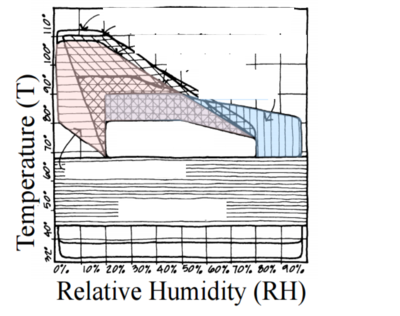
- Aindirect evaporative
- Bhigh mass night ventilation
- Cdirect evaporative
- Dhigh mass
- Enatral ventilation
- Fcomfort zone
- Gevaporative cooling
- Hsolar heating
Informações
- Descrição
- eliminate heat gains
- Autor
- Raelle Barnard
- Idioma
- English
- Visualizações
- 8
- Etiquetas
- Avaliação
- Ainda sem avaliações Avalie este quiz