
Quiz
Exam 3 - Chapter 9, Part One
Perguntas do quiz (74)
1Which of the following is NOT considered one of the basic properties of muscle tissue?
- Aexcitability
- Belasticity
- Csupport
- DContractility
2The primary role of this type of muscle tissue is to push fluid and solids along the digestive tract and to perform varied functions in other systems.
- ASmooth muscle
- BCardiac muscle
- CSkeletal muscle
3The primary role of this type of muscle tissue is to push blood through arteries and veins in rhythmic contractions
- ASkeletal muscle
- BCardiac muscle
- CSmooth muscle
4Movement of skeletal muscles is an involuntary contraction
- AVerdadeiro
- BFalso
5__________ muscles are contractile organs directly or indirectly attached to bones of the skeleton.
- ASkeletal muscle
- BCardiac muscle
- CSmooth muscle
6_____ is the ability to continue to contract over a range of resting lengths
- AExtensibility
- BElasticity
- CExcitability
- DContractility
7The ability to respond to stimuli
- AExcitability
- BResponsibility
- CReaction
- Dstimulated
8The ability to rebound toward its original length
- AElasticity
- BContractility
- CStimulate
- DFlexion
9Which of the following is/are considered function(s) of skeletal muscle?
(Choose all that apply)- Aproduce skeletal movement
- BMaintain posture and body position
- CSupport soft tissue
- Dregulate entering and exiting of material
- Econtrol of the body and communication among its parts.
10Is control over swallowing, defecation, and urination voluntary or involuntary?
- AVoluntary
- BInvoluntary
11Some of the energy used for contraction is converted to heat
- AVerdadeiro
- BFalso
12dense tissue that contain connective tissue wrapped around each muscle fiber, which binds each fiber to its neighbor
- AEpimysium
- BPerimysium
- CEndomysium
13dense tissue that divides the muscle into parallel compartments of fascicles (a bundle of structures)
- APerimysium
- BEpimysium
- CEndomysium
14dense tissue that surrounds individual muscle fibers
- AEndomysium
- BPerimysium
- CEpimysium
15Nerves innervate the muscle by penetrating the _______
- Aepimysium
- BEndomysium
- CPerimysium
16There is a chemical communication between a nerve and a muscle
The chemical is released into the _____- Aneuromuscular junction (aka, neuromuscular synapse)
- BAxon
- CAxon Terminal
- DSynaptic Cleft
17• Blood vessels often parallel the nerves that innervate the muscle.
• They then ______- Abranch to form coiled networks to accommodate flexion and extension of the muscle
- Bdont do anything at all
- Cbranch to form coiled networks to push blood through arteries and veins
- Dflood the body with neural activity
18Membrane that surrounds the muscle cell
- ASarcolemma
- BSarcoplasm
- CMuscle fiber
- Dmyofilaments
19The cytosol (the aqueous component of the cytoplasm of a cell) of the muscle cell
- ASarcoplasm
- BMuscle fiber
- CSarcolemma
- Dmyosatellite cells
20______ is the same thing as muscle cell
- AMuscle fiber
- BSarcoplasm
- CSarcolemma
- Dmyosatellite cells
21Where are nuclei of muscle fibers located?
- Ajust deep to the sarcolemma
- Bin the sarcolemma
- Cin the Sarcoplasm
- Djust deep to the Sarcoplasm
- Ethe muscle fibers dont have nuclei
22______ are responsible for the contraction of muscles
- Amyofibrils
- Bmyofilaments
- CMuscle fibers
- Dsarcomeres
23______ are attached to the sarcolemma at each end of the muscle cell
- Amyofibrils
- Bmyofilaments
- Csarcomeres
- DMuscle fibers
24______ surrounds each myofibril
- Asarcoplasmic reticulum
- Bepimysium
- Cmyosin
- Dmyofilaments
25_____ are structures that consist primarily of the proteins actin and myosin
- Amyofilaments
- BCisternae
- CSarcolemmas
- DSarcomeres
26______ are thin protein filaments in myofilaments
- AActin
- BMyosin
- Ctitin
- Dtroponin
27______ are thick protein filaments in myofilaments
- AMyosin
- BActin
- Ctroponin
- Dtitin
28All the myofilaments are arranged parallel to the long axis of the cell
- AVerdadeiro
- BFalso
29______ are/is the main functioning unit of muscle fibers
- ASarcomere
- Bmyofibrils
- CMuscle fibers
- Dmybrofiber
30_____ creates the striations that give the skeletal muscle its identifiable characteristic
- Aoverlapping actin and myosin (A Band)
- Bseparation of actin and myosin
- Cthe 10,000 myofibril per sarcomere
- DThe Z Line (Z disc)
31Within a sarcomere, the region between the A band and the Z line that contains of only thin filaments is the __________.
- AI band
- BM line
- CH band
- Dzone of overlap
32Overlapping _____ bands create striations
- AZ bands
- BI band
- CA band
- DH band
- EM line
33_____ is a protein that covers the binding sites when the muscle is relaxed
- ATropomyosin
- BTroponin
- Ctitin
- Dnebulin
34Know this picture . . .
https://image.slidesharecdn.com/ch09lecturepresentation-140913123742-phpapp01/95/dr-b-ch-09lecturepresentation-15-638.jpg?cb=1410612013
Skeletal muscles consist of muscle fascicles
• Muscle fascicles consist of muscle fibers
• Muscle fibers consist of myofibrils
• Myofibrils consist of sarcomeres
• Sarcomeres consist of myofilaments
• Myofilaments are made of actin and myosin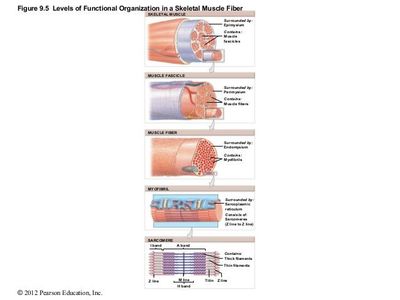
- Aok
- Bno
35Which of the following statements regarding thick filaments is FALSE?
- AMyosin heads project toward the actin filaments
- BAdjacent thick filaments are interconnected by proteins of the H band.
- CMyosin filaments consist of an elongated tail and a globular head
- DA core of titin connects the Z lines
36Which of these consists of Actin?
- AThin Filaments
- BThick Filaments
37Which of these consists of Myosin?
- AThin Filaments
- BThick Filaments
38A contracting muscle shortens in length
- AVerdadeiro
- BFalso
39Contraction is caused by interactions between _______ and _______ within the sarcomere
- Athick and thin filaments
- Bmyofibrl and fascicle
- Cepimysium and perimysium
- DI band and H band
40Contraction is triggered by the presence of ______
- Acalcium ions
- Bphosphate ions
- Ccollagen fibers
41Arrange the following from smallest structure to largest structure:
(perhaps do it on a piece of paper):
a. Muscle cell or muscle fiber
b. Fascicle
c. Myofilaments
d. Whole skeletal muscle
e. Myofibril- AMyofilaments, Myofibril, Muscle cell or muscle fiber, Fascicle, Whole skeletal muscle
- Bdont got it
42According to the sliding filament theory when a muscle contracts, what happens?
- AThe thick filaments slide past the thin filaments, and the sarcomere shotens.
- BThe thin filaments slide past the thick filaments, and the sarcomere shortens.
- Cactin filaments slide away from each other allowing the fibers in the muscle to contract
43What controls muscle fibers?
- Amotor unit
- Bmotor unit and motor neuron
- Cmotor neuron
- Dmuscles
- ENone of the listed responses is correct.
44Motor Units (Motor Neurons Controlling Muscle Fibers) have two types of control.
The control over the eye muscles is an example of _________; meaning a ___________.- APrecise control; motor neuron controlling two or three muscle
fibers - Bless precise control; motor neuron controlling two or three muscle
fibers - CPrecise control; A motor neuron controlling perhaps 2000 muscle fibers
- Dless precise control; A motor neuron controlling perhaps 2000 muscle fibers
- APrecise control; motor neuron controlling two or three muscle
45__________ refers to the condition in which muscles of the body remain semi-contracted for an extended period
- AMuscle tension
- BMuscle contraction
- CMuscle retraction
46Muscle tension depends on (choose all that apply)
- AThe frequency of stimulation
- BThe number of motor units involved
47A ______ is a motor neuron controlling Muscle Fibers
- AMotor Units
- Bmuscle fascicles
- Cmotor neurons
- Dneural pathway
48______ is the tension of a muscle when it is relaxed
- AMuscle Tone
- BMuscle Control
- CMuscle Contraction
- DResting Muscle
49_______ stabilizes the position of bones and joints.
An example would be the amount of muscle involvement that results in normal body posture- AResting Muscle
- BMuscle Contraction
- CMuscle Tone
- DMuscle Control
50_______ are specialized muscle cells that are monitored by sensory nerves to control muscle tone
- AMuscle Spindles
- BMuscle Fibers
- Cred fibers
- Dwhite fiber
51Enlargement of the muscle is known as _______
- AMuscle Hypertrophy
- BMuscle Atrophy
- CMyopathies
52Exercise causes (choose all that apply)
- AAn increase in the number of mitochondria
- BAn increase in the activity of muscle spindles
- CAn increase in the concentration of glycolytic enzymes
- DAn increase in the glycogen reserves
- EAn increase in the number of myofibrils
53______ is the discontinued use of a muscle
- AMuscle Atrophy
- BMuscle Hypertrophy
- CMyopathies
54What is muscle tone?
- Athe reduction in muscle size, tone, and power
- Bthe resting tension of skeletal muscles
- Ca single contraction
- Dmuscle recruitment
55the study of, Myofibrils, Myofilaments, Sarcomeres is _______
- AMicroscopic anatomy
- BGross anatomy
56Myofibrils are bundles of myofilaments (protein filaments).
- AVerdadeiro
- BFalso
57Humans rely on muscles for:
- AMany of our physiological processes
- BVirtually all our dynamic interactions with the environment
- CStores minerals needed by blood cells.
- DOxen-agates the body
58Epimysium, perimysium, and endomysium converge to form ______. (Read them all)
- Atendons
- Bconnective tissue
- CAponeuroses
- DAll of these (they're the same thing - tends = bundle, aponeuroses = sheet)
59Myosin (thick filament) and Actin are arranged in repeating units called _______
- Asarcomeres
- Btropomyosin
- Cmuscle waves
- Dtransverse tubules
60Thin Filaments (Actin) Consists of twisted filaments of F actin strands and G actin globular molecules. Which of these consists of an active site (binding site)
- AG actin molecules
- BF actin strand
61One sarcomere can defined as _____ line to _____ line
- Az to z
- Ba to a
- Ch to h
- Db to b
62This is a picture of a portion of a sarcomere.
What bank is represented by the red on the bottom. This is a stack of Actin and Z line.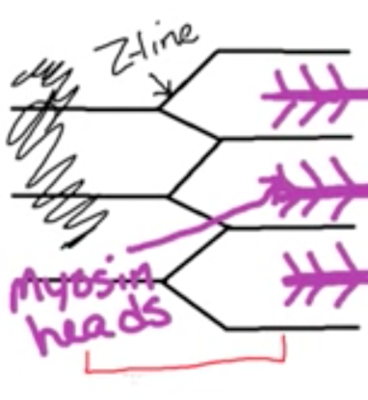
- AI band
- BZ line
- CB line
- DH line
63In between the I bands is the ____ band. This is represented by the green in this picture.
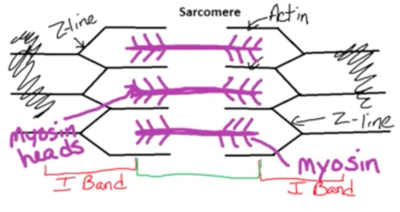
- AA band
- BB band
- CBoy band
- DZ band
64In this picture the orange is the H zone. In the H zone there is only myosin and it is therefore less dark than the rest of the A band where actin and myosin are stacked.
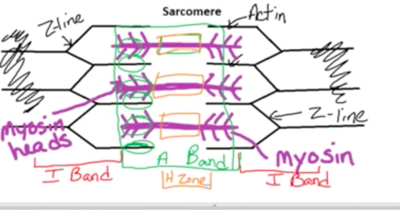
- AVerdadeiro
- BFalso
65Muscle fiber also contains an abundance of WHAT, a starchlike carbohydrate that provides energy for the cell during heightened levels of exercise.
- Aglycogen
- Bcalcium
- Ccalcium phosphate
- Dcytosol
66Part of actin filaments. A thin filament also has molecules of protein called WHAT (an elongated protein winds along the groove of the F actin).
- ATropomyosin
- BTroponin
- Ctitin
- Dmyoblast
67Each tropomyosin molecule has a smaller calcium-binding protein called WHAT bound to it.
Holds tropomyosin in position- Atitin
- Bmyoblast
- Ctroponin
- Dmyosin
68a light band; from Z disks to ends of thick filaments
- AI band
- Bh band
- Ca band
- Dz band
69n the middle of the A band, there is a lighter region called the WHAT, into which the thin filaments do not reach.
- AH band
- BB band
- Cz band
- DI band
70The thick filaments originate at a dark WHAT in the middle of the H band.
- AM Line
- BZ line
- CK line
- DS line
71Each light I band is bisected by a dark narrow WHAT which provides anchorage for the thin filaments
- AZ disk
- BM line
- CH band
- DI band
72Each segment of a myofilament from one Z disc to the next is called a WHAT
- Amuscle fiber
- Bmyofibril
- Csarcomere
73Myofilaments are made of actin and myosin
- AVerdadeiro
- BFalso
74Study of Perimysium, Endmysim and epimysium
- Agross
- Bmicroscopic
Informações
- Descrição
- Quiz sobre Exam 3 - Chapter 9, Part One, criado por Levi Chodorow em 19-03-2017.
- Autor
- Levi Chodorow
- Idioma
- English
- Visualizações
- 22
- Etiquetas
- Avaliação
- 5,0 de 5 · 1 avaliação Avalie este quiz