
Fluxograma
Vulnerability, Mitigation and Adaptation
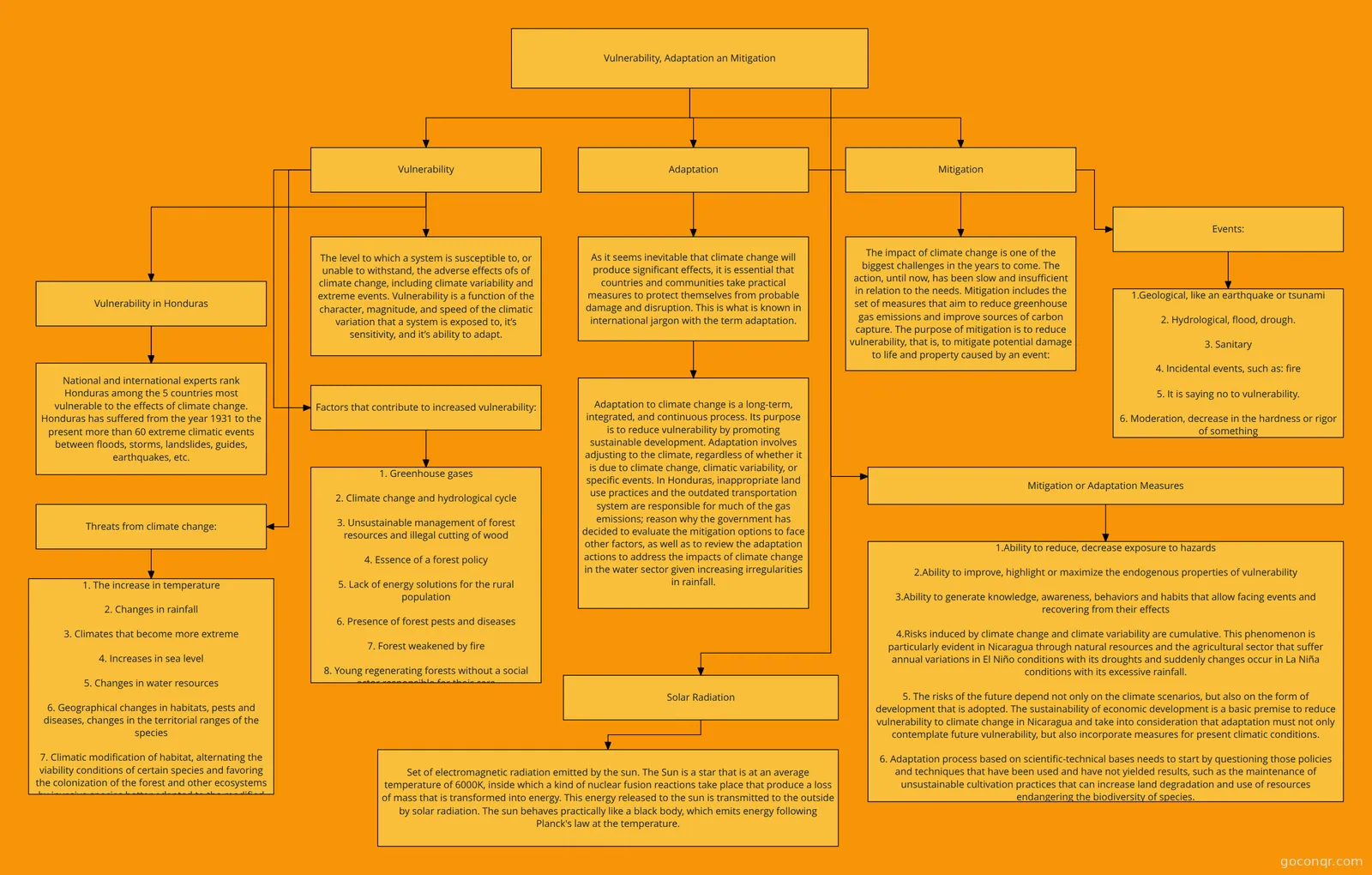
Flowchart: vulnerability, mitigation and adaptation to climate change
Conteúdo do fluxograma
Vulnerability, Adaptation an Mitigation
Adaptation
Mitigation
Vulnerability
The level to which a system is susceptible to, or unable to withstand, the adverse effects ofs of climate change, including climate variability and extreme events. Vulnerability is a function of the character, magnitude, and speed of the climatic variation that a system is exposed to, it’s sensitivity, and it’s ability to adapt.
Vulnerability in Honduras
National and international experts rank Honduras among the 5 countries most vulnerable to the effects of climate change. Honduras has suffered from the year 1931 to the present more than 60 extreme climatic events between floods, storms, landslides, guides, earthquakes, etc.
As it seems inevitable that climate change will produce significant effects, it is essential that countries and communities take practical measures to protect themselves from probable damage and disruption. This is what is known in international jargon with the term adaptation.
The impact of climate change is one of the biggest challenges in the years to come. The action, until now, has been slow and insufficient in relation to the needs. Mitigation includes the set of measures that aim to reduce greenhouse gas emissions and improve sources of carbon capture. The purpose of mitigation is to reduce vulnerability, that is, to mitigate potential damage to life and property caused by an event:
Factors that contribute to increased vulnerability:
1. Greenhouse gases
2. Climate change and hydrological cycle
3. Unsustainable management of forest resources and illegal cutting of wood
4. Essence of a forest policy
5. Lack of energy solutions for the rural population
6. Presence of forest pests and diseases
7. Forest weakened by fire
8. Young regenerating forests without a social actor responsible for their care
Threats from climate change:
1. The increase in temperature
2. Changes in rainfall
3. Climates that become more extreme
4. Increases in sea level
5. Changes in water resources
6. Geographical changes in habitats, pests and diseases, changes in the territorial ranges of the species
7. Climatic modification of habitat, alternating the viability conditions of certain species and favoring the colonization of the forest and other ecosystems by invasive species better adapted to the modified climate.
1.Geological, like an earthquake or tsunami
2. Hydrological, flood, drough.
3. Sanitary
4. Incidental events, such as: fire
5. It is saying no to vulnerability.
6. Moderation, decrease in the hardness or rigor of something
Events:
Adaptation to climate change is a long-term, integrated, and continuous process. Its purpose is to reduce vulnerability by promoting sustainable development. Adaptation involves adjusting to the climate, regardless of whether it is due to climate change, climatic variability, or specific events. In Honduras, inappropriate land use practices and the outdated transportation system are responsible for much of the gas emissions; reason why the government has decided to evaluate the mitigation options to face other factors, as well as to review the adaptation actions to address the impacts of climate change in the water sector given increasing irregularities in rainfall.
Mitigation or Adaptation Measures
1.Ability to reduce, decrease exposure to hazards
2.Ability to improve, highlight or maximize the endogenous properties of vulnerability
3.Ability to generate knowledge, awareness, behaviors and habits that allow facing events and recovering from their effects
4.Risks induced by climate change and climate variability are cumulative. This phenomenon is particularly evident in Nicaragua through natural resources and the agricultural sector that suffer annual variations in El Niño conditions with its droughts and suddenly changes occur in La Niña conditions with its excessive rainfall.
5. The risks of the future depend not only on the climate scenarios, but also on the form of development that is adopted. The sustainability of economic development is a basic premise to reduce vulnerability to climate change in Nicaragua and take into consideration that adaptation must not only contemplate future vulnerability, but also incorporate measures for present climatic conditions.
6. Adaptation process based on scientific-technical bases needs to start by questioning those policies and techniques that have been used and have not yielded results, such as the maintenance of unsustainable cultivation practices that can increase land degradation and use of resources endangering the biodiversity of species.
Solar Radiation
Set of electromagnetic radiation emitted by the sun. The Sun is a star that is at an average temperature of 6000K, inside which a kind of nuclear fusion reactions take place that produce a loss of mass that is transformed into energy. This energy released to the sun is transmitted to the outside by solar radiation. The sun behaves practically like a black body, which emits energy following Planck's law at the temperature.
Informações
- Descrição
- Fluxograma sobre Vulnerability, Mitigation and Adaptation, criado por Marcela Fuentes em 29-08-2020.
- Criado por
- Marcela Fuentes
- Visualizações
- 1
- Avaliação