
Flashcards
Science year 8 test 1
Flashcards do conjunto (15)
- 1Dalton's 5 atomic rules1) all matter of s composed of atoms
2) atoms cannot be created of destroyed
3) all atoms of the same element are identical
4) chemical reactions occur when atoms are rearranged
5) compounds are formed by the combination of two or more different kinds of atoms - 2Mendeleev's table the storyMendeleev was a scientist who also loved to play cards, he began to attempt and organise the elements into Gould by writing them on cards and putting their atomic weight underneath them. Eventually he fell asleep and dreamt the solution he was looking for; in the dream he organised the elements into groups of columns, ones which had similar properties were placed near each other in groups in a periodic order, he even left gaps for future elements which were soon found proving his theory correct. When he first created the periodic table the elements were organised in atomic weight rather than their atomic number.
- 33 main groups of the periodic tableThe three main groups of the periodic table are: Group 1: alkali metals- highly reactive metals which are solid at room temperature this group includes: Hydrogen (H), Lithium (Li), Sodium (Na), Potassium (K), Rubidium (Rb), Caesium (Cs), Francium (Fr)
Group 7: Halogens - also highly reactive, first two are gases at room temperature, second two are liquids and final two are solids, this group includes: fluorine (F), Chlorine (Cl), Bromine (Br), Iodine (I), Astatine (At), Tennessine (Ts)
Group 8/0: Nobles gases- very unreactive gases at room temperature this group includes: Helium (He), Neon (Ne), Argon (Ar), Krypton (Kr), Xenon (Xe), Radon (Rn), Oganesson (Og) - 4Chemical and physical propertiesChemical properties of a substance describe how it reacts with other substances, for example, flammability and reactions with acids.
Physical properties are properties that describe substances, these include: melting points, boiling points, freezing points, colour, density, etc. - 5Chemical and physical changesChemical changes are changes that cannot be reversed easily, for example, creating compounds
Physical changes are changes that can be reversed easily, for example, freezing water can easily be returned to its original state. - 6How to write out formulas for metals reacting with waterMetal+water->metal hydroxide+hydrogen
Lithium+water->Lithiumhydroxide+hydrogen
Li+H2O->LiOH+H2 - 7How to write put formulas for metals reacting with oxygenTo react an atom with oxygen you must burn it so that it can rearrange with the oxygen atoms around it.
Metal+oxygen->Metaloxyde
Lithium+oxygen->Lithiumoxyde
Li+O2->Li2O - 8How to write out experimentsWhen writing out experiments never write it in first person, for example, rather than witting it like 'we put magnesium in a crucible' write 'magnesium was placed in the crucible'
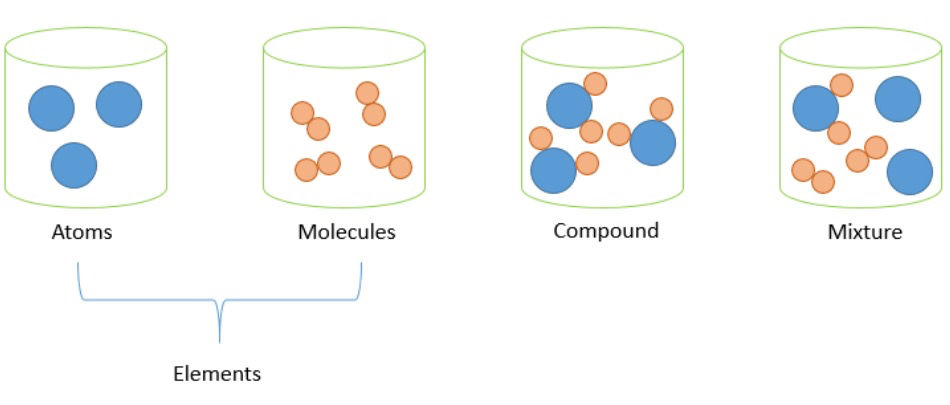
- 9Elements, compounds, and mixtures.Elements are single types of atoms that are not mixed with other different types of atoms.
Compounds are combinations of two or more atoms that are chemically combined together, they are not easily reversed.
Mixtures are result of atoms mixed together, but not combined, they are easily reversed - 10Groups and periods in the periodic tableGroups go across top of the periodic table
Periods go down the periodic table - 11How to identify what a substance looks likeSome chemicals have a number after their symbol, this means how many molecules of a certain element there are on the atom, for example; H2O has two hydrogen atoms, meaning, there are two smaller hydrogen molecules on a larger oxygen molecule. If the symbol doesn't have any numbers it means that there are only one of each molecule.
They can also be identified by size. - 12Mass of atomsWhen atoms combine their mass does not simply disappear as they cannot be destroyed, therefore, when atoms are combined together as a compound the mass of the resulting compound will be the mass of the molecules that created the compound added together.
- 13The periodic table layoutOn the periodic table the elements that are further to the left are metals at room temperature and on the right are non-metals, separating these two are semi metals.
Furthermore, towards the left of the periodic table, elements are more alkaline and further to the right they are more acidic. - 14How to work out what type of atom structure a diagram shows.If a diagram shows only one type of atom, meaning they are all identical, it shows an element
If a diagram shows two or more different types of atom combined together, meaning they are obviously linked to each other, it shows a compound
If a diagram shows different atoms randomly scattered around and not linked together, it shows a mixture. - 15What happens during a reactionDuring a reaction atoms react with each other and rearrange, sometimes they break their bonds and rearrange with other atoms to create separate compounds, however, this only happens when compounds is included in the reaction.
Informações
- Descrição
- Year 8 first test
- Criado por
- Emily Harris · out 2017
- Atualizado
- 6 abr 2018
- Visualizações
- 13
- Tags
- Avaliação