
Flashcards
Introduction to thermodynamics 2

Flashcards do conjunto (38)
- 1What is a property?Any characteristics of a system
- 2What are intensive or extensive properties units? What is an intensive property?Intensive (T, P, r, ...) or extensive (V, m, …). Intensive properties are those that are independent of the mass of a system such as temperature, pressure, and density.
- 3What is a specific property?Intensive properties per unit mass such as specific volume (v=V/m).
- 4What are extensive property?Are those whose values depend on the size—or extent—of the system: Total mass, total volume, and total momentum are some examples of extensive properties.
- 5What is 'state'?Condition of a system for a given set of properties which completely describe it.
All the properties can be measured or calculated throughout the entire system. - 6What is equilibrium state?A state of balance. No unbalanced driving forces (e.g., DT).
- 7How are the number of properties required to fix the state of a system given? Define the above.The state postulate: The state of a simple compressible system is completely specified by two independent, intensive properties (e.g., T & v, or P & v).
- 8Why is a system called a simple compressible system?Has the absence of electrical, magnetic, gravitational, motion, and surface tension effects.
- 9Define cycle.A system is said to have undergone a cycle if it returns to its initial state at the end of a set of processes
- 10Define process.Change from one state to another
- 11What is the equilibrium process?The process path indicates a series of equilibrium states through which the system passes during a process
- 12What is the quasi-equilibrium process?The system remains infinitesimally close to an equilibrium state at all times
- 13How is a non-quasi equilibrium process denoted?Denoted by a dashed line between the initial and final states instead of a solid line
- 14What is steady flow process?The term ‘steady’ implies no change with time
- 15What is a thermodynamic unit?Any physical quantity can be characterised by dimensions. The magnitudes assigned to the dimensions are called units. Some basic dimensions such as mass, length, time, and temperature are selected as primary or fundamental dimensions, while others such as velocity, energy, and volume are expressed in terms of the primary dimensions and are called secondary dimensions, or derived dimensions.
- 16What are macroscopic forms of energy?Those a system possesses as a whole with respect to some outside reference frame.
- Kinetic
- Potential - 17Define kinetic energy. What is the equation?The energy that a system possesses as a result of its motion relative to some outside reference frame:
- 18Define potential energy. What is the equation?The energy that a system possesses as a result of its elevation in a gravitational field:

- 19What are microscopic forms of energy?Those related to the molecular structure of a system and the degree of the molecular activity, and they are independent of outside reference frames.
- Internal energy - 20What is internal energy?The sum of all microscopic forms of energy (sum of kinetic and potential energy of molecules) :

- 21Internal energy: -Sensible energy (HEAT / THERMAL ENERGY)Sensible energy, the portion of the internal energy associated with the kinetic energies of the molecules.
At higher temperatures, the molecules possess higher kinetic energies, so a substance has a higher internal energy. - 22Internal energy: -Latent energy (HEAT / THERMAL ENERGY)Latent energy, the portion of the internal energy associated with the phase of a substance or the level of intermolecular forces.
A substance at the gas phase has a higher internal energy than it is in the solid or the liquid phase. - 23Internal energy: - Chemical energy - Nuclear energyChemical energy, associated with the atomic bonds in a molecule.
Nuclear energy, associated with the strong bonds within the nucleus. - 24Total energy definition and equation.The sum of various forms of energy contained in a system:
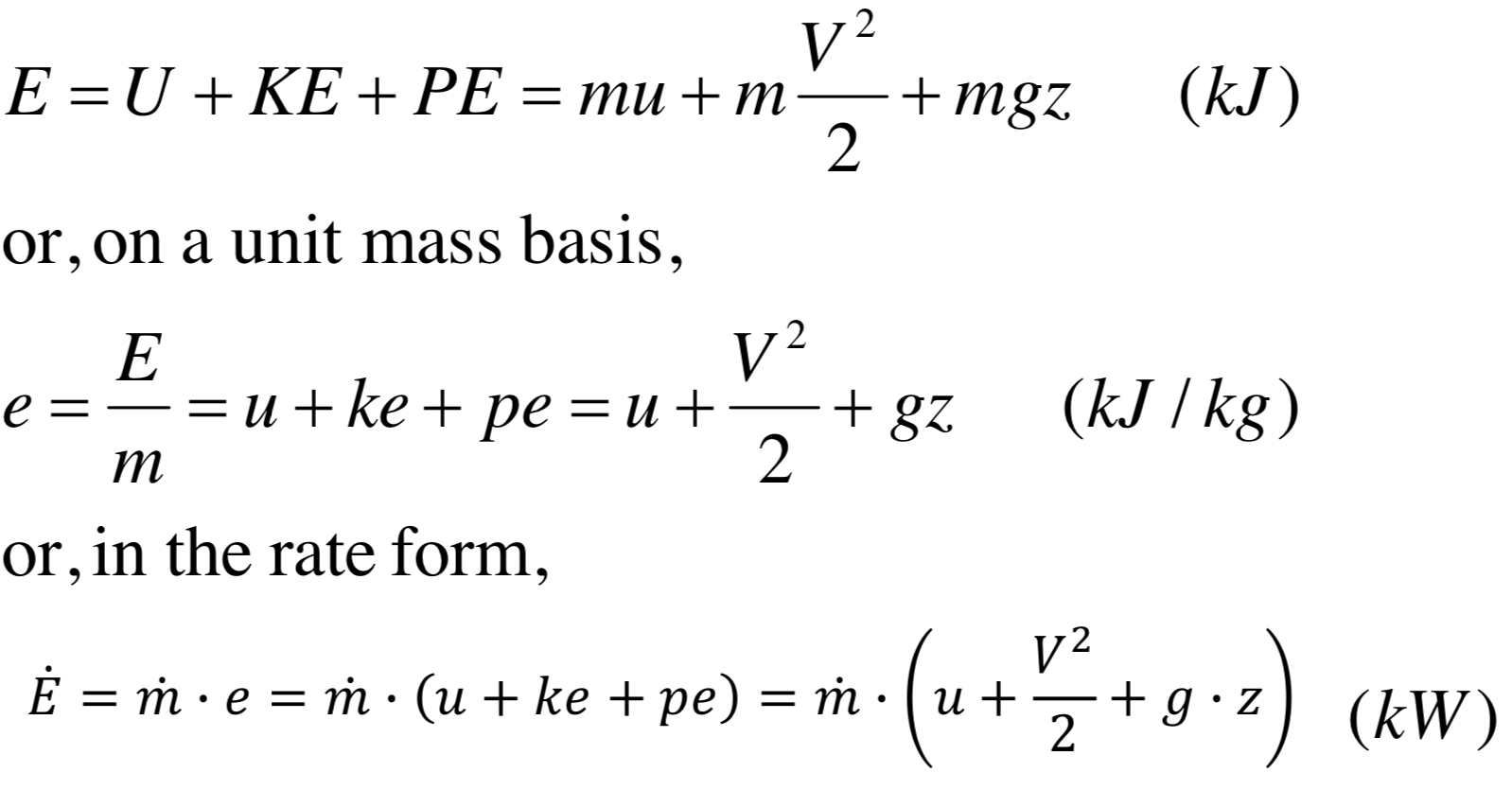
- 25How does thermodynamics use total energy? What can total energy be assigned? What is the change in energy independent of?- only deals with change of total energy rather than its absolute value
- assigned a value of 0 at any convenient reference point
- change in total energy independent of reference point - 26What is energy transfer?Energy transfer are recognised at the boundary of a system as they cross it.
- 27Energy transfer: heat?Heat: the form of energy transfer between a system and its surroundings (or two systems) due to a temperature difference. In thermodynamics, heat means the transfer of thermal energy during a process: Conduction, convection & radiation
- 28Energy transfer: work?Work: if an energy transfer crossing the boundary of a system is not heat, it must be work: A rising piston, a rotating shaft, and an electrical wire crossing the system boundaries are all associated with work interactions.
- 29Similarities between heat and work energy transfers?- Both are recognised at the boundaries of a system as they cross the boundaries. That is, both heat and work are boundary phenomena.
- Systems possess energy, but not heat or work.
- Both are associated with a process, not a state. Unlike properties, heat or work has no meaning at a state.
- Both are path functions (i.e., their magnitudes depend on the path followed during a process as well as the start end states). - 30What is mass flow?When mass enters or leaves a system, it will bring in or take out energy with it.
- 31When direction of heat or work is not known, what do we do? What do +ve and -ve results indicate?We can simply assume a direction for the interaction (using the subscript in or out) and solve for it.
A positive result indicates the assumed direction is right. A negative result, on the other hand, indicates that the direction of the interaction is the opposite of the assumed direction.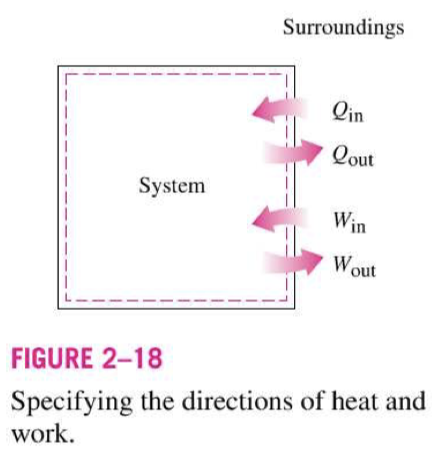
- 32State the first law of thermodynamics / energy principle.The first law of thermodynamics, also known as the conservation of energy principle, states that energy can be neither created nor destroyed during a process; it can only change forms.
- 33What is the net change in total energy of system during a process equal to?The net change (increase or decrease) in the total energy of a system during a process is equal to the difference between the total energy entering and the total energy leaving the system during the process.
- 34What is the change in total energy of a system equation?
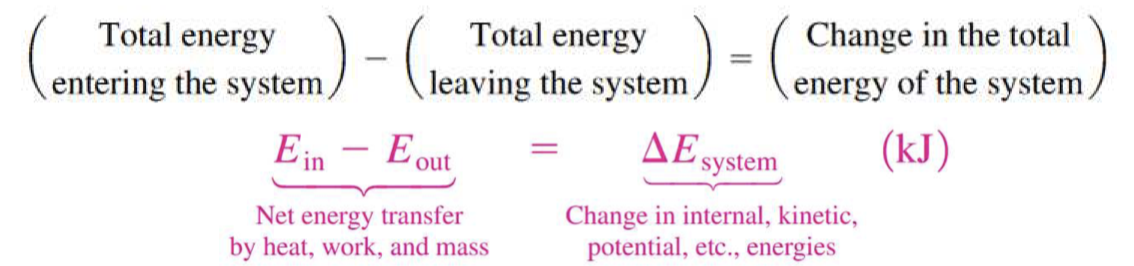
- 35Continued change in total energy of a system equation

- 36What is the change in total energy of a system equation in the rate form?
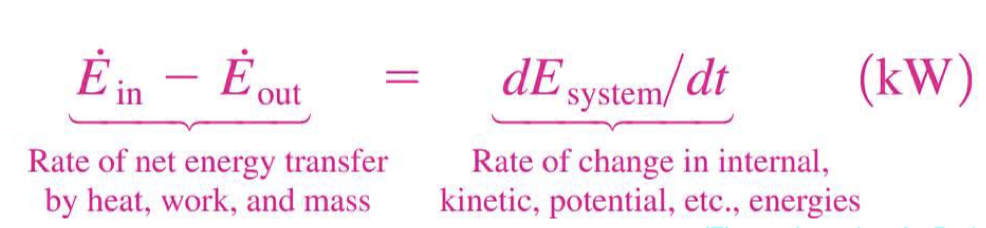
- 37What is the equation for efficiency?

- 38Efficiency of gas boiler

Informações
- Descrição
- - Property, state, process and cycle - Forms of energy
- Criado por
- Alice Kimpton
- Visualizações
- 24
- Avaliação