
Flashcards
Wireless Networking
Flashcards do conjunto (32)
- 1What is a wireless networkAny network where information is transmitted wirelessly
- 2Name 3 things that wireless communication uses ? & What are they examples of*Radio waves
*Microwaves
*Free-space optical communications
&
Electro-magnetic waves - 3What are electromagnetic waves characterised by & What is the electromagnetic spectrum ?Their frequency & wavelength
&
The range of all possible frequencies of radiation - 4How can we transfer info using a simple radio wave?We must modulate it in some way
- 5How can we modulate a radio wave? & What is a carrier wave?By changing either amplitude or its frequency
&
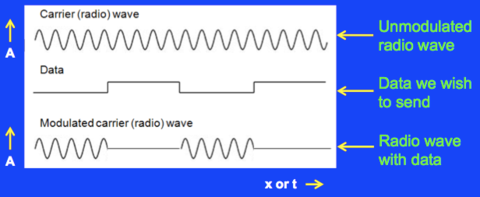
The carrier wave is the initial electromagnetic wave - 6What type of modulation is this and explain what's going onAmplitude modulation and we have our unmodulated radio wave we then have our data and then add the data to the radio wave
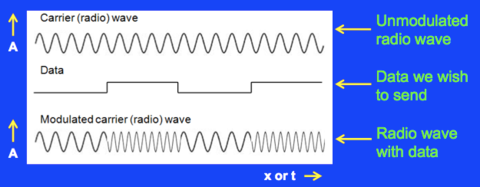
- 7What type of modulation is this and explain what's going onFrequency modulation and we have our unmodulated radio wave we then have our data and then add the data to the radio wave
- 8What are the range of frequencies measured as and what is it?Bandwidth
&
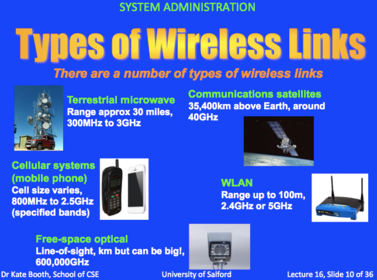
It's the range of frequencies occupied by a modulated wave. Its size depends on the type and ‘depth’ of the modulation. - 9Name the 5 types of wireless links and they're ranges
- 10Name the 5 types of wireless networksWireless PAN (Personal Area Network)
Wireless LAN (Local Area Network)
Wireless Mesh network
Wireless MAN (Metropolitan Area Network)
Global Area Network - 11What is a Wireless PAN (Personal Area Network) and give an exampleCentred around an individual and it's range is typically a few meters an example is bluetooth
- 12What is a Wireless LAN (Local Area Network) & what is requiredTypical maximum operating range usually within a building
&
*Wireless Access Point
*Wireless Client - 13What is a Wireless Mesh networkIt Doesn't require an infrastructure to operate, although they may have a connection to a fixed network. It Requires Ad Hoc and mesh routing capabilities
- 14What is a Wireless MAN (Metropolitan Area Network)Is a connection of several wireless LANs over an area the size of a city
- 15What is a global Area NetworkIs when Computers and Local Area Networks using wireless connectivity connect to form a bigger network.
- 16What is a issue with global Area NetworkA major issue is handover from one local coverage area to the next
- 17What is an access pointThe base station for the network. They normally act as routers and as connections to a fixed wire network.
- 18What is a wireless clientA device with a wireless network interface
- 19What are, and what are the differences between a BSSID and a SSID?A BSSID is the Basic Service Set Identifier. It is the MAC address of the Access Point.
A SSID is an ‘informal’ name for a BSS, and can be chosen by the AP administrator. - 20What are, and what is the relationship between, a BSS and an ESS?A BSS is a Basic Service Set – an Access Point and its connected devices
A ESS is an Extended Service Set.
An ESS is a set of connected BSSs that share the same SSID, security and back-end wired network (distribution system). A device sees all APs in a ESS as single BSS. - 21When using extended service set are devices able to roam between AP's without interrupting communicationsYes
- 22What is the difference between ad hoc and infrastructure mode in wireless networking?In ad hoc mode there is no access point and devices communicate directly with each other. The SSID of the network is chosen by the client that ‘starts’ the network and it is broadcast in turn by a randomly chosen member of the network.
In Infrastructure mode devices are all clients, which then connect to dedicated Access Points. - 23What is Wi-Fi DirectA standard that allows a device to become an AP for ‘clients
- 24What are the two types of roaming in Wi-Fi networks and what do they doInternal roaming - Clients move from one AP to another in the same ESS when the first AP becomes too weak
External roaming - Client moves into another WLAN, typically from a different provider & the client must have software installed to ensure sessions persist, so no loss of communications, during the transfer - 25What can happen when radio signals overlap each otherThey can interfere with one another
- 26What 3 issues can interference cause? & How can you prevent them?*Loss of data
*Reduced performance
*Total loss of connectivity
&
By making sure that adjacent base stations do not operate on the same frequency - 27What encryption and integrity protocols were used with WEP, and why are these a problem in modern networks?RC4 was used for encryption & CRC32 was used for integrity
- 28Why is physical layer security important on a wireless network?Wirless is an open medium so anyone can capture data packets, unlike a wired network where some effort has to be made to tap the cable.
- 29What is Wi-Fi Protected Setup and why is it weak?Wi-Fi Protected Setup enables users to easily setup wireless communications using WPA or WPA2 with a secure pre-shared key (secret).
&
The pin method because all the possible pins could be tried by an attacker to find the correct one to connect to the Access point and then obtain the pre-shared key - 30What is the relationship between WEP, WPA and WPA2?WEP uses the secret key + IV and a RC4 algorithm to achieve security
WPA was a half-way house between WEP and WPA2. It solved the problems of WEP by replacing the simple key generation (secret key + IV) with the Temporal Key Integrity Protocol (TKIP).
WPA2 implements the mandatory requirements of the current security standard for WLANs. It replaces RC4 with AES - 31How do some AP(Access Protocols) prevent the issues with WPSBy slowing or disabling the PIN method after a specified number of failed connections
- 32What is? Velocity Frequency WavelengthVelocity - The speed in a given direction
Frequency - Number of cycles per second
Wavelength - Distance travelled in one cycle
Informações
- Descrição
- Lecture 16 Flash cards about wireless networking
- Criado por
- Tunds
- Visualizações
- 167
- Tags
- Avaliação