
Flashcards
PPU085
Flashcards do conjunto (76)
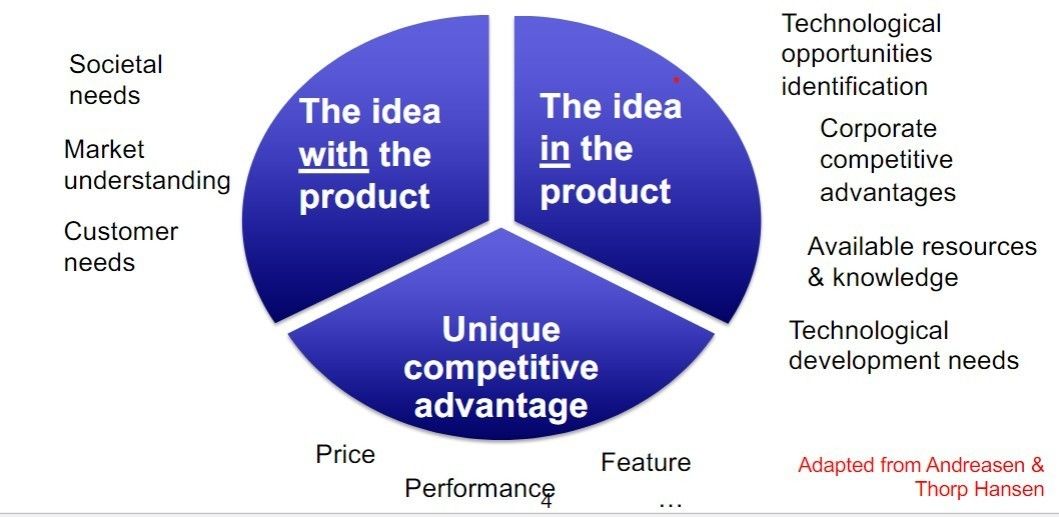
- 1What makes a product?
- 2What makes a new product succeedUniqueness
Superior performance
Sufficient target market segment
Based on internal strengths
Deep insight into customer needs
Effective use of new development process
Good collaboration in development - 3What makes a new product fail?Poor idea
Poor positioning
Market too small
Lacking company capabilities
Organisational problems
Inadequate distribution
Poor timing - 4What can be done to maximize the probablility of success and minimize failure for a product development?•A structured development process
– Explicit decision process
– Checklists including key steps
– Self-documenting
•Use of relevant methods and tools
•A multi-disciplinary development team
•(Shift in) perspective, (changes in) attitude towards
customer and user orientation - 5What is the opportunity identification process?Establish a charachter
Generate and sense many opportunities
Screen opportunities
Develop exceptional opportunities
Select exceptional opportunities
Reflect on the result and process - 6Describe the key concept: CustomersThe one who buys the product/service which is a client, customer, purchaser.
Can be internal or external - 7Describe the key concept: UsersOne who use the product or is involved in the activity.
Primary user is the end user
Secondary user, Can be a person who maintains the product
Tetirary user, a person who is affected by its purchase or is involved with the decision of the purchase - 8Describe the key concept: StakeholdersPerson, group or organisation which has an interest or concern in a situation/organisation
Someone who is involved with and/or affected by the course of action
Primary stakeholders: Investors, employees, suppliers...
Stakeholders could also be societys or communications - 9What is an extreme user?Persons who use the product in special envioriments or have individual circumstances that require them to have an adapted product
Extreme users need may reflect latent needs of mainstream users - 10What is a lead user?A person who experiences a product before others
Stand to benifit greatly from the new product
Often have - 11What is a lead user?One who experiences a prodcut before others
Stand to benefit greatly from the product
Often have useful ideas to share
Can articulate their needs better than an average users - 12Describe the key concept: NeedA lack of something
Statements by customers
Gap between existing and desired products
Any attribute of a potential product stated by the customer
Needs show themselves in a "readiness to search for activities or situations which expected to satisfy the needs" - 13Describe the key concept: Customer or user requirementThe customer/users own formulation of something such as; easy, fast, natural etc
Those requirements which the user has for the thing in use - 14Describe the key concept: Technical requirementThe customer/user requirement transformed into a measureable engineering term or specification.
- 15Mention challanges in understanding customer needsThe customer does not know what they want.
Good customer understanding could be a vaccum which have a lamp at the nozzle so you'll see under beds etc
Bad customer understanding could be an alarmclock which is not lighted and the numbers is not possible to see at night - 16What is the iceberg fenomen for customer needs?Only a very small
amount of the total list
of customer
requirements are
immediately available
(or available through
the traditional market study) - 17What might the customer not tell you?Requirements associated with problems of which the customer is not aware due to habits, “compensating behaviour”
•Emotional and semantic requirements
•Requirements associated with
culture and socio-historical aspects
•Observations are essential to solve this - 18Define the classification of customer needs
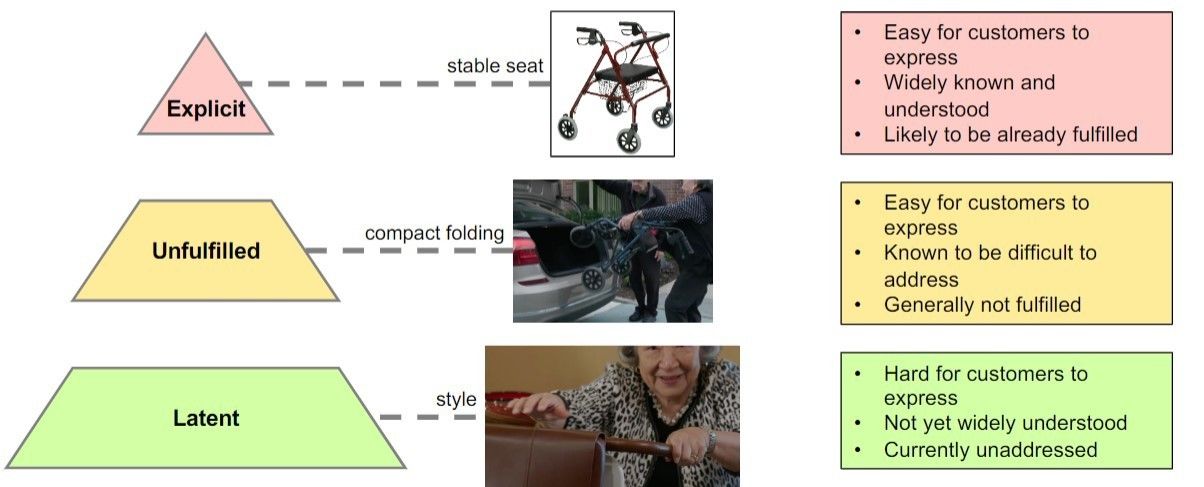
- 19What is the KANO model?A model which proposes three types of need and requirements that need to be adressed from a competetiv perspective.
1. Basic needs/equirements
2. Performance needs/requirements
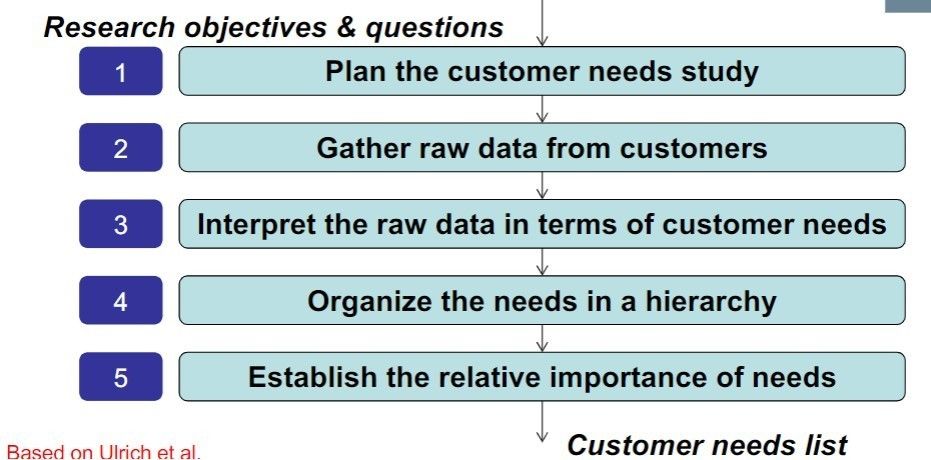
3. Exitment needs/requirements - 20What is the customer need study process?
- 21What is the real-win-worth?Proposed ideas are evaluated with respect to three basic questions
• Is there a real market and a real product
• Can we win? Can our product or service be competitive? Can we succeed as a company?
• Is it worth doing? Is the return and risk acceptable? - 22What criterias consists the Best practice scoring model of?Each criteria’s is rated from 0-10:
1. Financial reward vs risk
2. Strategic alignment and importance
3. Product and competitive advantage
4. Leverages core competence
5. Market attractiveness
6. Technical feasibility - 23What identifirs a product plan?A product plan identifies the portfolio of products to be developed by an organization and the timing of their introduction to the market. The portfolio will comprise product development project of different magnitude and level of novelty, including fundamentally new, new platforms, derivative products and improvement projects.
- 24What is a good product plan characterised by?A good product plan is characterised by:
1. Timeliness of product launches - product variants are available when requested by the market
2. Realistic timing and phasing with respect to corporate resources
3. Coverage of essential market segments
4. Balancing of improvement, derivate, platform and breakthrough projects - 25What does a product portfolio consist of?Improvement projects
Derivative projects
New platforms
Fundamentally new products - 26In a business model canvas, what are three components of the value proposition for an intended new product?The three components are the gains that it offers, the pains that it avoids and the jobs that the product or service offers the customer.
The jobs that the washer-dryer does are to wash and dry clothes. The other solutions can also carry out those jobs, but:
The gains of the washer-dryer are that it quickly and with high cleaning quality cleans and dries clothes.
The pains that it avoids are the needs to hang up wet clothes to dry and the room space needed for that, or even the physical exhaustion associated with hand-washing. - 27What is the procedure for benchmarking?1. Form a list of relevant properties
2. Identify competing/related products
3. Information search / buy the products (test, break it down, …)
4. Systemize the information (excel)
5. Analyse the information - 28What are the steps of a Quatitative data analysis?1. Form a data set (in ex. Excel)
2. Clean up the data set
3. Analyse the basic metrics
4. Analyse the relationship between two variables
5. Analyse the relationship between three or more variables - 29How do you plan a survey?1. State purpose of survey
2. Identify information of interest
3. Identify population to be surveyed
4. Determine sample size and source - 30What is probability sampling?Probability samples – provides an equal chance for everyone in the population to be randomly selected for the sample. An example is systematic random sampling, wherein a population of N individuals is given a random number each from 1 to N. With the needed sample size n, every kth =N/n individual is selected (starting number is also random)
• [… Sampling]: Simple random, Systematic random, Cluster - 31What is Non-probability sampling?Non-probability samples – every sample where individual are not randomly selected; example is convenience sample (first available person is selected)
• […Sampling] Quota, Convenience, Purposive, Snowball - 32What is census?Census – The whole population is surveyed (financially viable when the population is small)
- 33What are the steps of the Best practice scoring modelEach criteria’s is rated from 0-10:
1. Financial reward vs risk
2. Strategic alignment and importance
3. Product and competitive advantage
4. Leverages core competence
5. Market attractiveness
6. Technical feasibility - 34What characterises a good product plan by?1. Timeliness of product launches - product variants are available when requested by the market
2. Realistic timing and phasing with respect to corporate resources
3. Coverage of essential market segments
4. Balancing of improvement, derivate, platform and breakthrough projects - 35What is the basic components of a product plan?A product plan identifies the portfolio of products to be developed by an organization and the timing of their introduction to the market. The portfolio will comprise product development project of different magnitude and level of novelty, including fundamentally new, new platforms, derivative products and improvement projects.
- 36What do the product portfolio consist of?Improvement projects
Derivate projects
New platform
Fundamentally new projects - 37What is MVP, minimal viable product?MVP represent the minimal set of features that customers are willing to pay for. The main purpose of a MVP is to:
1. Maximize learning, by getting something into the hands of early adopters and thus receive feedback as early as possible
2. Minimize wasted engineering hours, by making sure that development efforts are put towards features that the customer actually needs - 38What does the planning phase consist of?Marketing
• Articulate market opportunity
• Define market segments
Design
• Consider product platform and architecture
• Assess new technologies
Manufacturing
• Identify production constraints
• Set supply chain strategy
Other
• Research: Demonstrate new technologies
• Finance: Provide planning goals
• General management: Allocate project resources - 39What is needed for something to be able to be granted a patent?Three criteria required for the product in order for it to be granted: Useful, novel (original), non-obvious
- 40What is patent landscaping?Patent landscaping is using patent information to determine filing trends, areas of interest, leading actors etc.
- 41What is Intellectual property ?Intellectual property – Patent, copyright, trademark, trade secrets
- 42How do you assess the uniqueness of a technical solution (patent)?1. Seek out related patents (through keyword, assignee, classification search)
2. Study the relevant patents (Drawing and detailed descriptions + Claims)
3. Map the connections between solution features and claims - 43What are the four different way of conducting patent search?search by entering […] into the patent database forms
1. Keywords (expressing utility, function, or structure)
2. Assignee (individual or company)
3. Classification (according to patent classification)
4. Related patents (prior art, citation search) - 44What classifies the Technology readiness level (TRL) and what are the steps?TRL assessment classifies the maturity of a particular technology. A nine-level scale from is employed. The levels correspond to
(1) Basic principles observed and reported
(3) Experimental proof of concept
(5) Technology validated in relevant environment
(7) System prototype demonstration in the operational environment
(9) Actual system proven in operational environment - 45What are the main motives for introducing the TRL?The main motives for introducing the model include:
• Minimizing risk in complex systems development, i.e. not launching a technology that has not been tested and validating, to the market
• Identifying suitable “next steps” and activities in the long and complex development processes
• Monitoring and comparing the status of a portfolio of development projects (“will technology X be ready in time for mission Y”?) - 46What are the parts of a patent for a Post-it?Utility: Document ideas on small piece of paper in such a way that it can be attached to a variety of surfaces. Then de-attached and re-attached somewhere else. This process can possible be repeated multiple times
Structure: Paper, Glue
Function: Provide writeable surface, attach, de-attach, move - 47What is a market extension?The production of more variety of products for a particular brand, is usually mobilized by evolving consumer needs.
For instance, company X was established, and its product is white t-shirts. The business does well, and there seems to be every indication that selling other colours of t-shirts will do good as well. Customers start asking for t-shirts with collar too, so company X begins manufacturing that as well. This is called a market extension because they are serving more needs for their customers.
Another example is if company X only initially sold small, medium and large sized t-shirts. However, there is no competition for plus sized individuals, so they begin selling these t-shirts as well. They now cover a broader market, thus it is also an example of market extension. - 48What are the sub-aspects for the "Product planning considerations?Competitive strategy:
aspects in which you can do better than the competitors
Technology leadership, cost leadership, customer focus, imitative (follow)
Technology development:
technology need to be in a mature state for market introduction (when needed)
Product platform planning (what product variant at what time), managing the portfolio (long-term / short-term)
Market strategy
– Market trends, market segmentation - 49What are the tools to conteract that: Company capabilities do not match the requirements for producing and marketing the producto Product-process change matrix:
helps identify need for manufacturing changes associated with a particular product change
Tool for analysing the relationship between product life cycle and technological life cycle. Made up of two dimensions to illustrate the linkage between the product produce and the production process.
o Manufacturing readiness level (MRL) assessment:
classifies maturity of manufacturing capabilities and suggest a pathway for process development - 50What are the tools to conteract that: Side-stepped by changes regarding technology etc.o Technology roadmap:
predicts when in the future a particular technology needs to be ready for implementation
o Technology S-curve:
predicts progress of technology performance and change of dominant design - 51What are the tools to conteract that: Poor positioning in relation to competitorso Benchmarking:
quantified comparison with existing design
o Patent analysis:
determine the uniqueness of a solution - 52What are the tools to conteract that: Poor idea, nothing new or beneficial is offeredo Proper opportunity identification process
Search externally
Search internally
o Evaluate ideas and concepts with ex. Best practice scoring - 53What is the purpose of the mediating tools photographs, existing products and mood boards?Describe problem - Photographs
Elicit customer needs - Existing products
Generate ideas - Image boards - 54What is probing?Refers to the use of follow up questions intended to clarify or enrichen the respondent’s initial answer
1. What do you mean?
2. Why (do you think that x is better than y)
3. Can you demonstrate - 55Why is it not suitable to draw customer requirements directly from customer needs studies such as interviews or observations?A systematic way of documenting and analysing customer information is essential in order to reduce the risks that one
• …overlooks important information + information that does not confirm one’s pre assumptions
• …draw conclusions on basis of what one remembers most clearly, and what made the strongest impression - 56What can you capture in a literature data extraction spreadsheet?In a literature data extraction spreadsheet, you capture
1. Metadata of each found publication:
authors, published year, publication title, name of journal, book or conference proceeding, and publisher
2. Evaluations of publications
summary of the key content + valuation of relevance and quality
3. Information of the sources that have been searched
4. Search elements such as keywords that were applied. - 57What are the benefits of personal interviews, questionnaires and observations?Personal interview:
• Questions can be asked directly, and followed by probing questions
Questionnaire / Survey:
• Enables the filtering of answers regarding behaviours and valuation with respect to different demographic groups
Observation:
• “What features are the most important… first impression” – can be observed by looking what the user engages with first - 58Create a amall questionnaire for a dishwaser evaluationDemographic
• What is your gender?
• What is your age? <<30, 31-50, >51>
• What is your family status?
• …
Behavioural
• What kitchen items do you wash in your dish washer (multiple options)?
• How many times in a week do you use your dish washer? <<2, 3-5, 6-7, >7>
• …
Rating
• My dish washer effectively cleans my kitchen items
• … - 59What is the procedure for benchmarking?Procedure for benchmarking
1. Form a list of relevant properties
2. Identify competing/related products
3. Information search / buy the products (test, break it down, …)
4. Systemize the information (excel)
5. Analyse the information - 60What does the opportunity identification process look like?1. Establish a charter
2. Generate and sense many opportunities
3. Screen opportunities
4. Develop exceptional opportunities
5. Select exceptional opportunities
6. Reflect on the result and the process - 61What aspects needs to be considered afte an oppurtunity identification process?aAfter the process has been finished, it is important to consider if these aspects have been correctly addressed. If not, it may be of interest to redo the process or parts of it.
Source of the opportunities (internal or external)?
Was many opportunities considered?
Was the innovation charter too narrow?
Was the screening criteria biased?
Are the result exciting? - 62What is VRIN and give an example. What new opportunities could be found by this?VRIN (Valuable – Rare – Inimitable – Nonsubstitutional) Resources
The VRIN resource of GKN include:
• Competence to design highly optimized components built from advanced materials for highly demanding environments. This resource is VRIN since it requires highly competent engineers long experience of these kinds of components
• Equipment for manufacturing (machining, welding, additive manufacturing) of very large, complex components built from advanced materials and to very tight tolerances. These machines are very expensive and require highly skilled staff to operate and can hence also be argued to meet the VRIN criteria.
New opportunities could include:
• Design of additional types of aeroengine components, thus expanding on their design skills
• Design and manufacturing of components for industrial turbines, such as gas and steam turbines - 63What is MVP?Minimal viable product MVP
MVP represent the minimal set of features that customers are willing to pay for. The main purpose of a MVP is to:
1. Maximize learning, by getting something into the hands of early adopters and thus receive feedback as early as possible
2. Minimize wasted engineering hours, by making sure that development efforts are put towards features that the customer actually needs - 64What is a moodboard?Image (mood) board - is a collage of images that aims to representing a context, culture, or reference objects. The images describes the mood or feeling of a context and user.
Strengths: provide a holistic and associative description of a user + Provide some guidelines for designs and design evaluations. - 65What is included in a persona and what are the strengths of the use of this?Personas - provide a qualitative data-based characterization of a typical users or customers. Typically includes a photo, an illustrative quote, specific background of the user/customer, personal attributes and needs
Strengths include the ability to differentiate between users as well as direct links to customer needs. - 66What are the Desirable market characteristics ?Desirable market characteristics
Large market size – Low risk – High growth potential – High reward potential – Early entry - 67What does mine your sources refer to?Utilization of personal contacts in order to find new ideas. Variants include getting in touch with lead users, contacting individuals with specific interests through social medias, interviewing researchers at universities etc.
- 68What are the parts of a Buisness model canvas?• Key partners – partners and suppliers with clarification of the activities and resources they provide
• Key activities – activities required to develop, manufacture, sell, and deliver the product
• Key resources – physical, human and intellectual resources required to perform the key activities
• Value proposition – description of the product and its benefits, i.e. what problems it solves for the customers
• Customer relationships – description of the interaction with the customer
• Channels – models for sales, delivery, and service
• Customer segments – identification of customer groups, including the most important customers
• Cost structure – important costs inherit in our business model, e.g. fixed and variable costs
• Revenue streams – method for payment from customer - 69Name some differences between SWOT and PEST• SWOT assesses a particular company (can be a competitor), product or idea, whereas a PEST considers a market
• SWOT relies mainly on internal information, whereas PEST considers external information
• SWOT works well in a workshop format with little preparation, whereas PEST requires extensive information search beforehand
• SWOT has a synthesis element, whereas PEST is mainly analytical - 70What are the parts of a mission statement?Product description
Benefit Proposition
Key Buisness goals
Primary Market
Secondary Markets
Assumptions and constraints
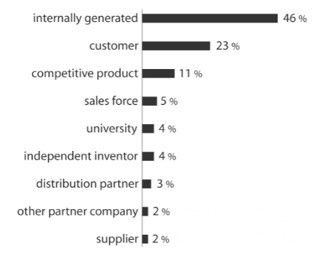
Stakeholders - 71What are the Tools and organisational approaches for opportunity identification: internal and exrternal?• Internal: Research labs • “Brainstorming” sessions • Systems where employees can submit improvement idea
• External: Customer/supplier visits/interaction • Interviews • Patent searches • Literature studies - 72What does the data show?The data shows that if a company want to be successful in identifying product opportunities it is not enough to only internal sources (e.g. own research), nor only on external sources (e.g. competitor benchmarks). Working with both kinds of sources is essential and of almost equal importance.
- 73What are the advantages & disadvantages for a SWOT analysis?Advantages:
• Easy to create
• Quick to create
• Can be applied to novel
designs
Disadvantages:
• Lacks systematic approach
• Qualitativ - 74What are the advantages & disadvantages for product benchmarking?Advantages:
• Quantitative
• Supports positioning &
visualisation
• Systematic
Disadvantages:
• Identfies differences in
performance, cost etc, but
not the underlying causality
• Difficult to apply to very
novel designs - 75What are the advantages & disadvantages for patent benchmarking?Advantages:
• Systematic
• Helps identify no-go
solutions (protected by
active patents)
• Helps identify possibly
useful solutions (no longer
active patents)
Disadvantages:
• Expensive, time-consuming
search
• Requires expertise
• Qualitative - 76What are the advantages & disadvantages for technical models?Advantages:
• Trade-offs can be studied
• Precise guidance for
decision-making
Disadvantages:
• May be difficult and time-consuming to create accurate parametric models
• Design must be relatively
detailed
Informações
- Descrição
- FlashCards sobre PPU085, criado por Viktoria W em 04-01-2022.
- Criado por
- Viktoria W
- Visualizações
- 3
- Avaliação