
Flashcards
Structure Determination
Flashcards do conjunto (42)
- 1how do you calculate empirical formula?Step 1: divide % abundance by atomic weight
Step 2: Divide each value from Step 1 by the lowest value - 2How do you obtain the molecular formula?Step 1: calculate the molecular weight of the empirical formula
Step 2: Obtain the molecular weight from data given/ mass spectrum
Step 3: divide molecular weight of sample by molecular weight of empirical formula
-the number from step 3 is how many times the empirical formula fits into molecular formula - 3Alternative method to calculate molecular formulaStep 1: convert % abundance of element in to a decimal
Step 2: put it into the following eqn
no.of atoms = (decimal*molecular mass)/atomic mass
Step 3: repeat for all other elements in the sample - 4How do you find the number of double bond equivalents?Step 1: Imagine a linear chain of the C, N and O atoms and work out how many Hs required to give a fully saturated molecule.
Step 2: Compare the no. of H atoms needed so that the molecule is saturated. Half of the difference in these numbers is the number of double bond equivalents - 51 DBE1 double bond/1 ring
- 62 DBE2 double bonds
1 double bond + 1 ring
2 rings
1 triple bond - 74 DBE special casecan be a benzene ring
- 8Beer-Lambert LawA=εlc
- 9IR 600-1400 cm-1Fingerprint region
- 10IR 1600- 1850 cm-1C=C
C=O
C=N - 11IR 2100-2300 cm-1triple bonds
CC
CN - 12IR 2700-3000 cm-1C-H
- 13IR 3000-3200 cm-1O-H
- 14IR 3200-3450 cm-1N-H
- 15H NMR δ7-δ8Aromatic protons
- 16H NMR δ5-δ6Vinyl Protons
C=C-H - 17H NMR δ2.5Acetylenic protons
R-C-C-H - 18H NMR δ9-δ10Aldehyde proton
O-C(R)-H - 19H NMR δ10+Carboxylic acid proton
- 20H NMR ~δ1-2Alkane
- 21H NMR ~δ2.5proton attched to a triple bonded C
- 22C NMR δ165-210C=O
- 23C NMR δ100-150C=C
- 24C NMR δ65-90C-O
- 25C NMR δ0-40alkanes
- 26C NMR δ75-95C triple bonded to C
- 27C NMR δ110-150Aromatic
- 28C NMR δ30-65C-Cl
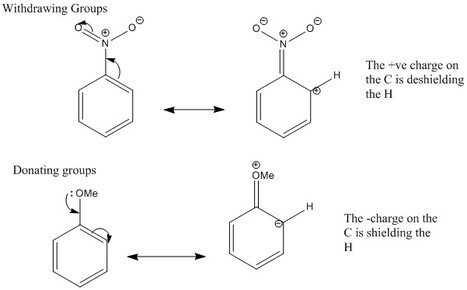
C-BR - 29H NMR Withdrawing groups next to the protonthe proton is more deshielded
- 30H NMR Donating groups next to HH is more shielded
- 31If resonance can occur such as a double bond near a carbonyl it is often the H nearest to the opposite end of the carbonyl that is more deshielded rather than the H nearest the withdrawing O because of the resonance sturucture. The same can be said for the Hs near donating groups. See pics
- 32Three factors that affect J (coupling constant)1) Dihedral angle( trans better overlap of orbitals, greater J)
2) Bond Length (shorter bond larger J)
3) Electronegativity (weakens communication) - 33roofingwhen two portons are chemically similar their shift is much more similar and they couple slightly with each other leading to roofing where the direction of the roof points towards the other peak that is being coupled to
- 34—X and X' are equivalent
They are chemically and spectrscopically identical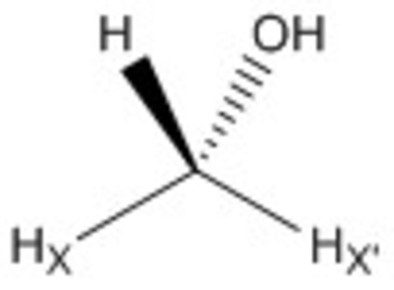
- 35—X and X' are enatiotopic.
They are only different in a chiral environment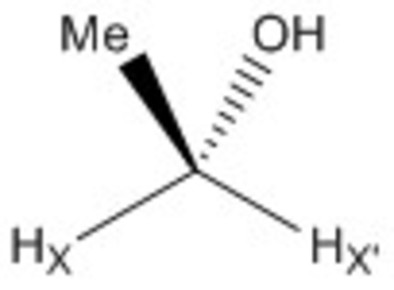
- 36—X and X' are diastereotopic
They are always different chemically and spectroscopically, but not by predictable amounts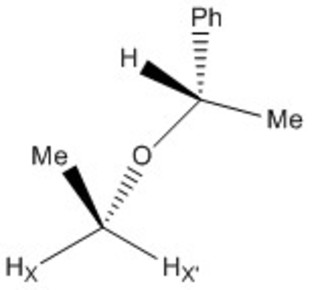
- 371H NMR exchangeDifferences in spectroscopic timescales tells us about the rates of proton exchange:
Rate of change SLOW = two distinct signals
Rate of change FAST = single population average is obsereved - 3813C NMR Electronegative substituentsDeshield C
Low field - 39Intensity of signals in 13C NMRIn 13C, relaxation effects alter intesities of signals. Relaxation of carbon nuclei occurs via interactions with protons. Hence quaternary carbons that do not have H nearby relax very slowly and usually give weak signale
- 4013C-13C couplingnot usually observed unless 13C enriched molecules is synthesized
- 4113C-1H couplingSpectra usually recorded decoupled and so only singlets are observed
- 4213C-1H off resonance couplingUses weak 1H decoupling and can be used to determine the number of protons attatched to any carbon.
Me= quartet, CH2 - triplet ect.
Informações
- Descrição
- University Organic Chem FlashCards sobre Structure Determination, criado por julia_reast_93 em 17-01-2014.
- Criado por
- julia_reast_93
- Visualizações
- 120
- Tags
- Avaliação