
Flashcards
quANTUM
Flashcards do conjunto (24)
- 1describe the photoelectric effect?UV radiation from a UV lamp is directed at the surface of a zinc plate placed on the cap of a gold leaf electroscope. this device is a very sensitive director of charge. when it's charged, the thin gold leaf of the electroscope rises- its repelled from the metal stem because they both have the same charge.
- 2what happens in the photoelectric effect when the electroscope is negatively charged?when the electroscope is negatively charged, the leaf raises and stays in position. however, if UV light is directed at the zinc plate, the leaf gradually falls. the leaf falls because the conduction electrons at the zinc surface leave the zinc surface when UV light is directed at it. the emitted electron are called photoelectron.
- 3what happens if the electroscope is positively charged?the leaf raises and stay there, regardless of whether or not UV light is directed at the zinc.
- 4key observations of the photoelectric effect.photoelectric effect of electrons don't take place if the frequency of the incident radiation is below a certain value known as the threshold frequency.
the number of electrons emitted per second is proportional to the intensity of the incident radiation, provided that the frequency is greater than the threshold frequency. if the frequency is less then no photoelectric emissions take place no matter how intense the incident radiation is.
photoelectric emission occurs without delay as soon as the radiation is directed at the surface. - 5what cant the wave theory of light explain?the existence of a threshold frequency or why photoelectric emission occurs without delay.
- 6according to wave theory what happens in the photoelectric effect.each conduction electron at the surface of a metal should gain some energy from the incoming waves, regardless of how many waves arrive each second.
- 7formula for energy of a photon?E = h x f
- 8explain the photoelectric effect?when light is shone on a metal surface, an electron at the surface absorbs a single photon from the incident light and therefore gains energy.
an electron can leave the metal if the energy gained from a single photon exceeds or equal to the work function of the metal.
the excess energy gained by the electron becomes kinetic energy. - 9define work functionminimum energy needed by an electron to escape from the metal surface.
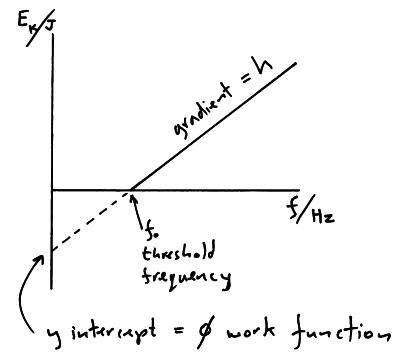
- 10formula for the maximum KE of an emitted electronEK = hf - work function
- 11formula for threshold frequencyf min = work function / planks constant
- 12what is stopping potential?the minimum potential needed to stop photoelectric emission.
- 13graph of EK against frequency
- 14define ionisation of an atomadding or removing electrons from an atom.
removing makes the atom positive
adding makes the atom negative - 15define excitationthe process of an atom absrob energy without becoming ionised as a result of an electron inside an atom moving from inner-shell to outer-shell.
- 16what happens excitation?the colliding electron makes an electron in the atom move from inner shell to outer shell. energy is needed for this process. excitation energy is always less than ionisation energy because the electron is not removed completely from the atom.
- 17what is lowest energy state calledground state
- 18what is de-excitationprocess in which atoms losses energy, by photon emission as a result of an electron inside an atom moving from an outer shell to an inner shell or in which an excited nucleus emits a gamma photon
- 19explain the fluorescent tubethe tube has fluorescent coating on its inner surface. the tube contains mercury vapour at low pressure. when the tube is on it emits visible light because:
ionising and excitation of the mercury atoms occur as they collide with each other and electrons in the tube.
the mercury atoms emit UV photons and other photons when they de-excite.
the UV photons are absorbed by the atoms of the fluorescent coating causing the atoms to excite.
the coating atoms de-excite in steps emitting visible light. - 20explain how line spectrum are produced?Energy from collision of charged particles transfers to electrons in gas molecules.
Electrons excited to higher energy levels.
Photon energy = hf
The more energy the electrons absorb the higher the energy levels reached.
Electrons are unstable at higher energy levels so will fall back down.
When it falls down it will emit a photon.
Each spectral line corresponds to an electron falling down to a lower energy state.
Spectral lines are at specific wavelengths.
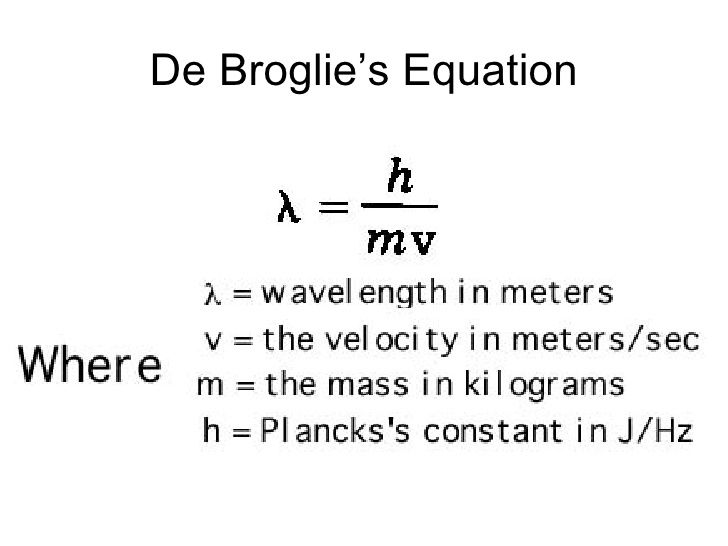
Energy gap, ∆E = hf - 21de broglie wavelength formula
- 22experiment that prove light as particlethe photoelectric effect
- 23experiment that proves light has wave like nature.diffraction of light
- 24wave like nature of electron experiementelectron diffraction.
accelerate electrons in a vacuum tube interact with the spaces in a graphite crystal. as they pass through the spaces, they diffract just like waves passing through a narrow slit and produce a pattern of rings proof that particles have wave properties.
diffractions pattern increase if the wavelength of the wave is greater. slower electrons wider ring spacing, higher velocity shorter wavelength.
you can only get differaction if a particle interacts with an object about the same size as its de broglie wavelength.
Informações
- Descrição
- A level Physics (quantum ) FlashCards sobre quANTUM, criado por Mohamed Essa em 11-04-2017.
- Criado por
- Mohamed Essa
- Visualizações
- 0
- Avaliação