
Flashcards
The Nervous Impulse
Flashcards do conjunto (25)
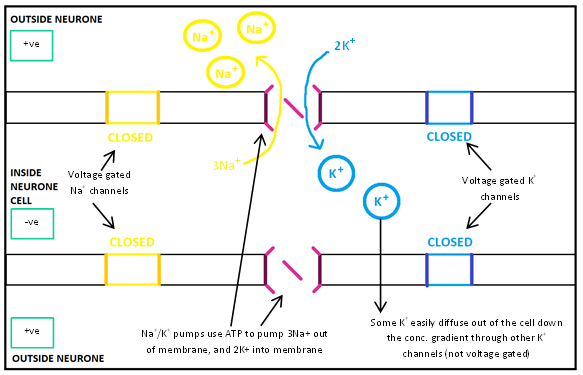
- 1What are the 4 stages of the nervous impulse?Resting potential
Nerve impulse/action potential
Repolarisation
Hyperpolarisation - 2What happens in the neurone during resting potential?
- 3What happens to the potential difference of the cell membrane during resting potential?The cell membrane is polarised (at -60mV)
- 4Complete the sentences: The Na⁺/K⁺ pumps move Na⁺ out of the neurone, but the membrane isn't _____________ to Na⁺ ions, so they cannot __________ back in. This creates a Na⁺ _________________ gradient.The Na⁺/K⁺ pumps move Na⁺ out of the neurone, but the membrane isn't PERMEABLE to Na⁺ ions, so they cannot DIFFUSE back in. This creates a Na⁺ ELECTROCHEMICAL gradient.
- 5What happens in the neurone during an action potential?
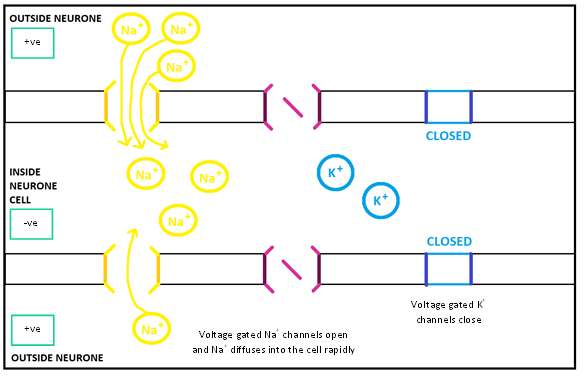
- 6What happens to the potential difference of the cell membrane during an action potential?The cell membrane becomes depolarised (+40mV)
- 7What happens in the neurone during repolarisation?
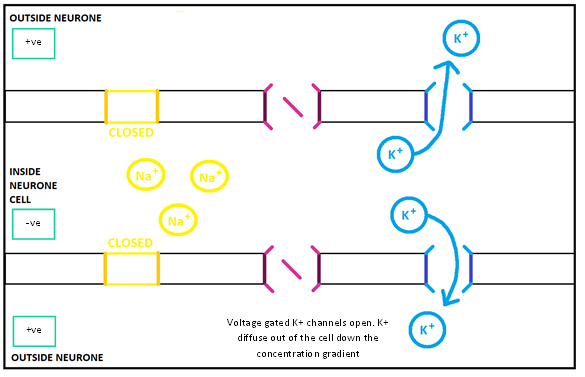
- 8What happens to the potential difference of the cell membrane during repolarisation?The charge is around -75mV
- 9What happens in the neurone during hyperpolarisation?
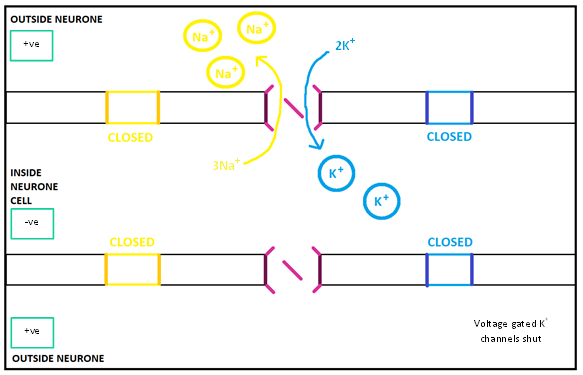
- 10What happens to the potential difference of the cell membrane during hyperpolarisation?The repolarisation overshoots and is more negative than resting potential. The original potential difference of -60mV must be restored
- 11Describe the graph showing a nerve impulse travelling through a neurone
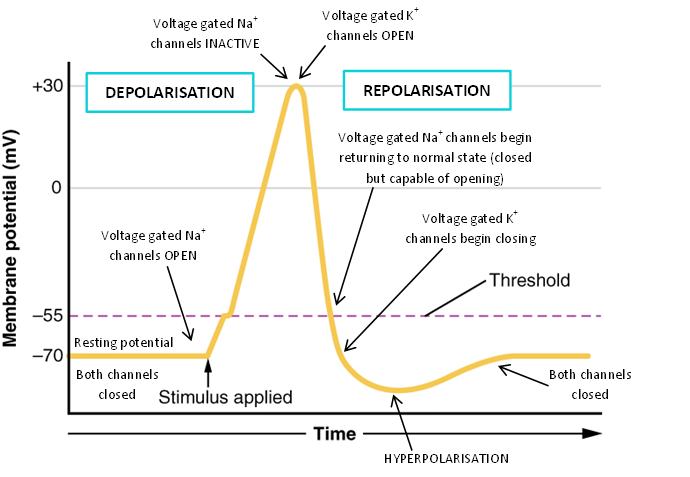
- 12What is the refractory period?The period when, after an action potential, the neurone cell membrane can't be excited again straight away. This is because the ion channels are recovering and can't be made to open
- 13The refractory period acts as a time delay between one action potential and the next. This makes sure that action potentials.....Don't overlap but pass along as discrete impulses
Are unidirectional (only travel in one direction) - 14Complete the sentences: When an action potential happens, some of the Na⁺ ions that enter the neurone diffuse __________. This causes Na⁺ ion channels in the next region to _______ and Na⁺ diffuses into that part. This establishes a _________ __________ and initiates a wave of _________________ to travel along the neurone.When an action potential happens, some of the Na⁺ ions that enter the neurone diffuse SIDEWAYS. This causes Na⁺ ion channels in the next region to OPEN and Na⁺ diffuses into that part. This establishes a LOCAL CIRCUIT and initiates a wave of DEPOLARISATION to travel along the neurone.
- 15TRUE OR FALSE: The wave of depolarisation moves away from the parts of the membrane in the refractory periodTRUE
The parts of the membrane in the refractory period can't fire an action potential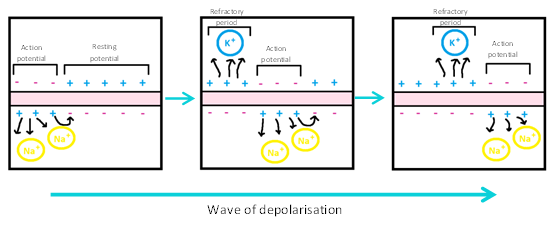
- 16TRUE OR FALSE: A bigger stimulus causes a bigger action potentialFALSE
BUT! A bigger stimulus will cause action potentials to fire more frequently. If the brain receives a high frequency of action potentials, it interprets this as a big stimulus and responds accordingly. - 17What does it mean by the "all-or-nothing" nature of action potentials?If the threshold isn't reached, an action potential won't fire
- 18TRUE OR FALSE: Once the threshold is reached, an action potential will always fire with the same change in voltage, no matter how big the stimulus isTRUE
- 19What are the 3 factors that affect the speed of conduction of action potentials?Myelination
Axon diameter
Temperature - 20In the peripheral nervous system, what is the myelin sheath of neurones made up of?A type of cell called a Schwann cell
- 21Complete the sentences: Some neurones have a ________ ________ (an electrical conductor). In the peripheral nervous system, the myelin sheath is made of a type of cell called a ____________ _____, which is wrapped around the axon (and/or __________). Between the Schwann cells are the ______ ___ ________ where Na⁺ channels are concentrated.Some neurones have a MYELIN SHEATH (an electrical conductor). In the peripheral nervous system, the myelin sheath is made of a type of cell called a SCHWANN CELL, which is wrapped around the axon (and/or DENDRON). Between the Schwann cells are the NODES OF RANVIER where Na⁺ channels are concentrated.
- 22In a myelinated neurone, the speed of conduction is faster than in a non-myelinated neurone. Why?In a myelinated neurone, depolarisation only happens at the nodes of Ranvier. The neurone's cytoplasm conducts enough electrical charge to depolarise the next node, so the impulse 'jumps' from node to node. This is called saltatory conduction.
In a non-myelinated neurone, the impulse travels as a wave along the whole length of the axon membrane. This is slower than saltatory conduction. - 23How does axon diameter affect the speed of conduction?Action potentials are conducted quicker along axons with bigger diameters - there's less resistance to the flow of ions than in the cytoplasm of a smaller axon.
With less resistant, depolarisation reaches other parts of the neurone cell membrane quicker. - 24How does temperature affect the speed of conduction?The speed of conduction increases as the temperature increases - ions diffuse faster.
- 25TRUE OR FALSE: When the temperature gets too high, the speed of conduction decreasesTRUE
The speed only increases up to around 40°C - after that the proteins begin to denature and the speed decreases
Informações
- Descrição
- O usuário eliminou as informações de disciplina FlashCards sobre The Nervous Impulse, criado por Usuário eliminado em 05-03-2018.
- Criado por
- Usuário eliminado · mar 2018
- Atualizado
- 5 mar 2018
- Visualizações
- 20
- Histórico
-
- Criado por Yinka F · 15 fev 2018
- Copiado por Yinka F · 5 mar 2018
- Avaliação