
Flashcards
Bio 12 -- Carbohydrates
Flashcards do conjunto (26)
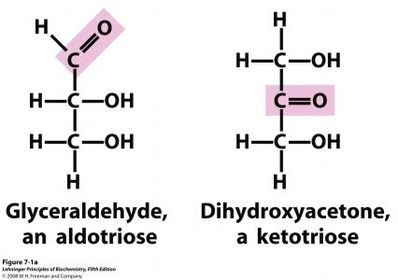
- 1How are the different types of monosaccharides distinguished?By:
- the carbonyl group they possess -- aldehyde or ketone
- the number of atoms in their carbon backbone - 2What are the two simplest monosaccharides called? Include their # of carbons + functional group.1. Glyceraldehyde
2. Di-hydroxyacetone
(in the triose group) - 3Draw riboseis an aldehyde
a pentose (5C) - 4Draw ribulose.- has ketone group
- a pentose (5C) - 5Name the 3 types of hexose sugars.Glucose
Galactose
Fructose - 6Draw alpha glucose and beta glucose
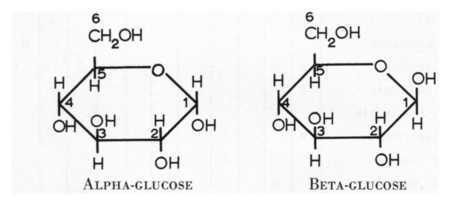
- 7Draw a full structural diagram showing the formation of sucrose
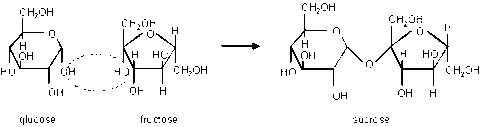
- 8Draw a full structural diagram showing the formation of lactose
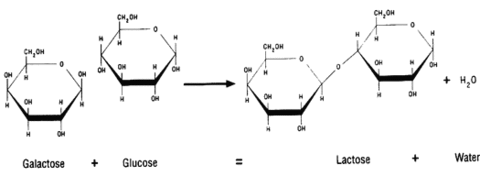
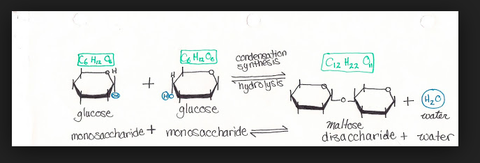
- 9Draw a full structural diagram showing the formation of maltose
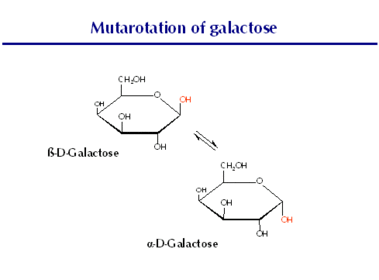
- 10Draw alpha and beta galactose.
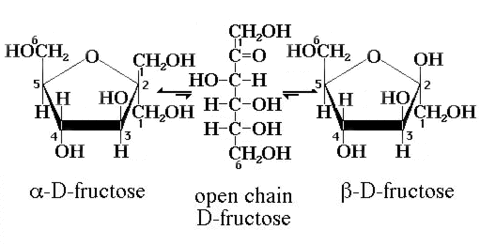
- 11Draw alpha and beta fructose.
- 12Triose monosaccharides include _____________ as the aldose and ____________ as the ketose group1) glyceraldehyde
2) dihydroxyacetone - 13Pentose include __________ as the aldose group and __________ as the ketose group1) ribose
2) ribulose - 14What is a glycosidic linkage? How are they formed?- Covalent bonds holding monosaccharides together.
- They are formed by condensation reactions where the H atom comes from the OH group of a sugar the -OH group comes from a hydroxyl group of the other - 15Name the three disaccharidessucrose
lactose
maltose - 16Important functions of polysaccharides in living cells are...? Give examples of each function.- energy storage; ex) starch and glycogen
- structural support; ex) cellulose and chitin - 17What is an isomer?Compounds with the same molecular formula, but different structure. (ex- alpha and beta molecules)
- 18Starch is made of long chains of ________________. It contains 25-30% _________ and 70-75% _________________. Branched chains with alpha __ - __ glycosidic bonds every 24-30 glucose units.- made of long chains of alpha-glucose molecules
- 25-30% amylose
- 70-75% amylopectin
- alpha 1-6 glycosidic bonds - 19Glycogen: found in _______ and _________ of animals. Made of _________ molecules, similar to _______________. Its shape is __________________.1) liver
2) muscles
3) alpha glucose
4) amylopectin
5) highly branched - 20Cellulose - found in __________ - composed of ______________ - held together by __ __-__ glycosidic links - shape is ___________1) plant cell walls
2) ß-glucose molecules
3) ß 1,4 glycosidic links
4) straight, parallel chains - 21Chitin; - found in __________ and __________ - Made of _________ molecules, it is chemically similar to cellulose by each glucose has an __________ group attached1) fungi cell walls, exoskeleton of insects
2) ß-glucose
3) amine (NH2) - 22What do most monosaccharides form in aqueous solutions?Monosaccharides with five or more carbons are linear molecules in the dry state, but readily form ring structures when dissolved in water.
- 23Amylose is a straight chain polymer of ___________ with _________ glycosidic linkages1. alpha-glucose
2. alpha 1-4 - 24Amylopectin is a branched-chain _____________ polymer with __________ linkages in the main chain and __________ linkages at the branch points.1.alpha-glucose
2. alpha-1–4
3. alpha 1-6 - 25Plants store starch as ___________ ______________.insoluble granules
- 26Chitin’s physical and chemical properties make it useful in medical applications, such as...contact lenses and the tough, yet biodegradable, stitches that decompose as a wound heals.
Informações
- Descrição
- Grade 12 Biology Unit 1 Biochem FlashCards sobre Bio 12 -- Carbohydrates, criado por itstinachen em 11-09-2014.
- Criado por
- itstinachen · set 2014
- Atualizado
- 19 fev 2016
- Visualizações
- 92
- Avaliação