
Flashcards
Solow Model
Flashcards do conjunto (45)
- 1The Solow Model emphasizes that which factors of production are unimportant?Land and natural resources

- 2What are Kaldor's 6 stylized facts of growth?1. Output per worker grows continuously, with no secular tendency for the rate of growth of productivity to decline.
2. The Capital-Labor (K/L) ratio shows continuous growth
3. The rate of return on capital is stable
4. The capital-output (K/Y) ratio is stable
5. The shares of labor and capital in GDP remain stable
6. We observe significant variation in rate of growth of productivity across countries - 3In an exogenous growth model, growth is caused by:Forces that are not explained by the model itself, namely exogenous forces.
- 4Suppose that two countries share identical levels of total factor productivity, identical labor force growth rates and identical savings rates. Country A has greater initial level of output per worker than Country B. According to the Solow model, how will the two countries grow in terms of output per worker, all else constant?Country B, the country with the smaller initial level of output per worker will grow more rapidly than the country with the greater initial level of output per worker.
- 5T/F The Solow Growth Model predicts that rich nations will grow faster than poor nationsFalse
Poor nations will grow faster than rich nations - 6T/F If the central prediction of the Solow Growth Model is valid, Per capita Real GDP differences among nations will diminish.True
- 7If a war destroys a large portion of a country's capital stock but the saving rate is unchanged, the Solow model predicts output will grow and that the new steady state will:Approach the same output level as before
- 8In the Solow growth model, if investment exceeds depreciation, the capital stock will ______ and output will ______ until the steady state is attained.increase; increase
- 9AL is referred to as _________, and technological progress that enters in this fashion is known as labor-augmenting or Harrod-neutral.Effective Labor
This way of specifying how A enters,
together with the other assumptions of the model, will imply that the ratio
of capital to output, K/Y, eventually settles down.the ratio is eventually.
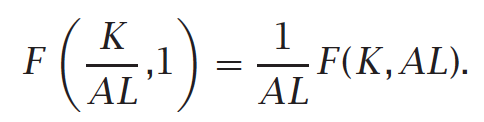
constant. - 10What are the implications of CRS in Solow's two arguments, capital and effective labor?Doubling the quantities of capital and effective labor (for example, by doubling K and L with A held fixed) doubles the amount produced.
Multiplying both arguments by any Non-neg. constant c causes output to change by the same factor: - 11What is the CRS equation for Solow's two arguments, capital and effective labor?Implications:
1. Economy is big enough that the gains from specialization have been exhausted
2. Inputs other than K, L, and A
are relatively unimportant.
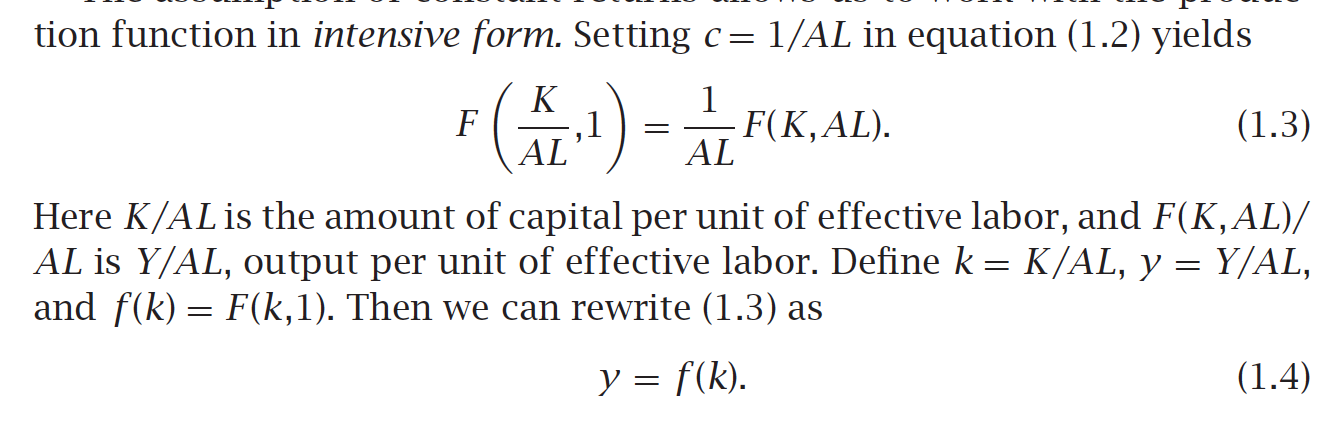
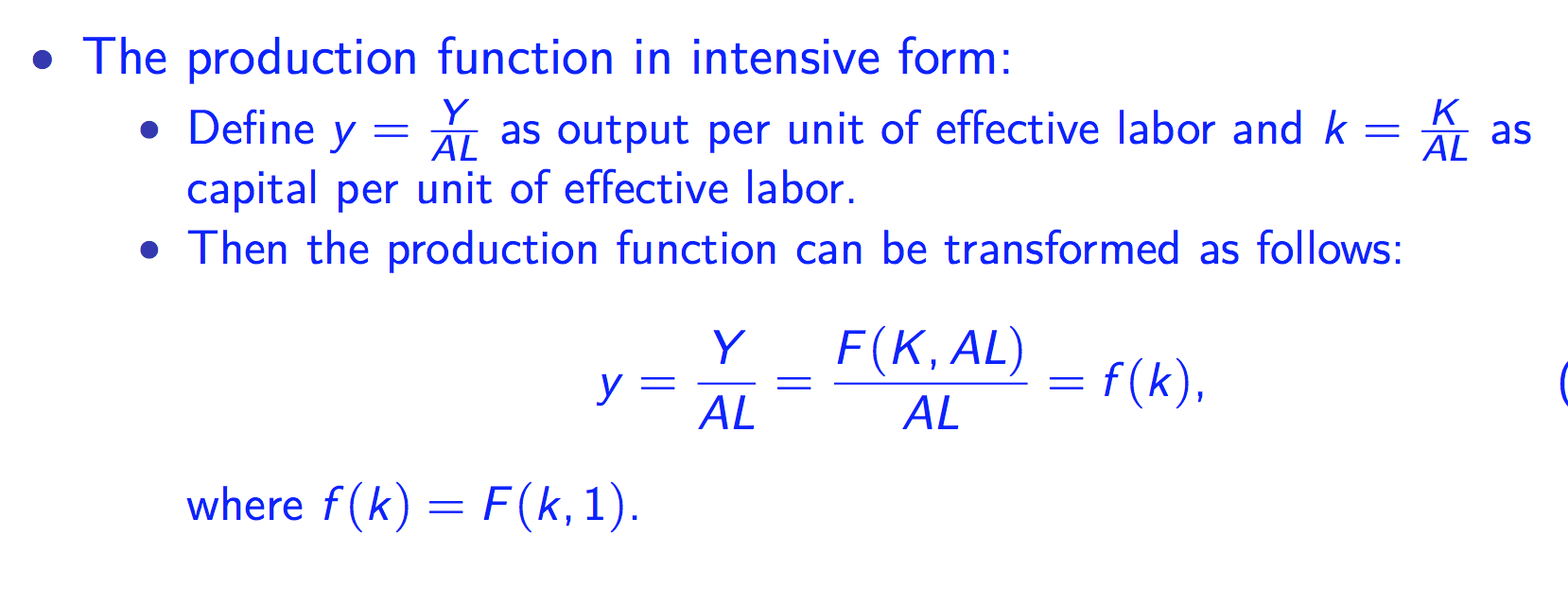
- 12Intensive form of Solow production functionSetting c = 1/AL in intensive form
- 13How do we get to output per unit of effective labor as a function of capital per unit of effective labor? Namely, y= f(k)
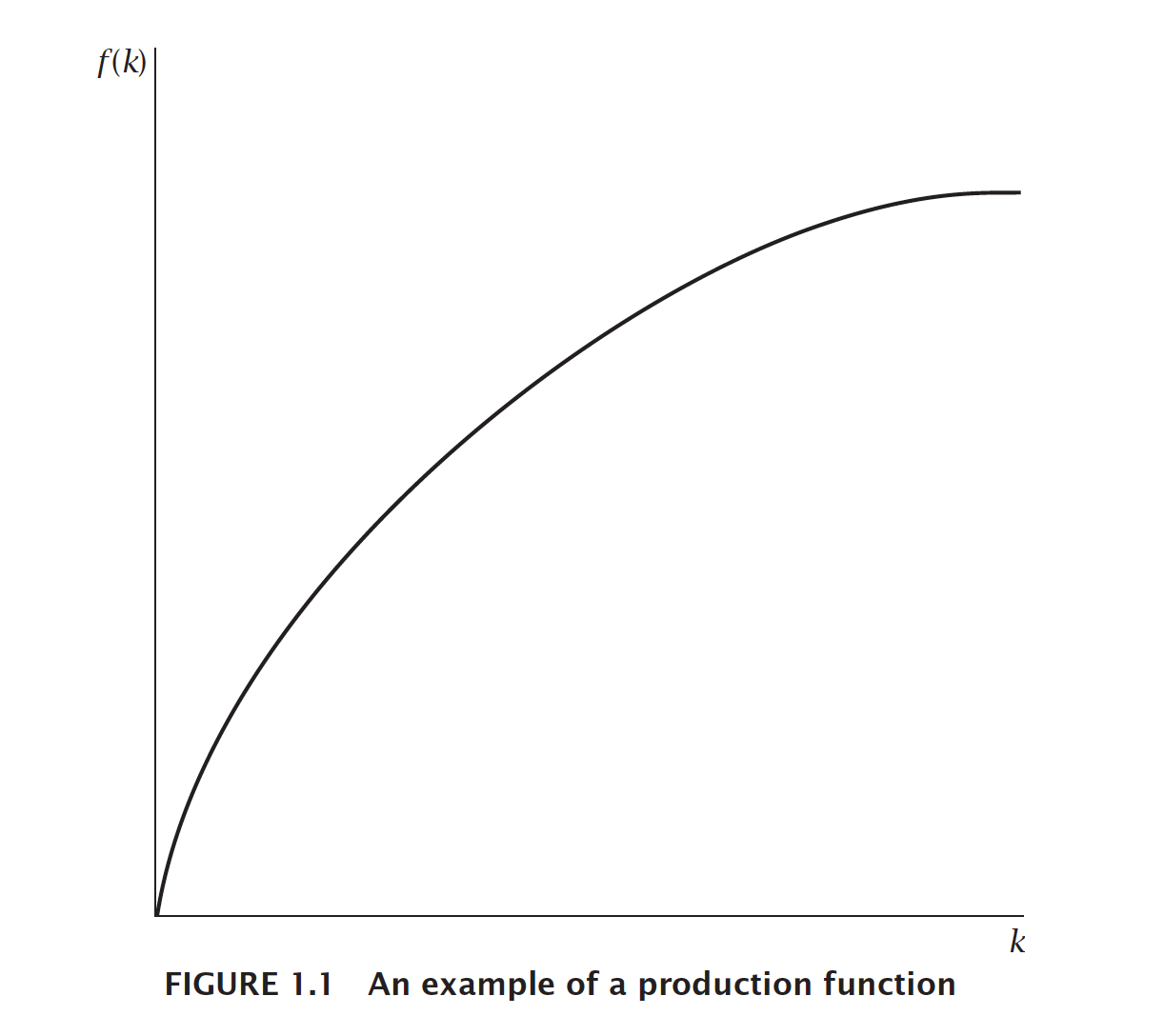
- 14ƒ'(k) = positive ƒ''(k) = negative what does this mean?ƒ'(k) = positive, means that the marginal product of capital is positive
ƒ''(k) = negative, means that the marginal product of capital declines at k rises - 15What are the implications of the Inada conditions for the Solow model?the marginal product of capital is very large when the capital stock is sufficiently small, and vice versa.
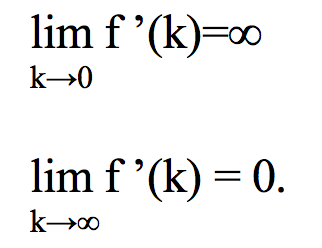
- 16What does the production function satisfying Inada conditions look like? In other words, one that shows ƒ'(k) = positive & ƒ''(k) = negative
- 17How does the production function takes its intensive form?
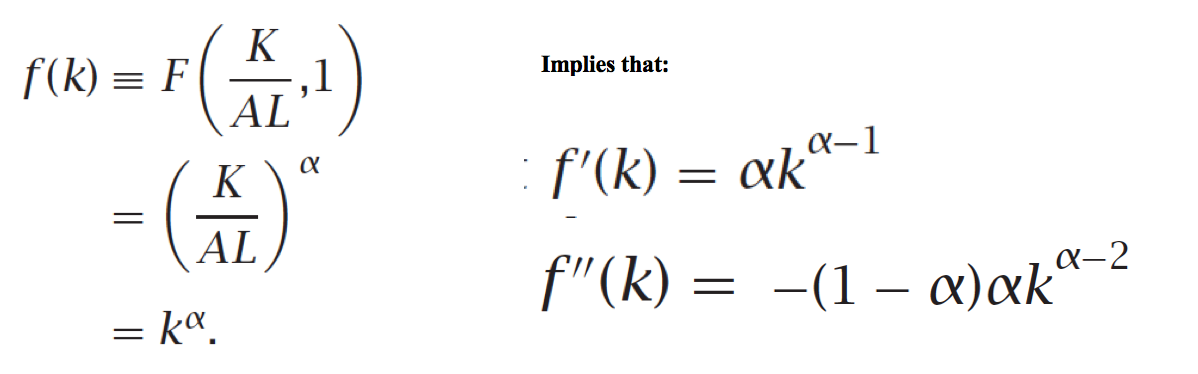
- 18What is the Solow production function expressed in Cobb-Douglas terms?Thinking of the two α as "a" and "b", them being < 1 indicates diminishing returns to a single factor, and a + b = 1 , indicating constant returns to scale.

- 19Illustrate that the Cobb-Douglas function has CRSα cancels for the c, leaving K^α (AL)^1-α, which is Cobb-Douglas
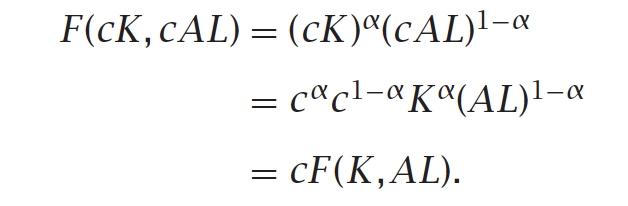
- 20Illustrate the intensive form of the production function:It is straightforward to check that this expression is positive, that it approaches infinity as k approaches zero, and that it approaches zero as k approaches infinity.
- 21What are the growth rates of Labor and Knowledge?n and g are exogenous parameters and where a dot over a variable
denotes a derivative with respect to time, shorthand for "dX(t )/dt".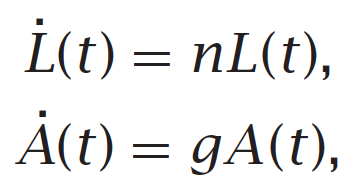
- 22With Cobb-Douglas, labor-augmenting, capital augmenting, and Hicks-neutral are essentially all the same.Yes, just know this.
- 23What does these equations imply?The growth rate of L is constant
and equal to n.
The growth rate of A is constant
and equal to g. - 24The growth rate of a variable equals the rate of change of its natural log. Demonstrate this: (Chain Rule, since ln X is a function of X, and X is a function of T)
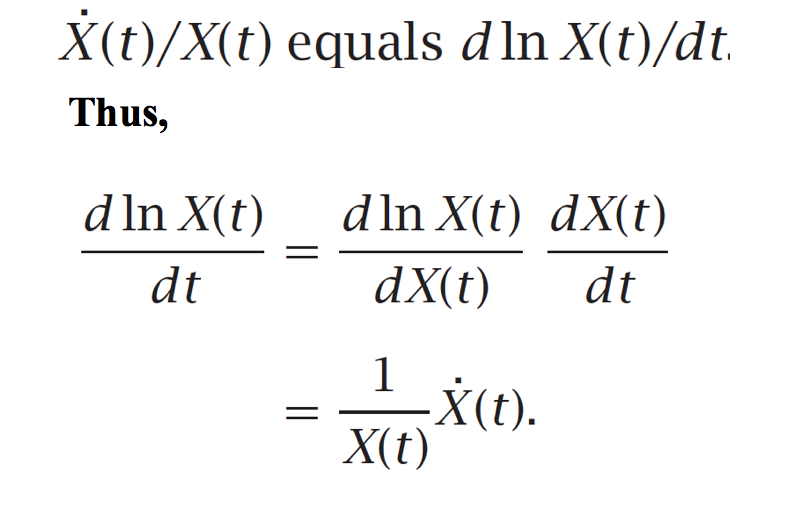
- 25Demonstrate that the rates of change of the logs of L and A are constant, and that they equal n and g, respectively.Thus, our assumption is that L and A grow exponentially.
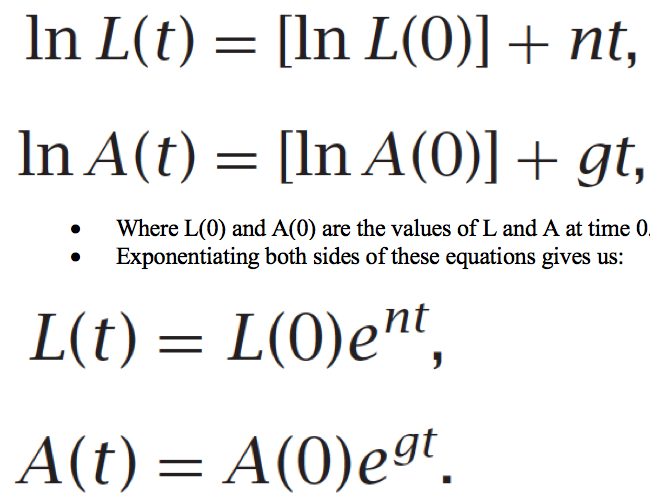
- 26In the Solow model, output is divided between ________ and _________. What is the equation showing this?Consumption and Investment
I(t) = Y(t) - C(t)
One unit of investment yields one unit unit of capital. - 27What formula demonstrates the growth rate of K?s= the fraction of Y devoted to I(t)
Although no restrictions are placed on n, g, and δ individually, their sum is
assumed to be positive.
- 28What are the distinctions between Solow, RCK, and Diamond regarding how output is divided between consumption and investment?In RCK and Diamond, the division arises endogenously from the interactions are optimizing agents
In Solow, the division is taken as given, as the fraction of output devoted to investment is exogenous. - 29What are some ways in which Solow is grossly oversimplified?Only a single good,
Gov't is absent,
Fluctuations in employment are ignored,
Only three inputs into production function, savings rate, depreciation, pop. growth, and tech. progress are constant - 30How are we to regarding the savings rate in the Solow model?Exogenous and Constant
- 31How are we to regard the evolution dynamics of labor and knowledge?Exogenous and Constant
- 32Demonstate the dynamics of kSince k = K/AL, we can use the chain rule:
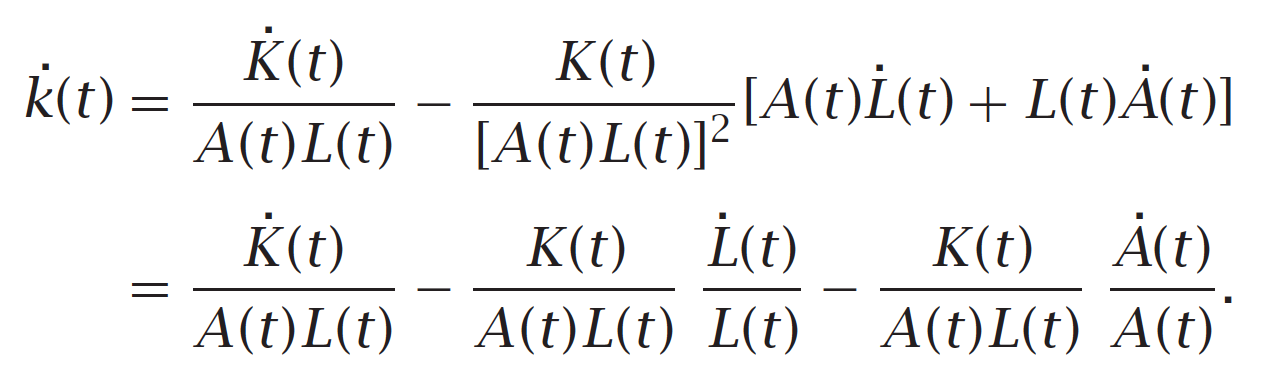
- 33Demonstate the dynamics of k (Cont'd)˙L /L and ˙A/A are n and g, respectively,
so ˙K is given by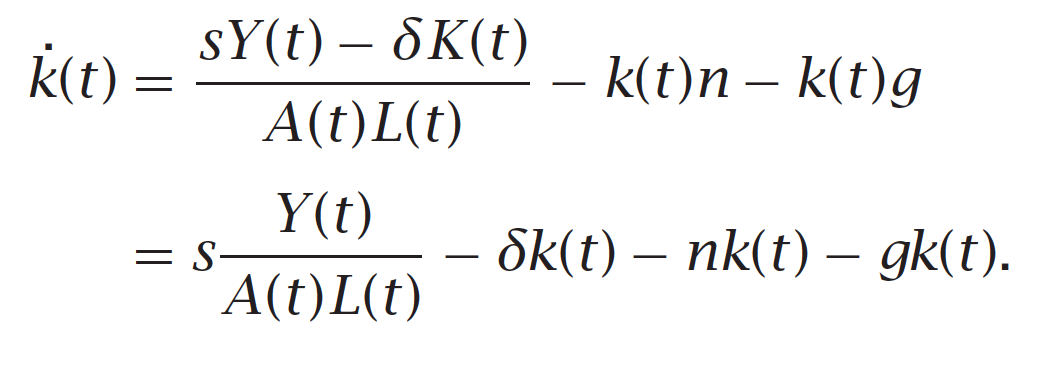
- 34What is an implication of the economy being closed in the Solow Model as it relates to savings/investmentSince the economy is closed, aggregate savings will always equal aggregate investment (S=I)
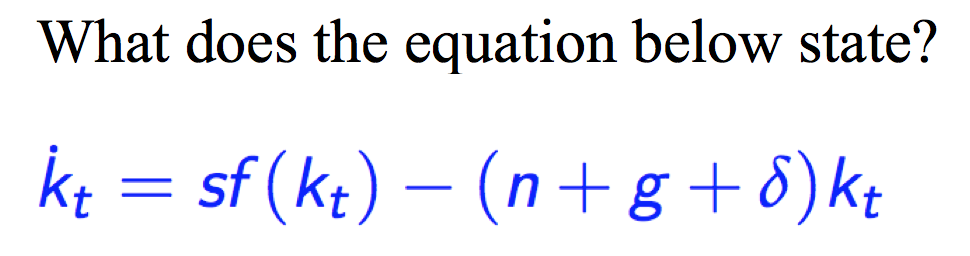
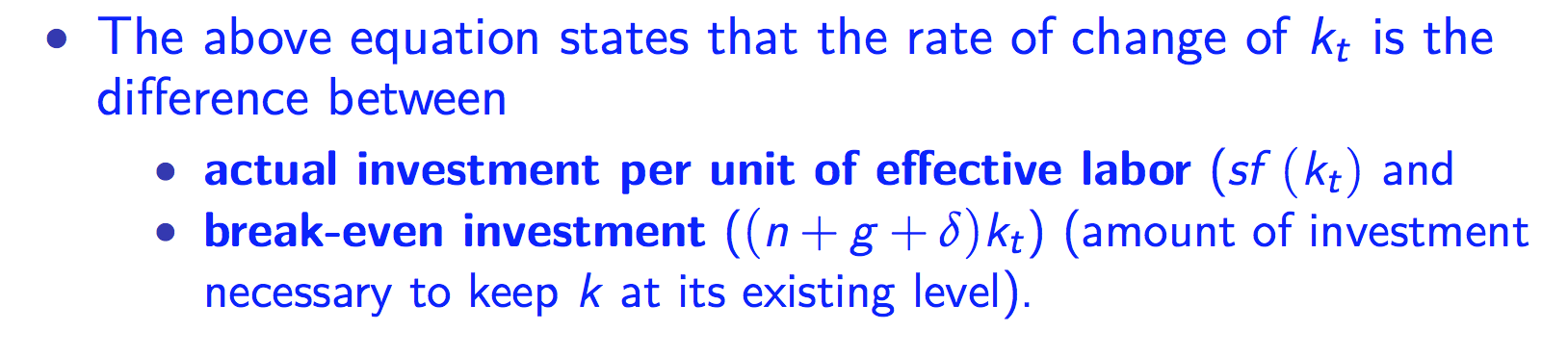
- 35—
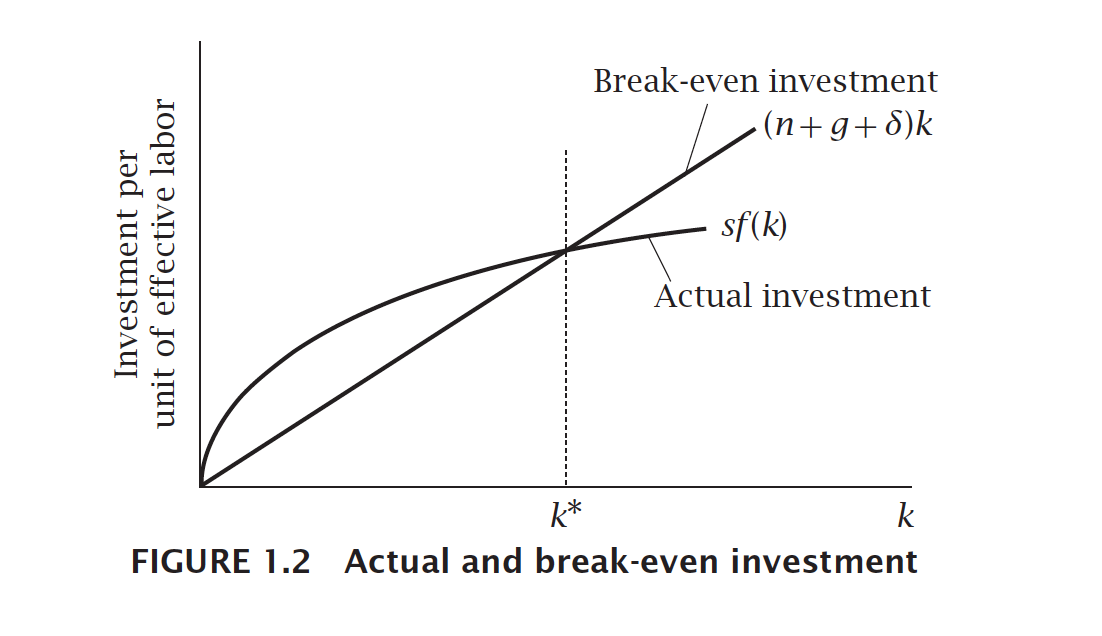
- 36Graph the dynamics of the economy
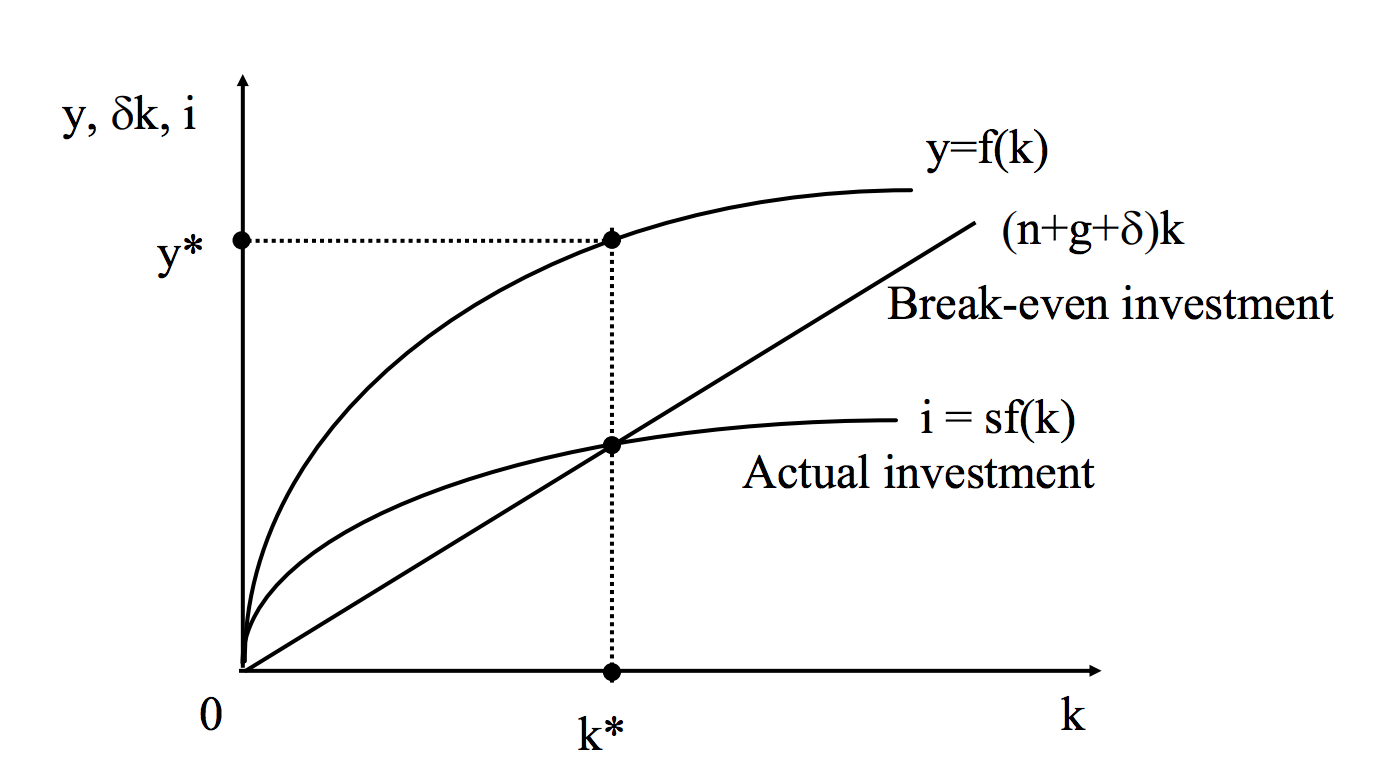
- 37Graph the phase diagram for k in the Solow Model. What are the implications?
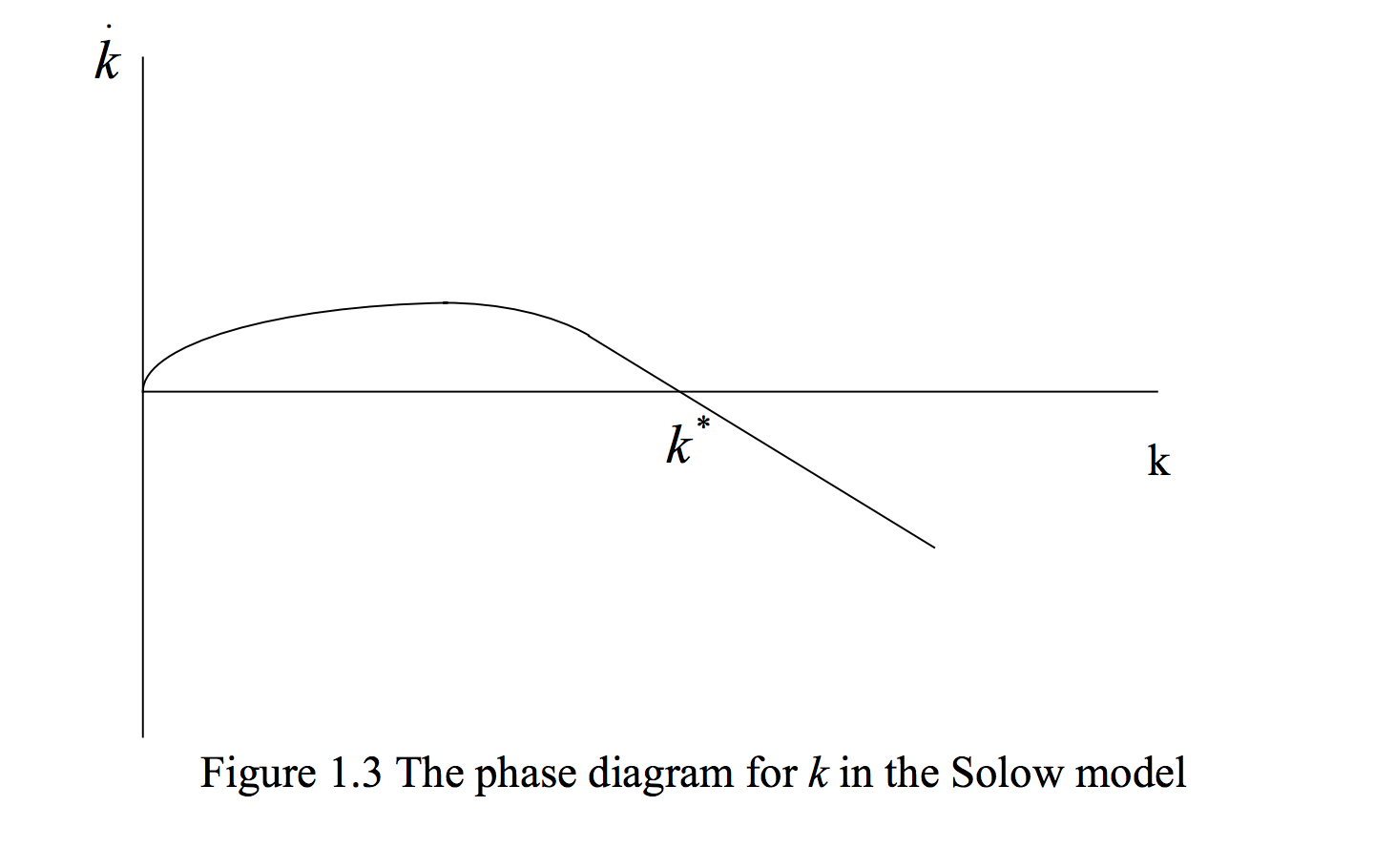
- 38What is true in the Steady State (BGP) concerning each variable?
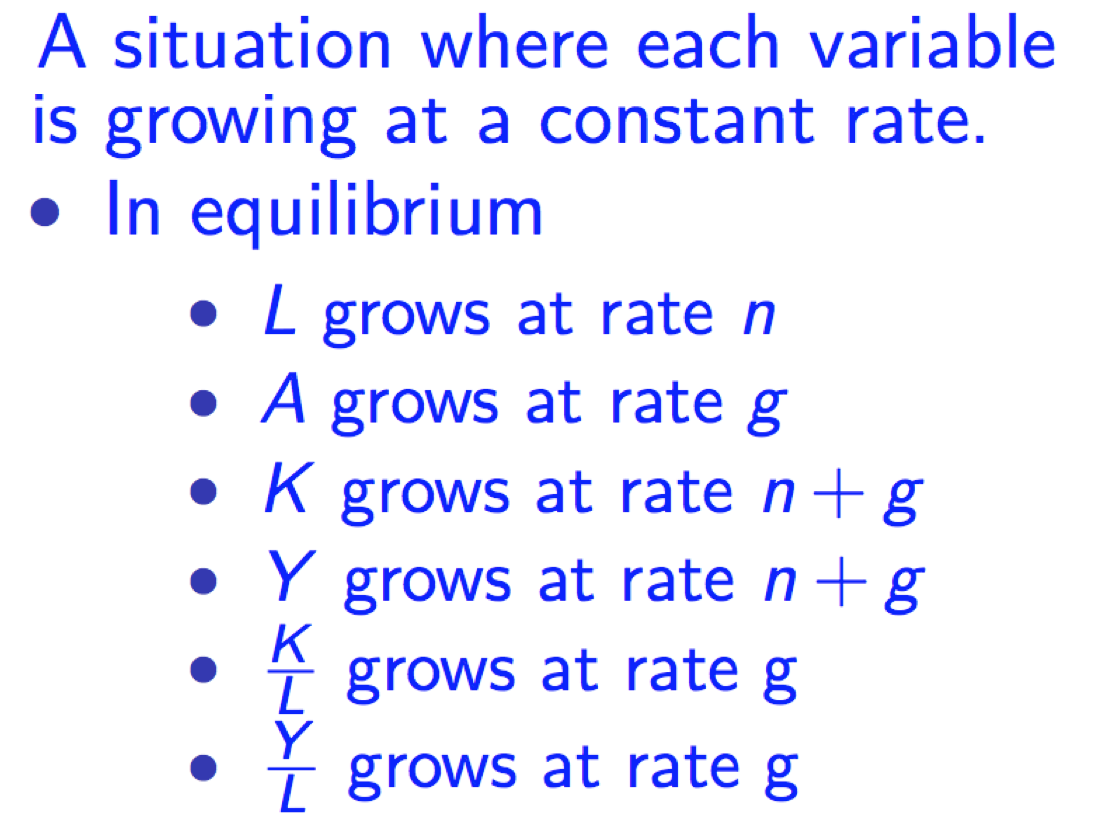
- 39Use logs to prove the constant growth rates in the steady state by differentiating with respect to time t
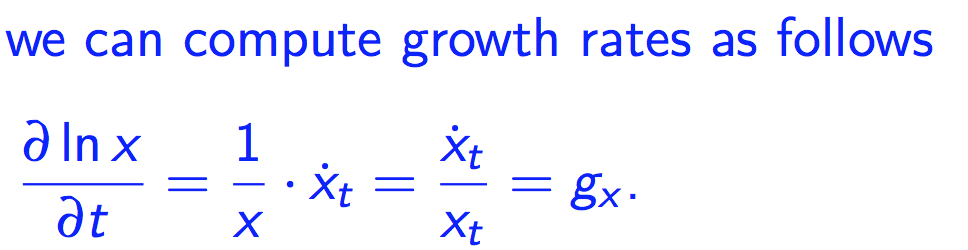
- 40Demonstrate on a graph the effects of an increase in the saving rate on investment, k*, and the new steady state.
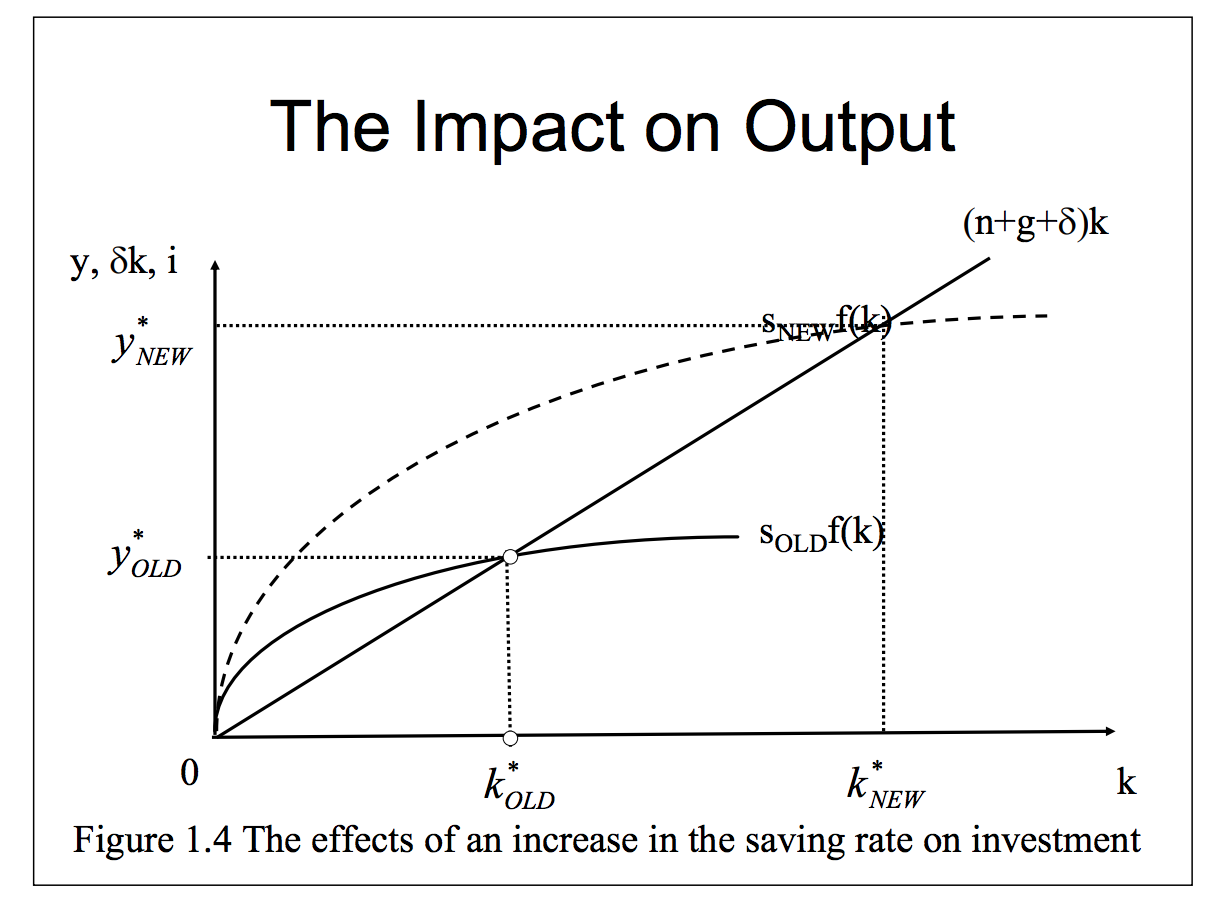
- 41What two effects does an increase in the savings rate have on consumption ?1. Initially, the increase in s lowers consumption.
2. However, in the medium- and long-run the initial effect is mitigated through the increase in k. In the new steady state consumption might even be higher. - 42Demonstrate the impact of a change in s can be computed as follows
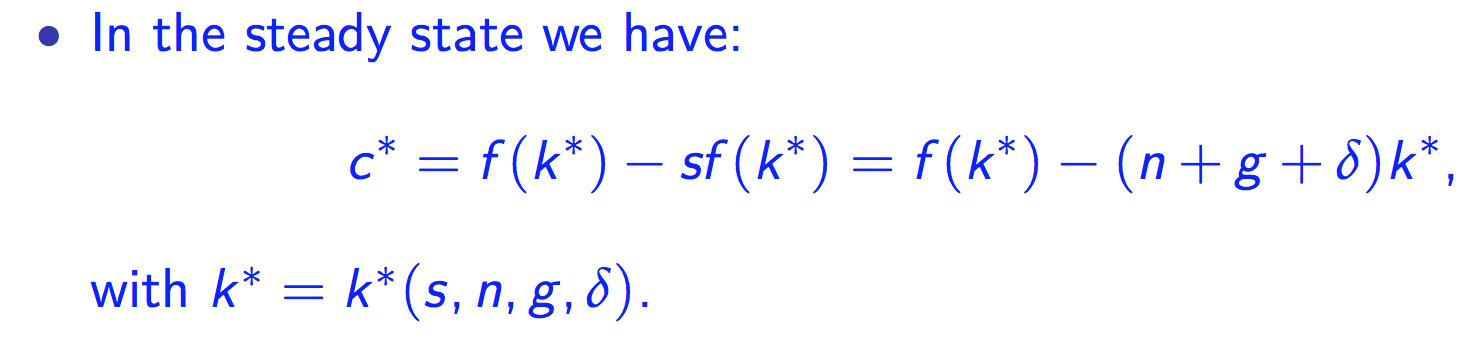
- 43To demonstrate a change in s and the effect is has on c, differentiate the above expression with respect to s.
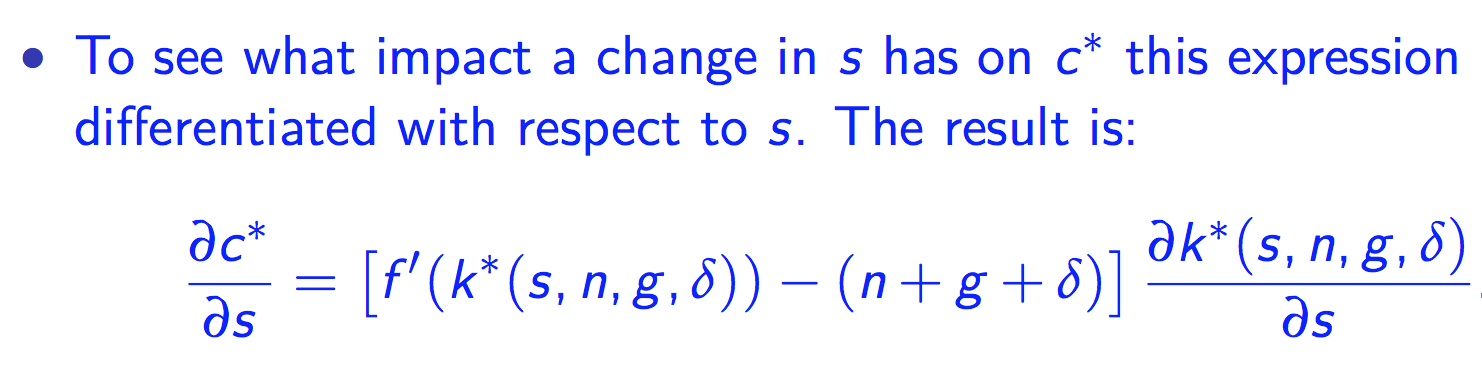
- 44If an increase in the savings rate raises or lowers consumption in the LONG RUN is dependent upon what?
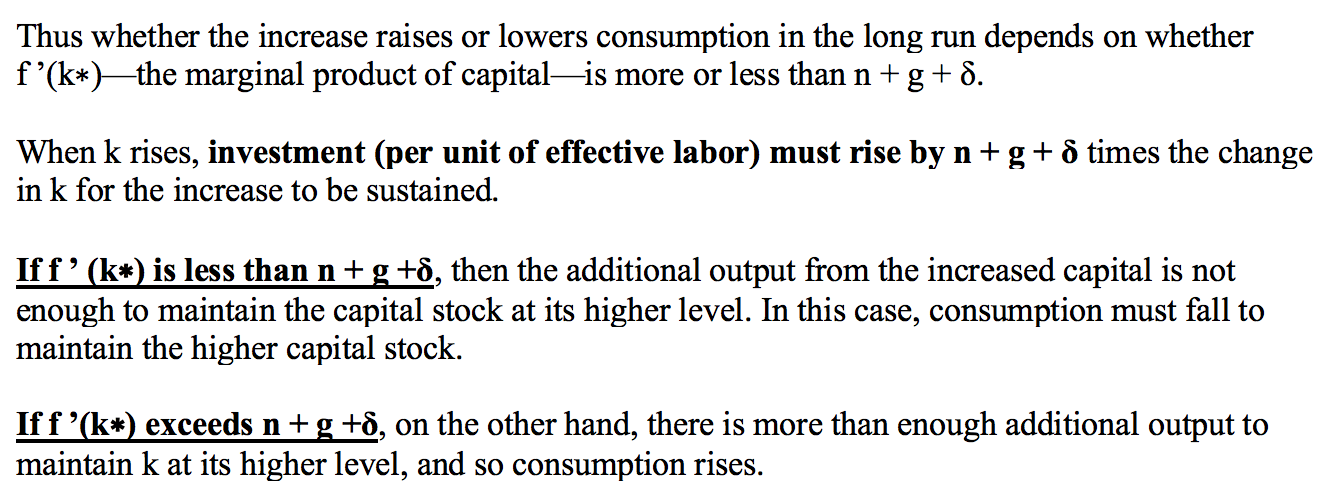
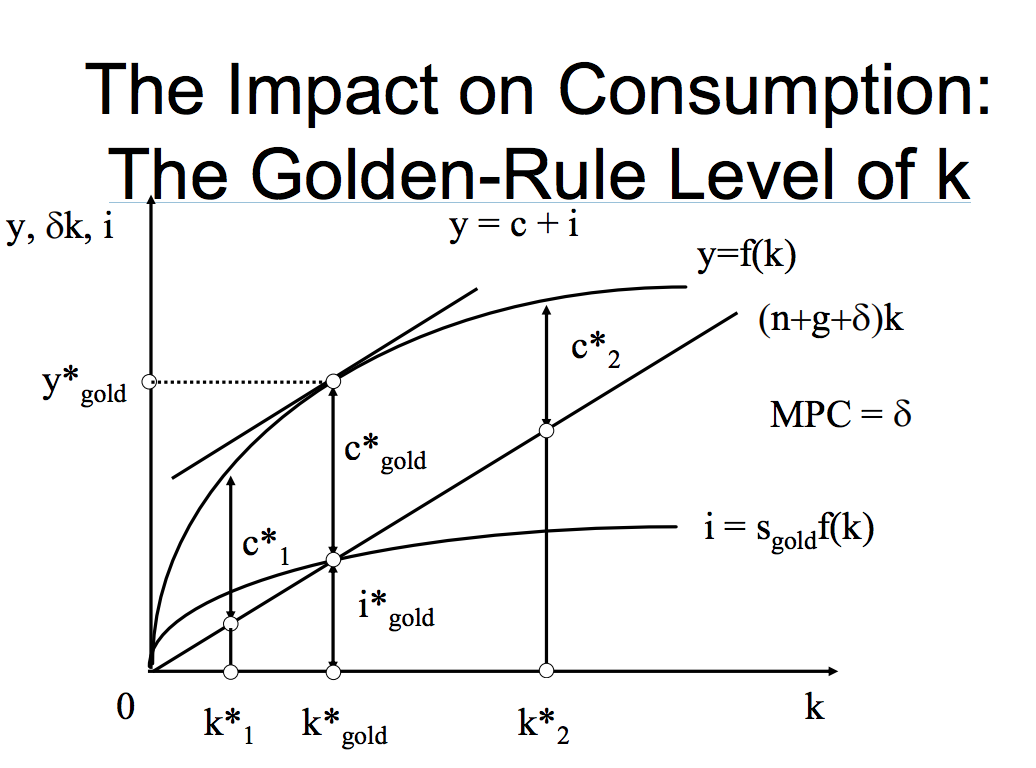
- 45Illustrate on a graph the Golden-Rule Level of k
Informações
- Descrição
- Business/Economics FlashCards sobre Solow Model, criado por Greg Caskey em 18-10-2018.
- Criado por
- Greg Caskey
- Visualizações
- 101
- Avaliação