
Flashcards
Eyes: orbit, reflexes and movements
Flashcards do conjunto (45)
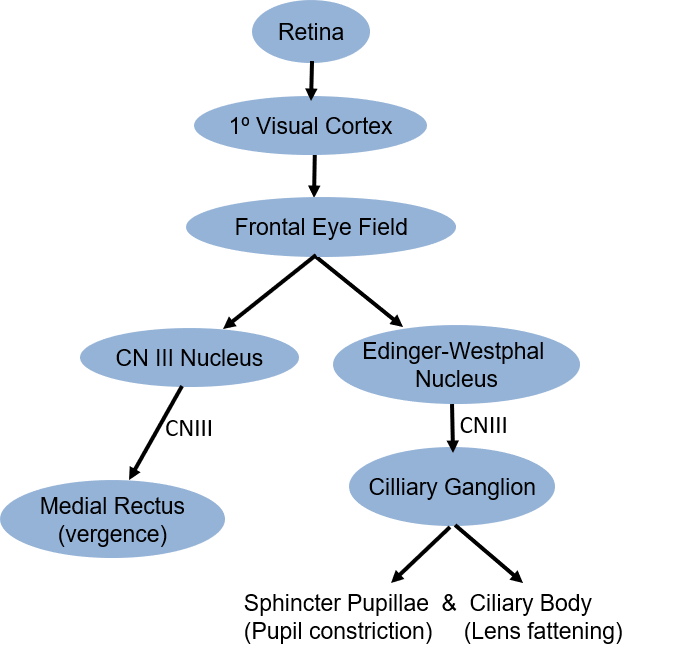
- 1Accommodationenables us to look at and focus upon objects close to the eye
- 2Cillary body contraction ...relaxes suspensory ligaments enabling the lens to recoil (makes it fatter)
- 3Process of accommodation
- 4Argyll-Robertson (Prostitute's) pupilNo pupillary reflex but accommodation reflex is ok
seen in: tertiary neuro syphilis & diabetic neuropathy - 5Edinger-Westphal nuclear damageNo direct or consensual reflex on damaged side
Pupil dilated & unreactive
Cause: vascular/tumour/brainstem - 6CN III compressionNo direct or consensual reflex on damaged side
Pupil dilated and unreactive
CNIII Compression = loss of all CNIII functions - 7CNIII Vascular lesion= sparing of pupillary functions
- 8Superior tarsal muscleSmooth muscle, innervated by sympathetic NS – open eyes more during fight or flight or by pharmacological reasons.
Not able to open eye by itself.
Loss will show partial ptosis in the eye - 9All extraocular muscles are innervated by...CN III except:
Superior oblique (the muscle with a trochlea) = trochlea nerve (CN IV)
Lateral rectus (the abductor muscle) = abducens nerve (CNVI) - 10—SR – Superior rectus
IR – Inferior rectus
MR – Medial rectus
LR – Lateral rectus
SO – Superior oblique
IO – Inferior oblique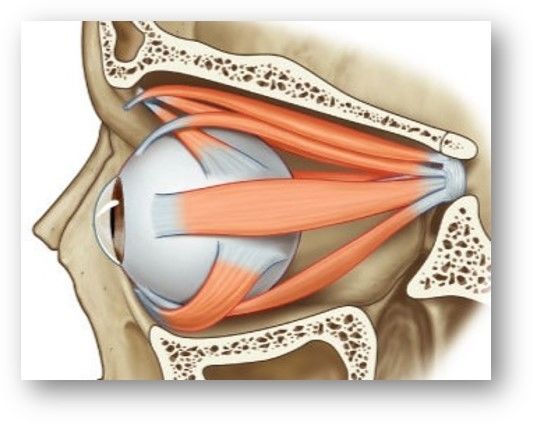
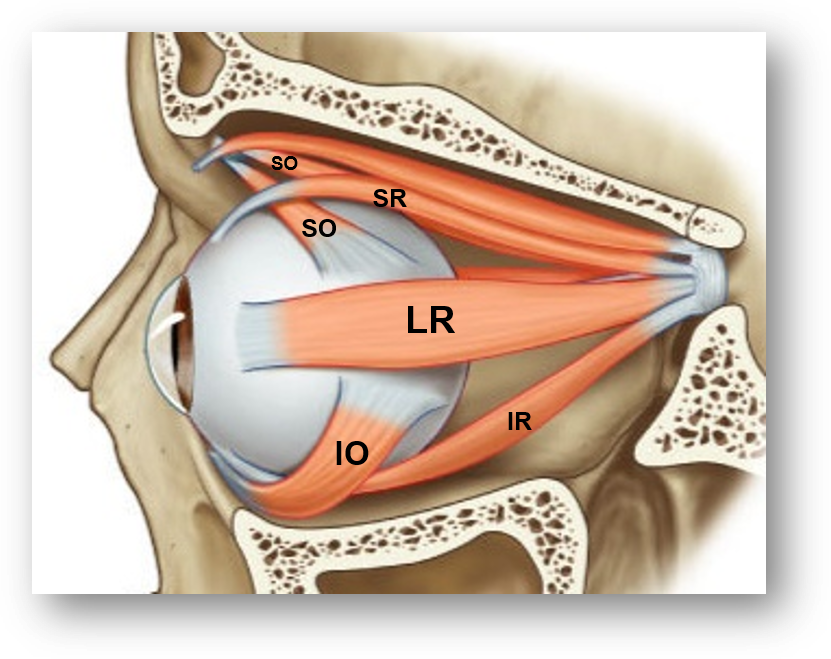
- 11Origin of rectus musclesa common tendinous ring at posterior of point
- 12Nerves that come through superior orbital fissureCN III
CN IV
CN Va
CN VI - 13tumour of meningies effect of eyesloss of eye movements
headache (CNVa) - 14Origin or inferior obliqueantero-medial floor of the orbit
(is like a hammock sitting under the eye) - 15The 3 perpendicular axis eye can moveBlack axis: Transverse = Look left or right
Red axis: Sagittal = Look up or down
Blue axis: Coronal = Torsion (twisting in and out)
Some muscles bring about combined eye movements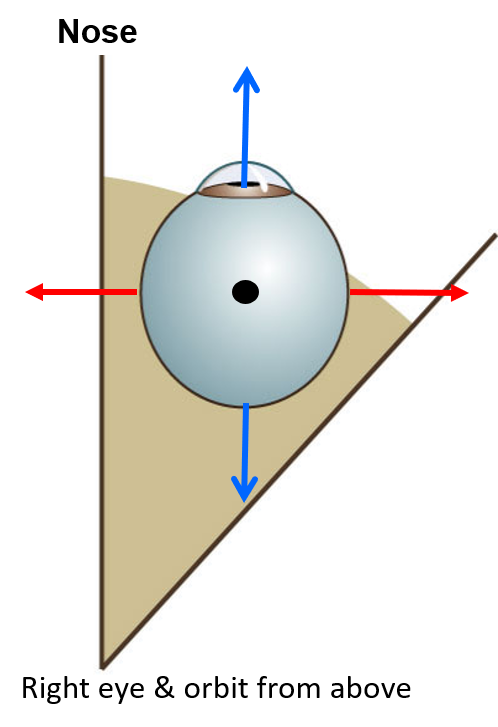
- 16Eye testing pattern and what they test
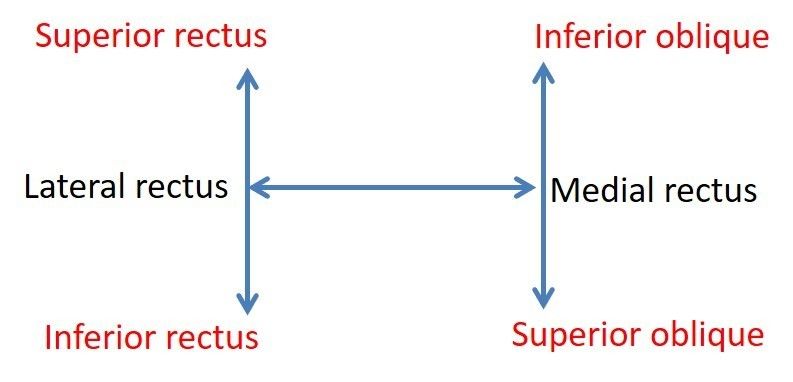
- 17Contraction of Lateral rectusabducts eye
- 18contraction of medial rectusadducts eye
- 19Contraction of the superior rectuselevates the eye
look up - 20Contraction of the inferior rectusdepresses the eye
look down - 21Contraction of superior obliquetilts eye downwards
- 22contraction of inferior obliquetilts eye upwards
- 23Hering's lawextraocular muscles normally have equal and simultaneous innervation
- 24If a given CN VI or its nucleus is damagedNo lateral movement of the affected eye.
Ipsilateral eye rests in adducted position = convergent squint.
Horizontal diplopia.
Diplopia worse when looking toward the affected side. - 25CN III is the motor supply for...the x4 muscles that move the eye,
x1 that opens the eyelid,
the sphincter pupillae,
the ciliary body - 26CN III lesion can produceComplete ptosis on affected side.
Down and out position of affected eye.
Divergent squint.
Horizontal and vertical diplopia.
Dilated pupil on affected side that’s unreactive to direct or consensual light.
Consensual pupil reflex intact in contralateral (unaffected) eye. - 27Patient can complain of sore neckloss of muscles (due to CN IV lesion) that mean eye can't rotate properly so at rest eye is not pointing straight ahead. Patient bends neck to correct this - hence pain
- 28Motor supply to superior obliqueCN IV
- 29CN IV lesion can produce:Upward deviation and extorsion (outward rotation) of the affected eye.
Vertical diplopia: worse when descending stairs / reading paper.
Torsional diplopia: double vision where the images twisted apart from each other.
Patient tilts head away from lesion to help prevent diplopia (counteracts extorsion produced by inferior oblique). - 30Track target definitionsmooth pursuit when target is moving
- 31stabilise target definitionyou are moving target is not
- 32scan target to targetsaccade (fast movement)
- 33centre that control eye movementVestibular nuclei & parapontine reticular formation
Frontal eye field (frontal cortex)
Saccade centres (several locations)
Visual association areas - 34what is the medial longitudinal fasciculus?is a neuronal tract that enables conjugate gaze & tracking neck movement
connects CNIII, IV and VI with vestibular nuclei, cerebellum & neck muscle lower motor neurons
(makes you look left or right) - 35Pathway of the medial longitudinal fasciculusAction potential travels from CNVI to CNIII
Involved in lateral gaze (& other things too)
Under automatic & voluntary control - 36Lesions of the medial longitudinal fasciculus results inInternuclear opthalmoplegia
Lesion cuts interneuron connections between CN VI & CN IIII
means you can't move your eyes properly
Can be bilateral or unilateral
Can still accommodate - 37vestibulo-occular reflexA rotation of the head is detected, which triggers an inhibitory signal to the extraocular muscles on one side and an excitatory signal to the muscles on the other side (semicircular canal is activated). The result is a compensatory movement of the eyes.
- 38Testing of vestibulo-ocular reflex:in comatose patients to determine brain stem function - Doll's eye sign positive is good
- 39Signalling to a given lateral semicircular canal increases if......head is rotated to toward & decreases if head is rotated away from it
- 40Effect of brainstem stroke on vestibular systemon affected side the lateral semicircular canal is not activated and the patient's eyes drift off to opposite side and snap back (nystagmous)
- 41Which direction will a right lateral semicircular canal or vestibular nucleus make the eyes look?to the left
- 42Right (VN, LSCC OR FEF) makes you look...Left
damage causes the eyes to drift/look right - 43Jerk nystagmous definitionRepetitive eye movement with a fast and slow phase
is described according to the fast phase
EXAMPLE:
Slow Phase: Eyes slowly drift left....they look towards the damaged left side
Fast Phase: Eyes move quickly rightwards back to the midline via action of saccade centres in brainstem & cortex - 44Result of putting cool/cold water into an external auditory meatusit mimics a vestibular system/nucleus lesion on that side
- 45Result of cold caloric testcan be used to induce nystagmous & test brainstem function
Informações
- Descrição
- Eyes: orbit, reflexes and movements
- Criado por
- Caitlin Murphy
- Visualizações
- 138
- Tags
- Avaliação