
18470550


| Questão | Responda |
| The distance covered by an object moving in a circle in one period is the .... | Circumference of the circle |
| How do we calculate the circumference of a circle? | π x d |
| How do we work out the time period? | T = 1/f (f = frequency) Note f = 1/T as well |
| How do we work out velocity when an object is moving in a circle? | v = (π x d) / T (T = time period) or v = π x d x f (f = frequency) |
| In circular motion, velocity is constantly..... | Changing, as direction is constantly changing |
| What is the symbol for angular speed? | ω |
| How do we calculate angular speed? | ω = (2π) / T OR ω = (2π)f |
| How do we calculate angular velocity? | v = rω (r = radius) |
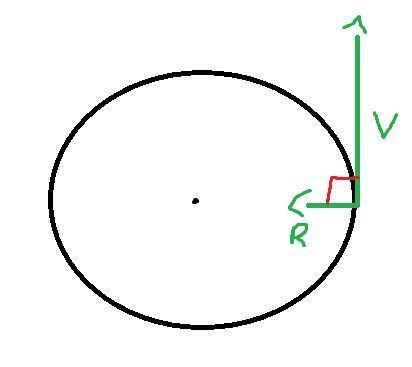
| What are the conditions of angular velocity? | Resultant force is perpendicular to velocity (RF towards centre, v is at tangent). This is called the centripetal force, which results in centripetal acceleration. |
| Diagram of above: (R = resultant force) | |
| How to calculate centripetal acceleration: | a = (v^2)/r OR a = rω^2 |
| How to calculate centripetal force: | F = (mv^2)/r OR F = mrω^2 |
| Note the centripetal is not a.... | Physical force, just circumstantial |
Quer criar seus próprios Flashcards gratuitos com GoConqr? Saiba mais.