
Flashcards
Waves
Flashcards do conjunto (30)
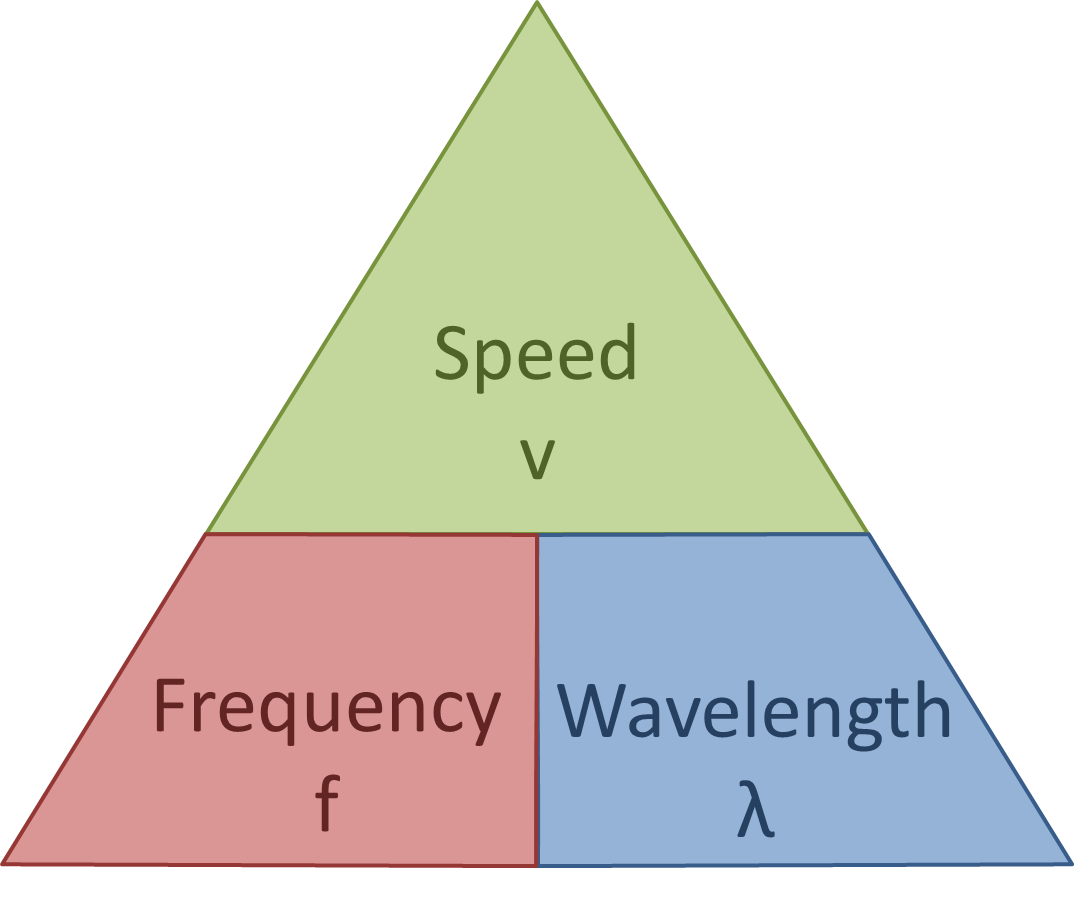
- 1Wave Speed EquationWave speed = frequency x wavelength
- 2Velocity EquationVelocity =
frequency x λ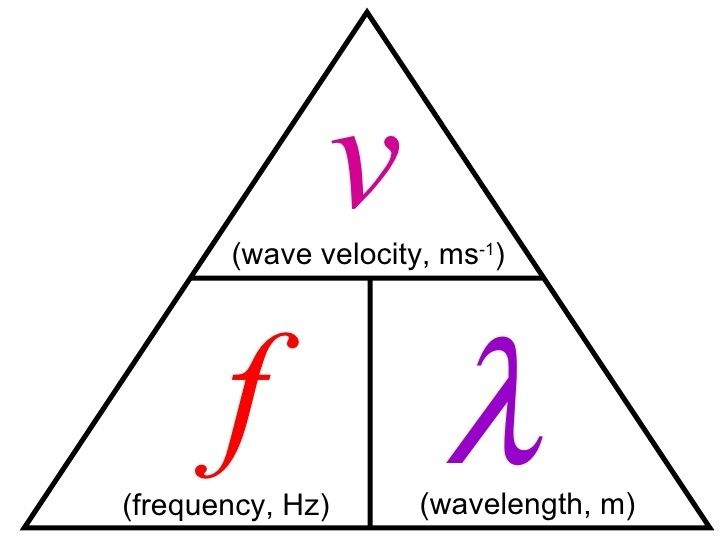
- 3Transverse WavesOscillate at a right angle to the direction of the wave (Eg. EM waves)
- 4Examples of transverse waves- electromagnetic waves (light)
- ripples and waves in water
- a wave on a string - 5Longitudinal WaveOscillate parallel to the direction of the wave (Eg. mechanical)
- 6Examples of longitudinal waves-sound waves in air (ultrasound)
- shock waves (some seismic waves) - 7When light enters an optically denser medium it refracts..Towards the normal
- 8When light enters an optically less dense medium it refracts..Away from the normal
- 9Conditions for TOTAL INTERNAL REFLECTION:The angle of incidence must be greater than the critical angle
-Light must travel from an optically dense medium to a less optically dense medium. - 10CladdingPrevents information to cross over from one fibre making it secure. Slightly lower refractive index compared to core making it totally internally reflect.
- 11Optical Fibres (ADVANTAGE)-More information -
More secure -
Little energy lost (Copper loses energy through heat loss) - 12Optical Fibres (DISADVANTAGE)-Impurity
-Modal dispersion
-Spectral dispersion - 13Stationary WavesProduced when two waves of the same frequency, amplitude and constant phase difference travel in opposite directions through the same medium.
- 14DiffractionIt's the spreading out of waves when they pass through an opening around an obstacle which is comparable in size to their wavelength.
- 15List the EM spectrumRadio Waves
Micro waves
Infra red
Visible Light
Ultra Violet (UV)
Xrays
Gamma Rays - 16Electromagnetic wavesThey do not travel through a medium but can travel through a vacuum. They travel through space at the speed of light (Eg. Radio, Infrared, UV)
- 17Radio waves~Used to broadcast TV and radio signals ~Long-wave radio can be transmitted around the world.
~ Radio waves carry few or no dangers because of their low frequency and long wavelength. - 18Micro waves~Used for satellite communication and mobile phones
~Microwaves can cause heating ~Microwaves can burn human body cells, and are therefore a danger. - 19Infrared waves~Used as a heat detecting radiation
~The higher the temperature the brighter the image appears, used by police
~Can also heat cells by causing them to vibrate, -IR has higher frequency so can cause skin burns. - 20Visible light~Visible light is required to see objects ~Visible light is reflected off objects
~Visible light is used in photography in a similar way to the eye
~Can cause blindness in extreme cases. - 21Ultraviolet~UV is absorbed by fluorescent
~UV is used to detect forged bank notes with no fluorescent markings
~Can also be used to disinfect water
~High frequency means ionising so can mutate cells cause cancer and eye damage. - 22X-Rays~ X-rays in hospitals not absorbed by denser materials so shows bone structure ~Also used in airports to scan baggage ~ More ionising, can cause cell mutation and cancer. more penetrative.
- 23Gamma rays~Ionising radiation, can cause cancer and mutations
~Can also be used to sterilise food
~Can treat cancer by killing cancerous cells ~ Highest frequency EM wave. - 24What is amplitudeThe maximum displacement of a point on the wave from its undisturbed position.
- 25WavelengthThe distance between the same point on two adjacent waves.
- 26FrequencyThe number of complete waves passing a certain point per second it is measured if Hertz ( 1 Hz is 1 waver per seconds).
- 27Period of a wave calculationperiod (s) = 1 / frequency (Hz) T = 1 / f
- 28What is refraction?- Waves changing direction at a boundary -When a wave crosses a boundary between materials at an angle it changes direction
-The amount refracted depends on how much the waves speed up/down. this depends on the density. - 29The law of reflectionThe angle of incidence is ALWAYS equal to the angle of reflection.
- 30What is refractionWhen light changes direction as it goes from one medium to another.