
Flashcards
Chapter 3 - micro
Flashcards do conjunto (72)
- 1Processes of lifeGrowth: increasing in size
reproduction: increase in number
repsonsiveness: ability to react to stimuli
metabolsm: controlled chem. rxns of organisms - 2Prokaryotes-lack nucleus
-lack various internal bound with phospholipid membranes
-small
-simple
-bacteria and archaea - 3euknucleus
internal membrane bound structures
larger
complex structure - 4glycocalyces of bacteriaoutermost strucutre
gelatinous, sticky substance that surrounds the cell
made of polysacch. or polypeptides or both
**protect cells from dessication (drying)
**helps in adhesion of cell to its substrate - 52 types of glycocalyces in bacteriacapsule and slime layer
- 6capsulemade of organized repeating units of organic chemicals
- firmly attached to cell wall
firm structure
-MAY PREVENT BACTERIA FROM BEING REZOGNIZED BY THE HOST - 7Slime layerloosly attached to cell surface
water sol.
sticky layer allows prok. to attach to surfaces - 8Flagella of bacterial cellsresponsible for movt of bacteria ( helps it go toward food, light or away from dangerous things)
-have long structures that extend beyond cell surface
-not present on all bactera and is diff. for diff. kinds of bac.** - 9Structure of flagella in bacterial cellscomposed of filament, hook, basal body
-Hook connects filament to basal body and basal body anchors filament and hook to cell wall by a rod and a series of rings
-composed of flagellin proteins - 10structure of flagella for gram -very thin layer of peptidoglycan
- 4 rings and 1 rod - 11structure of flagella for gram +thick peptidoglycan
2 rings and 1 rod
("positive marriage - 2 rings) - 12endoflagelladifferent kind of flagella
-doesn't go outisde the surface of the cell wall ( all inside)
-form an axial filament
-very typical for spirochetes - have a very typical corkscrew movt. ( this is how they are able to corkscrew its way inside the deepest tissues of the human cell - 13function of flagellarotation - propels bac. thru environm.
bac. move in response to stimuli ( taxis)
= so stumilis may be light (phototaxis) or chemical (chemotaxis), positive or neg.
rotation is reverisble: counter or clockwise
- runs and tumbles - 14runscounterclockwise
- 15tumblesclockwise
- 16Fimbriae and pillirod-like proteinacious structures
- 17fimbriaestricky, bristle-like projections
-used by bacteria to adhere to one
another, to hosts, substrates
- shorter than flagella and pilli
-serve an imp. function in biofilms***
-far more numerous than flagella, it surrounds the entire membrane - 18pilimade of pilin protien
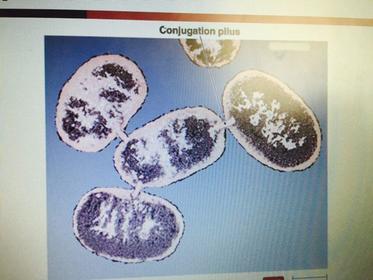
"conjugation pilli - mediate the transfer of DNA from 1 cell to another
longer than fimbriae but shorter than flagella
-basically only 1 or 2 per cell - 19What is eukaryotic flagella made of?different kind of protein subunits
- 20prokaryotic flagella made of ?flagellin
- 21—- one bacteria has conjugation pilli, extends it to another cell --> 2 cytoplasms fuse together and with the help of this tube, bacterial DNA is transferred from 1 cell to the other
- 22Bacterial cell wallprovide structure and shape
assist in attaching of cells or resisting antimicrobial rugs
**can target cell walls with antibiotic
give characteristic shape ( rod, coccus..)
made of peptidoglycan - 23gram + bacterial cell wallthick peptido. (complex polysacc. composed of alternating units of NAG and NAM - Covalently linked by tetrapeptide cross bridges
- those bridges contain polyalcohols named techoic acids
- appear purple
- mycolic acid - 24mycolic acid(lipid) in acid-fast bacteria helps cell survive dessication. - a waxy lipid structure
- ex. mycobacteria can't be stained using gram staining b/c of its waxy lipid structured cell - 25gram - cell wallonly thin layer of peptido.
bilayer membrance outside the peptido. that contains phospholipids, protieins and Lipopolysacc (LPS) - 26LPSknown as lipid A - what causes complications in gram - bacteria
-lipid is the toxic component
- also known as sepsis - causes toxic shock - 27Porinspace between the peptido and the cytop. membrane?
- called porins because they form pores across the membrane
( antibodies are usually made against those porin channels) - 28cytolplasmic membrance of bacteria - structurereferred to as phospholipd bilayer
- made of lipids and associated proteins
-fluid mosaic model - flowing of ions? - 29cytoplasmic mem. of bacteriavery specific in terms of how it acts
-contains a v. typical chemical gradient
- gatekeeper of the cell, controls what goes in and what goes out - 30function of cytop. mem.energy storage
harvest light in photosynthetic bacteria
**selectively permeable
phospholipid bilayer
-protein channels allow substances to cross membrane
- maintian a concentration and electrical gradient** - 31Passive processes of diffusionNO ATP REQUIRED
- 32kinds of passive processesdiffusion
facilitated diffusion ( specific and non-specific)
osmosis - 33active transportrequires ATP
- 34group translocationrequires ATP
- substance is chemically modified during transport
- glucose converted to glucose 6 phosphate - 35what happens in group translocation?glucose uses this particular channel to come inside, what happens is a phosphate molecule is added to that glucose so it becomes glucose 6 phosphate -- but then it can't use the same channel to go back outside so it retains its original characteristics back?
- 36kinds of active transportuniport
antiport
coupled transport; - 37uniportactive transport:
single sub. being transported in one direction only - 38antiport2 substances - 1 going in and 1 going out ( opp. direc)
- 39coupled transport2 substances being transported in the same direction
- 40components of cytop. of bacteriacytosol
inclusions
Endospores - 41cytosolliquid portion - mostly water - has ions, carbs, proteins, lipids and wastes
-contains cells's DNA in nucleoid - 42inclusionsreserve deposits of lipids, starch or comps. containing N P or S
- store carbon and energy as lipid polymer polyhydroxybutyrate NOT ATP - 43endosporesdangerous
- defensive strategy against unfav. conditions.
-dormant and resistant cells
what happens?
the bacterial vegetative cell when it finds itself in a harsh condition, it converts itself into an endospore and then it can survive harsh environment for decades. - 44sporulationformation of an endospore
- calcium and dipicolinic acid surrounds the membrane, couple of coats are dormed around the DNA. - 45ribosomes in prok.70s ( subunits 50 and 30) - different from euk.
- 46Cytoskeleton in prok.internal network of fibers
-forms cell shape - 47STRUCTURES OF ARCHAEglycolacyces: function in formation of biofilm, adherence
flagella: basal body, hook filament but contains differences with bactrial flagella
fimbria: many archae have them but not all - for adhesion
hami - only present in archae - fimbraie like structure - attaches to surfaces and helps it withstand harsh conditions - 48archael cell wallmost have cell walls but do not have peptidog.
contains a variety of polysacc and protiens - 49archael cytoplasmic membraneETHER LINKAGES NOT ESTER AS BACTERIA!
same functions - 50similarities b/w archael and bacterial cytoplasm70S ribosomes
fibrous cytoskeleton
circular DNA - 51differences b/w archael and bacterial cytoplasmdifferent ribosomal protiens ( diff. kinds)
diff. metabolic enzymes to make RNA
genetic code is more similar to euk. - 52glcycocalyces of euk.not as organized as prok capsules ( absent in euk. having cell walls)
help anchor animal cells to each other
strengthen cell surface
protection against dehydration
-cell to cell recognition and communication - 53who has cell walls in euk?fungi, algae, plants and some protozoa
- 54components of cell wall in eukcellulose - plants
chitin - fungal
polysaccharaides: algae - 55function of cell wall in euksupport against osmotic pressure and provide shape and protection
- 56cytoplasmic membrane in euk.contain steroid to help maintian fluidity
contains membrane rafts
control movt. in and out by active and passive processes, including endocytosis and exocytosis - 57membrane raftsregions of lipid and protein
- 582 types of endocytosisphagocytosis and pinocytosis
- 59phagocyt.engulfing " eating"
- 60pinocyt."drinking" extracellular fluids
- 61exocytosismaterial secreted out by secretory vessels
- 62structure of flagella in euk.differ functionally and structurally from prok.
- within the cytoplasmic mem.
- shaft is composed of of tubulin arranged from microtubules 9+2 arrangement
- filaments are anchored to cell by basal body - NO HOOK!
Basal body has 9+0 arrangement of microtubules
- may be single or multiple, found ar one pole of cell.
****DO NOT ROTATE, UNDULATE RYTHMICALLY - 63MOVEMENTS OF FLAGELLA IN EUK AND PROKPROK: ROTATES IN 360 DEGREES IN FORM OF RUNS AND TUMBLES
EUK: DO NOT ROTATE, UNDULATE RYTHMICALLY - 64Cilia in euk.shorter and more numerous than flagella
used to move substances
- flagella-liked arrangements of microtubules - 65Do prokaryotes have cilia?NOOOOO
- 66Ribosomes in euklarger than prok. (80S vs 70S)
subunits are 60 and 40
- in cytpo and ER - 67cytoskeleton of euk.fibers and tubules made of tubulin microtubules and other microfilaments composed of actin
-anchors organelles
- shape - 68centrioles and centrosomecentrioles - play a role in mitosis, cytokenisis, formation of cilia and flagella
- plants, algae, most fungi and prok. dont have it.
- composed of 9 triplets of tubulin microtubules resembling 9+0 arranegemnt
centrosome: region of cytop. where centrioles are found - 69function of golgi bodypackages large molec. for export
not in all euk. - 70lysosomebreaking down
catabolic enzymes - 71perixiosomesgarbage
- 72—
Informações
- Descrição
- FlashCards sobre Chapter 3 - micro, criado por merihan raouf em 23-09-2015.
- Criado por
- merihan raouf
- Visualizações
- 1
- Avaliação