
3970597


| Questão | Responda |
| Patterns of Human Inheritance | 1. Single Genes with 2 Alleles 2. Single Genes with Multiple Alleles 3. Many Genes Acting Together |
| Single Genes with 2 Alleles | Called Mendelian Traits Dominant vs Recessive Traits have distinctively different phenotypes Ex: widow's peak |
| Single Genes with Multiple Alleles | Three or more codes for a single trait, but a person can only carry two of the alleles Ex: Blood type |
| Traits Controlled by Many Genes | Multiple phenotype possibilities Ex: height--controlled by at least 4 genes |
| Sex Chromosomes | X is for Female Y is for Male Determine sex of person 1 of 23 pairs of chromosomes in our DNA Only pair that does not match |
| Fertilization | Egg always has X Sperm can have either X or Y Boys are XY Girls are XX Sperm determines sex of offspring |
| Sex-linked Genes | Trait is passed on the X or Y chromosomes Ex: Colorblindness Males more likely to show a recessive X chromosome-linked trait because they only have 1 X chromosome |
| Carrier | A person who has one recessive allele for a trait and one dominant allele |
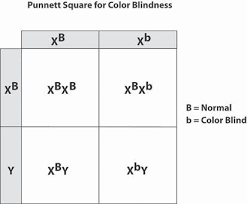
| What is the sex of the person that is a carrier for colorblindness? | Female XBXb |
| Effect of Environment | Many characteristics determined by interaction between genes and environment Ex: musical ability--genes give a person a good sense of hearing and coordination; environmental factors are instruction and practice |
| Genetic Disorder | Abnormal condition caused by 1. mutations in DNA of genes 2. changes in overall structure or number of chromosomes |
| Cystic Fibrosis | 1. Body produces abnormally thick mucus in the lungs and intestines 2. Caused by recessive allele mutation |
| Sickle-Cell Disease | Affects hemoglobin--a protein in red blood cells that carries oxygen Clog blood vessels |
| Hemophilia | A person's blood clots very slowly or not at all Don't produce protein needed for clotting Caused by Recessive Allele X-Chromosome |
| Down Syndrome | Cells have extra copy of Chromosome 21 Person has 3 Chromosome 21s Occurs during meiosis |
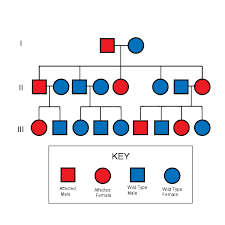
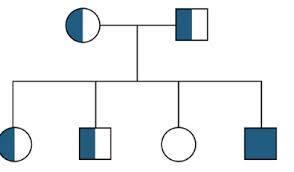
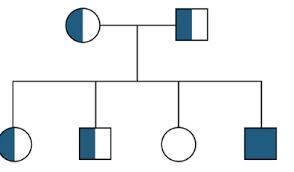
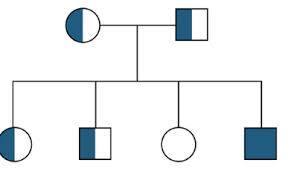
| Pedigrees | A chart or "family tree" that tracks which members of a family have a particular trait |
| What is this? | Pedigree |
| How do scientists manage genetic disorders? | Karyotypes to help diagnose 1. medical care 2. education 3. job training 4. other |
| a picture of all the chromosomes in a cell | Karyotype |
| help people understand their chances of having a child with a particular genetic disorder | genetic counselors |
| 3 methods for developing organisms with desirable traits | selective breeding cloning genetic engineering |
| selecting organisms with desired traits to be parents of the next generation | selective breeding |
| farmers saving seeds from healthiest plants for replanting | selective breeding |
| crossing two individuals with similar characteristics/genetic similarities | inbreeding |
| Breeding a male and female turkey that are both plump and grow quickly to generate fat plump, fast growing chicks | |
| crossing two genetically different individuals | hybridization |
| crossing corn that produces many kernels with corn that is resistant to disease to get a generation of corn that is both resistant to disease and produces many kernels | hybridization |
| an organism that has exactly the same genes as the organism from which it was produced | clone |
| genes from one organism are transferred into the DNA of another organism; used in medicines and crops | genetic engineering |
| example of genetic engineering in bacteria | insulin for diabetics |
| Example of genetic engineering in animals | human genes inserted into cows so that cows produce milk that contains blood clotting prtoeins for people with hemophilia |
| Inserting copies of a gene directly into a person's cells to correct genetic disorders | gene therapy |
| Concerns about genetic engineering | not safe for crops because might 1. harm the environment 2. cause health problems in humans |
| all the DNA in one cell of an organism | genome |
| the goal of the Human Genome Project | to identify the DNA sequence of every gene in the human genome |
| DNA technology used in Human Genome Project that identifies people and shows whether they are related | DNA Fingerprinting |
| True or False: Unless your an exact twin, your DNA is unique to you. | True |
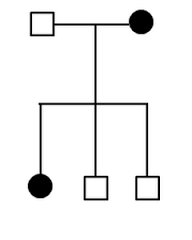
| Squares ? Circles? | Squares = Male Circle = Female |
| What does this mean in a pedigree? | marriage |
| In this pedigree, what does the verticle line stemming from the marriage represent? | offspring |
| What is half-shaded shape mean? | carrier |
| Fully-shaded shape? | expressed trait |
| No shading | trait is neither expressed or carried |
| Skin Color | Trait controlled by many genes |
| Environmental factors that affect height | diet |
| 4 Types of Blood | A, B, AB, O |
| Blood? Recessive, Dominant or Codominant | A and B Codominant O Recessive |
| How can two parents with type B blood have a child with O blood? | They are carriers for recessive Type O |
| Who is more likely to be colorblind? | Males because colorblindness is a recessive allele on the X chromosome. Since males are XY, they only have one X chromosome and so if they receive the recessive trait from their mother, there is no other allele to mask it. |
| Can a girl be colorblind? | Yes, but she must inherit two recessive alleles for colorblindness. |
| What tool do doctors use to help detect genetic disorders like Down Syndrome? | Karyotype |
| a condition caused by a chromosome that doesn't separate | nondisjunction |
| An extra copy of a chromosome | trisomy |
| Not a sex chromosome | Autosome |
| A pigment in skin or hair | melonin |
| How can you tell if a trait is sex-linked? | Females are carriers and Males have it. That means the trait is on the X chromosome. |
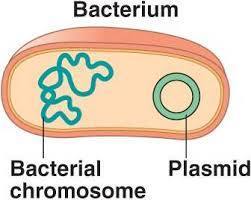
| What do these structures contain? | DNA |
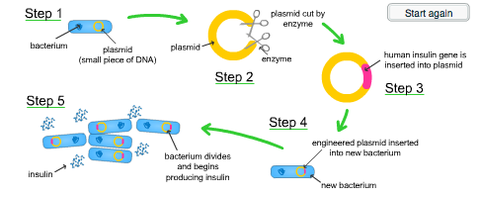
| What process is represented by this diagram? | genetic engineering |
| Plasmid cut by enzyme | Step 1 of Genetic Engineering |
| Step 2 of Genetic Engineering | Human insulin gene inserted into Plasmid |
| Step 3 of Genetic Engineering | Engineered plasmid inserted into new bacterium |
| Step 4 of Genetic Engineering | bacterium divides and begins producing new product (for example, insulin) |
| Why do scientist like to use bacteria for genetic engineering? | they reproduce quickly so large amounts of new genetic material can be produced quickly |
| Boy | XY |
| Girl | XX |

Quer criar seus próprios Flashcards gratuitos com GoConqr? Saiba mais.