
Flashcards
ISLC 1
Flashcards do conjunto (14)
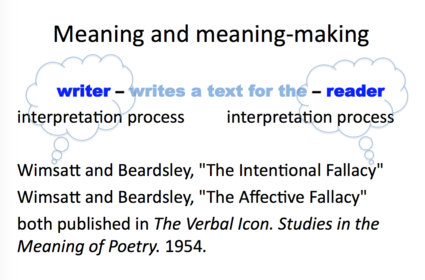
- 1meaning and meaning-making communication model? Why does ambiguity arise?• etymology: maenan (OE) = to think
• simple communication model:
speaker – says something to – listener
sender – message – receiver
addresser – message – addressee
• Roman Jakobson: ambiguities arise because of inherent instability of language - therefore, communicatioon always involves interpretation, on all sides! - 2meaning and meaning-making interpretation process
- 3Literature as communicationAuthor communication with reader through medium/channel of literary text which functions as a message
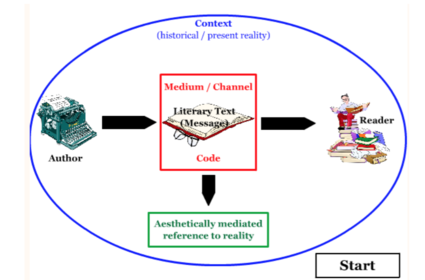
- 4Code?linguistic code (in which piece of writing is written in); what kind of language
and cultural code (things that help you in what kind of culture this is embetted in)
also: narrative strategies - 5Culture and meaning What is culture?Raymond Williams: social definition of culture
1. culture as a way of living
2. culture as a way of expression (performance: fashion, styling yourself, dancing)
3. culture as making and circulating meanings (closest to reading literary texts) - 6The circuit of culture
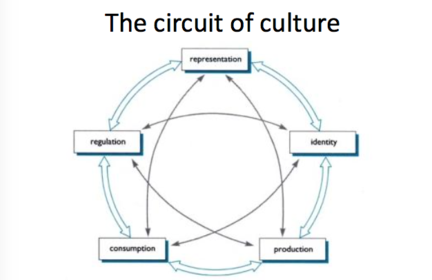
- 7Stuart Hall's leading questionWhat does it have to do with everything else?
"Culture [...] is not so much a set of things – novels and painting or TV programmes and comics – a a process, a set of practices. Primarily, culture is concerned with the production and exchange of meaning – the 'giving and taking of meaning' – between the members of a society or group."
-Representation 1977 - 8cultural meanings• help us understand the world
• define rules, norms and convenCons which structure our social reality
(eg. you know when you have to switch your phone off, ..)
• can be shared and/or in conflict
(is it okay to have a quich sms under the table during lecture?
Whether people look healthy, sick, stupid, etc.)
(hard to agree on that)
• can be in dominant or dominated
(held by minorities, not ethnic, but minority position, maybe religious believe, political believe)
• are constructed and perspectival (not natural. eg. That you have to stop when red traffic light – you've learned that, it's a construct of manhood)
perspectival: depending on where you stand (in a room as well as in a society); always different perspective
• are not natural or universal (=anti-essentialism) : red light in traffic means something different than red light on christmas tree
• are contingent (depending on the context and changing with particular context) on time, place, and other factors
• are context-specific
cannot be entirely controlled (you can't controll the meanin - 9literary meanings• have a variety of sources
• are contingent on the reader's or critic's theoretical lens or perspective
• are co-contructed between the sender, message and receiver
• are not natural nor universal (whenever you read sth, think again..eg. irony)
• are contingent on time, place and other factors
• are negotiable and need to be open to debate - 10to remember for both• Denaturalise what seems natural
• Question what seems certain
• Be sceptical of what appears normal
• Always ask (with Stuart Hall): "What does it have to do with everything else?" - 11fictional - referentialabout Literary Text
fictional: eg. Harry Potter
referential: refers to sth.
BUT everything is kind of referential because if there wasn't some kind of reference to our world, the text wouldn't matter to us at all! links! eg. time machine: link between future that H.G. Wells pictures-> he wants to warn us.
anyways, it is not the function of literature to point to sth. in the real world, but there is always a bit. Fictional aspect is the reason we read literature for. - 12What is a cultural product?eg. Ö1, House of Cards, ..
- 13We read and see what we know• LeMer and word recogniCon; sign recogniCon
• Structured knowledge: schemata, frames and
scripts
• Reading / perceiving what we know is faster and beMer remembered than reading what we don‘t know
--> our mind works economically
--> can it be trusted?? - 14Why studying culture for becoming a teacher?Languages are contextualised in culture.
Informações
- Descrição
- Culture & Literature FlashCards sobre ISLC 1, criado por Lisza Neumeier em 02-11-2016.
- Criado por
- Lisza Neumeier
- Visualizações
- 26
- Avaliação