
Flashcards
A2, OCR, Chemistry: Electrodes
Flashcards do conjunto (19)
- 1What is the definition for standard Electrode potential of a half cell, E°?is the e.m.f of a half cell compare to a standard hydrogen half cell, measured at 298K, with solution concentrations of 1 mol dm-3 and a gas pressure of 100kPa
- 2How is electricity associated with redox reactions?During redox reactions, there is a flow of electrons; the flow of electrons involves electrical energy
Redox reactions are of huge importance in the utilisation of electrical energy
Electrical energy is released when electrode flow between two half cells and form a cell - 3What is a half cell?Compromised of an element in two oxidation states
The simplest half cell consist of an (aq) solution of the element in which a metal rod of the spent is placed
The metal compound acts as an electrode - 4What is reduction?gain of electron
- 5What is oxidation?loss of electrons
- 6What is the hydrogen half cell?A half cell made of from non-metals in equilibrium with non-metal ions
Hydrogen gas with an (aq) hydrogen solution
-HCL(aq) of concentration 1mol dm-3 (source of H+)
-Hydrogen gas at 100kPa
-An inert Platinum electrode to allow electrons to pass into our out of the cell via a connecting wire
has an e.m.f value of 0V
used as reference for other half cells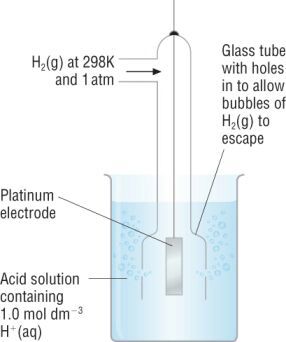
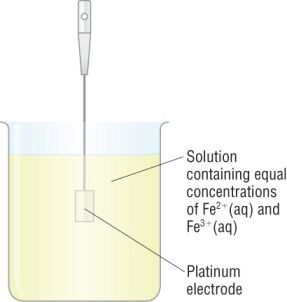
- 7What is a metal ion/metal ion half cell?contains is of the same element in different oxidation states
needs a platinum electrode because there is no solid piece of electrode that can act as the electrode
-equimolar concentrations of Fe2+ and Fe3+ - 8How do you measure standard electrode potentials using a hydrogen half cell?The standard electrode potential can be determined by connecting a half cell to a hydrogen half cell
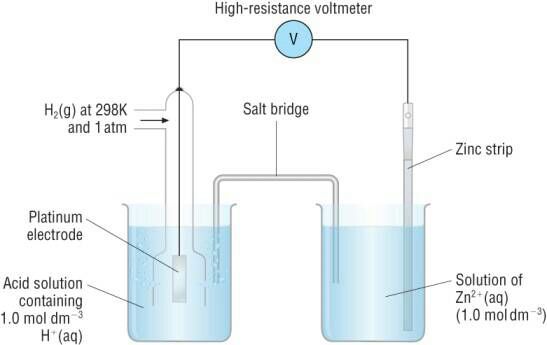
- 9What is the salt bridge, and wire for?wire- acts as a connecting wire to allow the electrode caring a charge to flow through it
Salt bridge- connects the two solutions and allows is don't a charge to be transferred between half cells
usually made from a piece of filter paper soaked in an (aq) solution of an ionic substance, usually KNO3 or NH4NO3 - 10What is the electrochemical series?The electrochemical series is a list of half cells ordered by their standard electrode potentials, E°
The more negative the E°value, the greater the tendency towards the half cell undergoing oxidation
More positive the E° value the greater tendency towards the half cell undergoing reduction - 11What can E° values be used for?Electrode potentials can be used to predict what will happen when half cells are connected together to form a cell
- 12What does the voltmeter do?It measures the potential difference of the cell-difference between the electrode potentials of the half cells
But the value the further away from the equilibrium position the reaction moves
E°cell= E°(+terminal) - E°(terminal) - 13How can you use standard cell potentials to predict the feasibility of reactions?Using the standard electrode potentials for each half cell we can determine whether electrons are likely to flow and therefore the feasibility of a reaction
- 14What are the limitations when predicting feasibility from cell potentials?Non-standard conditions alert the value of an electrode potential
A change in electrode potential resulting from changes in concentration means that the predictions made on the basis of the standard value may not be valid - 15Will a reaction actually take place?predictions can be made about the equilibrium position but not about the reaction rate which may be extremely slow due to a high activation energy
actual conditions of the reaction may be different from the standard conditions to measure E° values
-affects values
Standard electrode potential apply to (aq) equilibria (many reactions take place under different conditions)
-larger the difference between E°values the more likely the reaction will take place
-If the difference between E°values is less than 0.4V then the reaction is unlikely to take place - 16What are electrochemical cells?modern day cells and batteries
- 17Types of storage and fuel cells1. Non-rechargeable cells: provide electrical energy until the chemicals have reacted to such an extent that the voltage falls (cell is flat)
2. Rechargeable cells: chemicals in the cell react providing electrical energy-cell reaction can be reversed during recharging (chemicals are regenerated)
- nickel and cadmium batteries
-lithium-ion and lithium-polymer batteries used in laptops
3. Fuel cells: cell reaction uses external supplies of a fuel and oxidant (need to be supplied continuously)
cell continues to supply energy as long as they is a consistent fuel source - 18What is a fuel cell?A fuel cell uses energy from the reaction of a fuel with oxygen to a voltage
-Reactants flow in and products flow out while the electrolyte remains in the cell
-Fuel cells can operate virtually continuously so long as the fuel and oxygen continue to allow into the cell
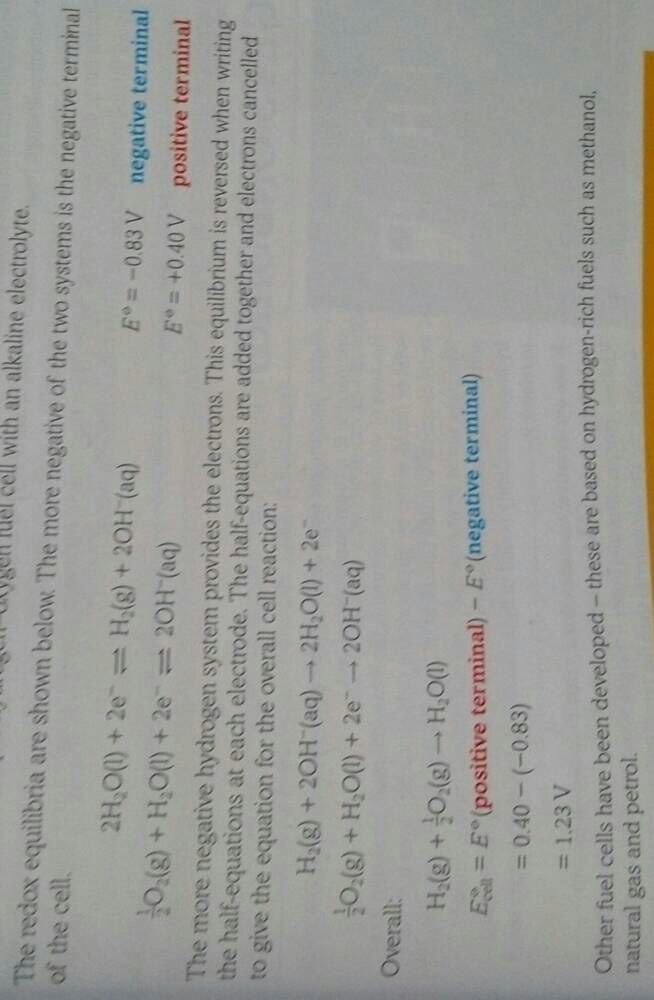
Fuel cells do not have to be recharged - 19Explain a simple hydrogen-oxygen fuel cell with an alkaline electrolyte
Informações
- Descrição
- A short summary of standard Electrodes
- Criado por
- Kellie Mayes-Barwick
- Visualizações
- 29
- Tags
- Avaliação