
Fluxograma
Sem título
Conteúdo do fluxograma
Proteins perform most of the cell’s functions…
±1- They serve as building blocks for cell structures
±2-They form the enzymes that catalyze the cell’s chemical reactions.
±3- They regulate the activity of genes
±4- They enable cells to move and communicate with one another.
A molecule of DNA consists of two long polynucleotide chains.
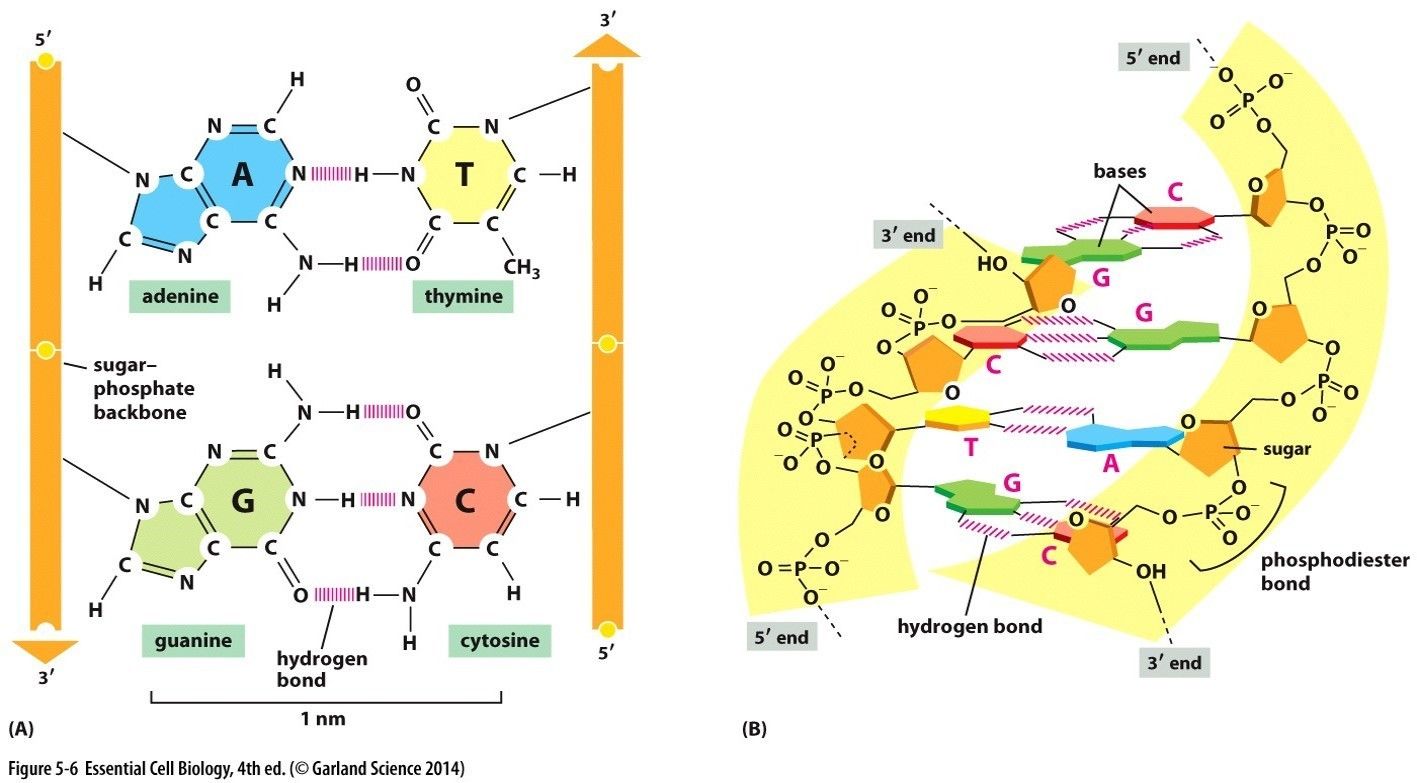
Each chain, or strand, is composed of four types of nucleotide subunits, and the two strands are held together by hydrogen bonds between the base portions of the nucleotides
NUCLEOTIDES
Composed of a nitrogen-containing base and a five-carbon sugar, to which is attached one or more phosphate groups.
•A DNA Molecule Consists of Two Complementary Chains of Nucleotides
The two polynucleotide chains in the DNA double helix are held together by hydrogen-bonding between the bases on the different strands
NUCLEOTIDES IN DNA
mmm
The nucleotides are covalently linked together in a chain through the sugars and phosphates, which form a backbone of alternating sugar–phosphate–sugar–phosphate.
The sugar is deoxyribose, and the base can be either adenine (A), cytosine (C), guanine (G), or thymine (T)
Why must the two DNA strands run in opposite directions (anti-parallel)?
All the bases are on the inside of the double helix, with the sugar–phosphate backbones on the outside
The strands run antiparallel so that they are oriented with opposite polarities (where each phosphate is found)
If the strands were to run parallel to each other, the nucleotides would be further away from each other, and because they would be, hydrogen bonds could not form between the nitrogen-containing bases
Also, the phosphates would be closer to each other, WHICH THEY RESIST BECAUSE THEY ARE NEGATIVELY CHARGED!!!!
Why do hydrogen bonds form so easily between NH groups of the nitrogen containing bases?
Because nitrogen atoms are very electronegative and have lone pairs of electrons
As a result, they can easily form hydrogen bonds with the hydrogen atoms on side-by-side NH’s
Informações
- Descrição
- Fluxograma sobre Sem título, criado por David Gonzales em 05-12-2018.
- Criado por
- David Gonzales
- Visualizações
- 0
- Avaliação