
Fluxograma
Needs analysis
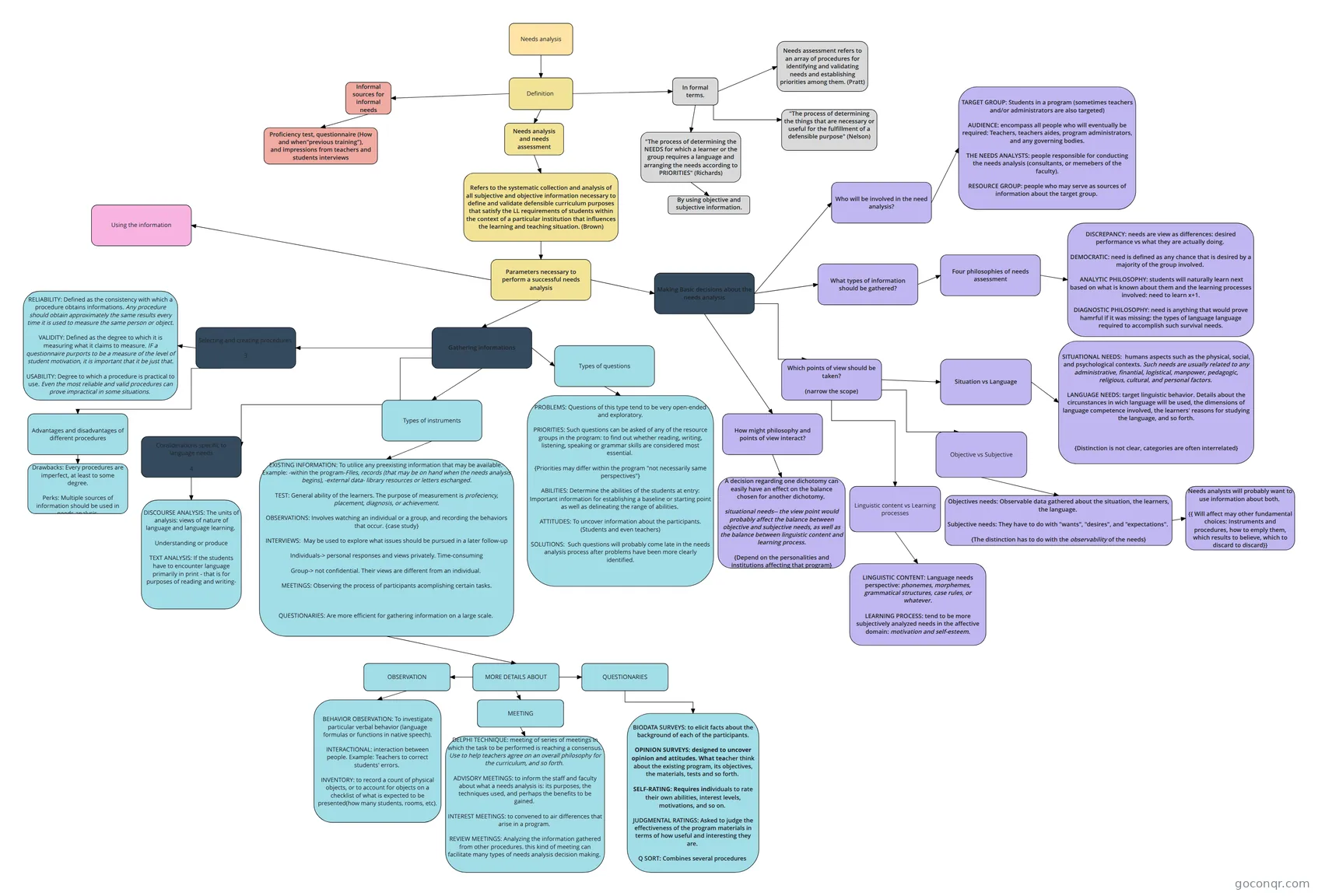
Flowchart: needs analysis in language teaching
Conteúdo do fluxograma
Needs analysis
Definition
In formal terms.
Informal sources for informal needs
Proficiency test, questionnaire (How and when"previous training"), and impressions from teachers and students interviews
"The process of determining the NEEDS for which a learner or the group requires a language and arranging the needs according to PRIORITIES" (Richards)
Needs assessment refers to an array of procedures for identifying and validating needs and establishing priorities among them. (Pratt)
By using objective and subjective information.
"The process of determining the things that are necessary or useful for the fulfillment of a defensible purpose" (Nelson)
Needs analysis and needs assessment
Refers to the systematic collection and analysis of all subjective and objective information necessary to define and validate defensible curriculum purposes that satisfy the LL requirements of students within the context of a particular institution that influences the learning and teaching situation. (Brown)
Parameters necessary to perform a successful needs analysis
Making Basic decisions about the needs analysis
Using the information
Gathering informations
Who will be involved in the need analysis?
What types of information should be gathered?
How might philosophy and points of view interact?
Which points of view should be taken?
(narrow the scope)
Types of questions
Types of instruments
Selecting and creating procedures
3
Considerations specific to language needs
4
TARGET GROUP: Students in a program (sometimes teachers and/or administrators are also targeted)
AUDIENCE: encompass all people who will eventually be required: Teachers, teachers aides, program administrators, and any governing bodies.
THE NEEDS ANALYSTS: people responsible for conducting the needs analysis (consultants, or memebers of the faculty).
RESOURCE GROUP: people who may serve as sources of information about the target group.
Four philosophies of needs assessment
DISCREPANCY: needs are view as differences: desired performance vs what they are actually doing.
DEMOCRATIC: need is defined as any chance that is desired by a majority of the group involved.
ANALYTIC PHILOSOPHY: students will naturally learn next based on what is known about them and the learning processes involved: need to learn x+1.
DIAGNOSTIC PHILOSOPHY: need is anything that would prove hamrful if it was missing: the types of language language required to accomplish such survival needs.
Situation vs Language
Objective vs Subjective
Linguistic content vs Learning processes
SITUATIONAL NEEDS: humans aspects such as the physical, social, and psychological contexts. Such needs are usually related to any administrative, finantial, logistical, manpower, pedagogic, religious, cultural, and personal factors.
LANGUAGE NEEDS: target linguistic behavior. Details about the circunstances in wich language will be used, the dimensions of language competence involved, the learners' reasons for studying the language, and so forth.
{Distinction is not clear, categories are often interrelated}
Objectives needs: Observable data gathered about the situation, the learners, the language.
Subjective needs: They have to do with "wants", "desires", and "expectations".
{The distinction has to do with the observability of the needs}
Needs analysts will probably want to use information about both.
{{ Will affect may other fundamental choices: Instruments and procedures, how to emply them, which results to believe, which to discard to discard}}
LINGUISTIC CONTENT: Language needs perspective: phonemes, morphemes, grammatical structures, case rules, or whatever.
LEARNING PROCESS: tend to be more subjectively analyzed needs in the affective domain: motivation and self-esteem.
A decision regarding one dichotomy can easily have an effect on the balance chosen for another dichotomy.
situational needs-- the view point would probably affect the balance between objective and subjective needs, as well as the balance between linguistic content and learning process.
{Depend on the personalities and institutions affecting that program}
PROBLEMS: Questions of this type tend to be very open-ended and exploratory.
PRIORITIES: Such questions can be asked of any of the resource groups in the program: to find out whether reading, writing, listening, speaking or grammar skills are considered most essential.
{Priorities may differ within the program "not necessarily same perspectives"}
ABILITIES: Determine the abilities of the students at entry: Important information for establishing a baseline or starting point as well as delineating the range of abilities.
ATTITUDES: To uncover information about the participants. (Students and even teachers)
SOLUTIONS: Such questions will probably come late in the needs analysis process after problems have been more clearly identified.
EXISTING INFORMATION: To utilice any preexisting information that may be available. Example: -within the program-FIles, records (that may be on hand when the needs analysis begins), -external data- library resources or letters eschanged.
TEST: General ability of the learners. The purpose of measurement is profeciency, placement, diagnosis, or achievement.
OBSERVATIONS: Involves watching an individual or a group, and recording the behaviors that occur. {case study}
INTERVIEWS: May be used to explore what issues should be pursued in a later follow-up
Individuals-> personal responses and views privately. Time-consuming
Group-> not confidential. Their views are different from an individual.
MEETINGS: Observing the process of participants acomplishing certain tasks.
QUESTIONARIES: Are more efficient for gathering information on a large scale.
MORE DETAILS ABOUT
MEETING
OBSERVATION
BEHAVIOR OBSERVATION: To investigate particular verbal behavior (language formulas or functions in native speech).
INTERACTIONAL: interaction between people. Example: Teachers to correct students' errors.
INVENTORY: to record a count of physical objects, or to account for objects on a checklist of what is expected to be presented(how many students, rooms, etc).
DELPHI TECHNIQUE: meeting of series of meetings in which the task to be performed is reaching a consensus. Use to help teachers agree on an overall philosophy for the curriculum, and so forth.
ADVISORY MEETINGS: to inform the staff and faculty about what a needs analysis is: its purposes, the techniques used, and perhaps the benefits to be gained.
INTEREST MEETINGS: to convened to air differences that arise in a program.
REVIEW MEETINGS: Analyzing the information gathered from other procedures. this kind of meeting can facilitate many types of needs analysis decision making.
BIODATA SURVEYS: to elicit facts about the background of each of the participants.
OPINION SURVEYS: designed to uncover opinion and attitudes. What teacher think about the existing program, its objectives, the materials, tests and so forth.
SELF-RATING: Requires individuals to rate their own abilities, interest levels, motivations, and so on.
JUDGMENTAL RATINGS: Asked to judge the effectiveness of the program materials in terms of how useful and interesting they are.
Q SORT: Combines several procedures
QUESTIONARIES
RELIABILITY: Defined as the consistency with which a procedure obtains informations. Any procedure should obtain approximately the same results every time it is used to measure the same person or object.
VALIDITY: Defined as the degree to which it is measuring what it claims to measure. IF a questionnaire purports to be a measure of the level of student motivation, it is important that it be just that.
USABILITY: Degree to which a procedure is practical to use. Even the most reliable and valid procedures can prove impractical in some situations.
Advantages and disadvantages of different procedures
Drawbacks: Every procedures are imperfect, at least to some degree.
Perks: Multiple sources of information should be used in needs analysis.
DISCOURSE ANALYSIS: The units of analysis: views of nature of language and language learning.
Understanding or produce
TEXT ANALYSIS: If the students have to encounter language primarily in print - that is for purposes of reading and writing-