
Fluxograma
Topic 6
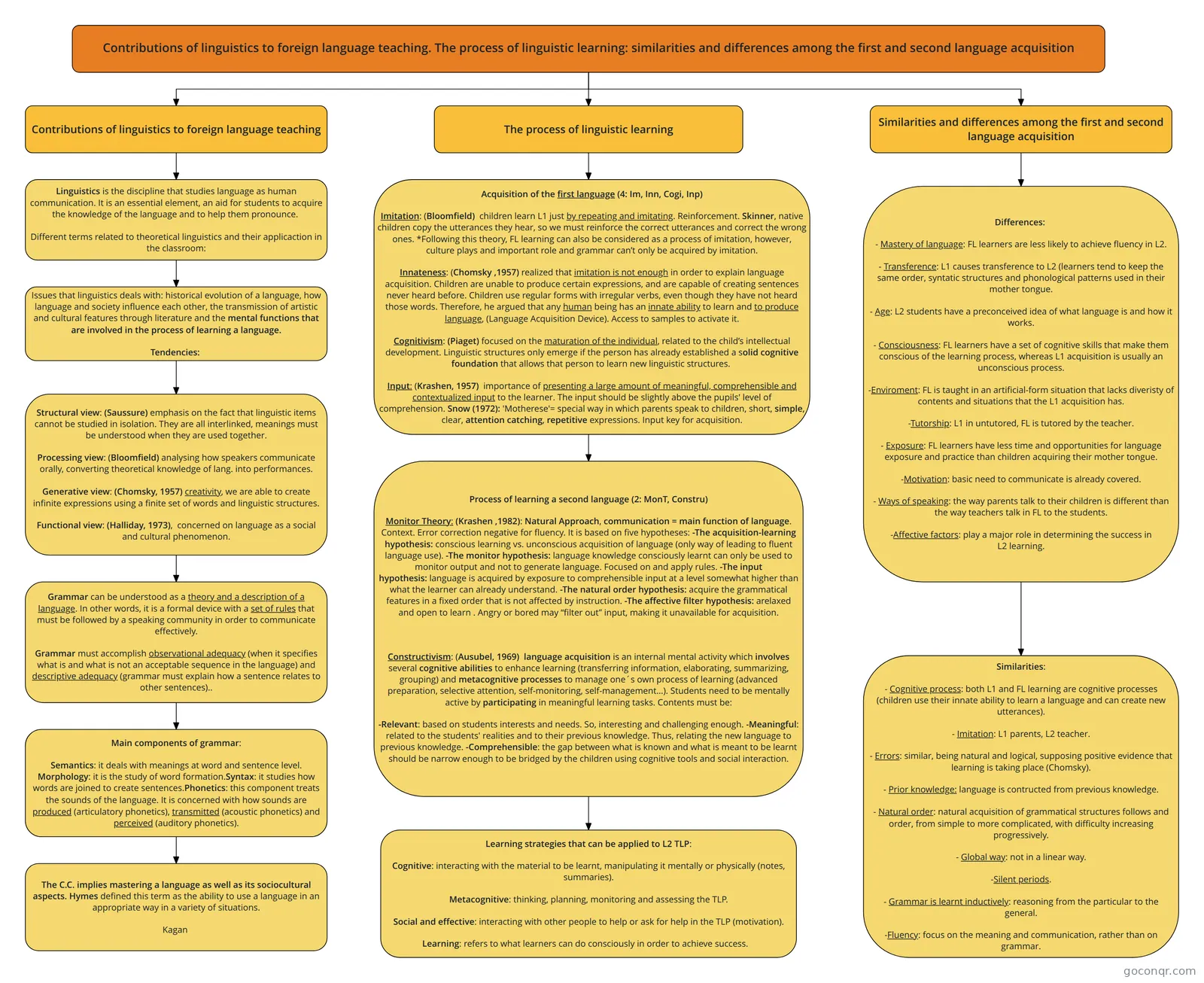
Flowchart: linguistics and L2 learning
Conteúdo do fluxograma
Contributions of linguistics to foreign language teaching. The process of linguistic learning: similarities and differences among the first and second language acquisition
Contributions of linguistics to foreign language teaching
Learning strategies that can be applied to L2 TLP:
Cognitive: interacting with the material to be learnt, manipulating it mentally or physically (notes, summaries).
Metacognitive: thinking, planning, monitoring and assessing the TLP.
Social and effective: interacting with other people to help or ask for help in the TLP (motivation).
Learning: refers to what learners can do consciously in order to achieve success.
Differences:
- Mastery of language: FL learners are less likely to achieve fluency in L2.
- Transference: L1 causes transference to L2 (learners tend to keep the same order, syntatic structures and phonological patterns used in their mother tongue.
- Age: L2 students have a preconceived idea of what language is and how it works.
- Consciousness: FL learners have a set of cognitive skills that make them conscious of the learning process, whereas L1 acquisition is usually an unconscious process.
-Enviroment: FL is taught in an artificial-form situation that lacks diveristy of contents and situations that the L1 acquisition has.
-Tutorship: L1 in untutored, FL is tutored by the teacher.
- Exposure: FL learners have less time and opportunities for language exposure and practice than children acquiring their mother tongue.
-Motivation: basic need to communicate is already covered.
- Ways of speaking: the way parents talk to their children is different than the way teachers talk in FL to the students.
-Affective factors: play a major role in determining the success in L2 learning.
Similarities:
- Cognitive process: both L1 and FL learning are cognitive processes (children use their innate ability to learn a language and can create new utterances).
- Imitation: L1 parents, L2 teacher.
- Errors: similar, being natural and logical, supposing positive evidence that learning is taking place (Chomsky).
- Prior knowledge: language is contructed from previous knowledge.
- Natural order: natural acquisition of grammatical structures follows and order, from simple to more complicated, with difficulty increasing progressively.
- Global way: not in a linear way.
-Silent periods.
- Grammar is learnt inductively: reasoning from the particular to the general.
-Fluency: focus on the meaning and communication, rather than on grammar.
Linguistics is the discipline that studies language as human communication. It is an essential element, an aid for students to acquire the knowledge of the language and to help them pronounce.
Different terms related to theoretical linguistics and their applicaction in the classroom:
Issues that linguistics deals with: historical evolution of a language, how language and society influence each other, the transmission of artistic and cultural features through literature and the mental functions that are involved in the process of learning a language.
Tendencies:
The C.C. implies mastering a language as well as its sociocultural aspects. Hymes defined this term as the ability to use a language in an appropriate way in a variety of situations.
Kagan
The process of linguistic learning
Acquisition of the first language (4: Im, Inn, Cogi, Inp)
Imitation: (Bloomfield) children learn L1 just by repeating and imitating. Reinforcement. Skinner, native children copy the utterances they hear, so we must reinforce the correct utterances and correct the wrong ones. *Following this theory, FL learning can also be considered as a process of imitation, however, culture plays and important role and grammar can’t only be acquired by imitation.
Innateness: (Chomsky ,1957) realized that imitation is not enough in order to explain language acquisition. Children are unable to produce certain expressions, and are capable of creating sentences never heard before. Children use regular forms with irregular verbs, even though they have not heard those words. Therefore, he argued that any human being has an innate ability to learn and to produce language, (Language Acquisition Device). Access to samples to activate it.
Cognitivism: (Piaget) focused on the maturation of the individual, related to the child’s intellectual development. Linguistic structures only emerge if the person has already established a solid cognitive foundation that allows that person to learn new linguistic structures.
Input: (Krashen, 1957) importance of presenting a large amount of meaningful, comprehensible and contextualized input to the learner. The input should be slightly above the pupils' level of comprehension. Snow (1972): 'Motherese'= special way in which parents speak to children, short, simple, clear, attention catching, repetitive ecpressions. Input key for acquisition.
Process of learning a second language (2: MonT, Constru)
Monitor Theory: (Krashen ,1982): Natural Approach, communication = main function of language. Context. Error correction negative for fluency. It is based on five hypotheses:
-The acquisition-learning hypothesis: conscious learning vs. unconscious acquisition of language (only way of leading to fluent language use).
-The monitor hypothesis: language knowledge consciously learnt can only be used to monitor output and not to generate language. Focused on and apply rules.
-The input hypothesis: language is acquired by exposure to comprehensible input at a level somewhat higher than what the learner can already understand.
-The natural order hypothesis: acquire the grammatical features in a fixed order that is not affected by instruction.
-The affective filter hypothesis: arelaxed and open to learn . Angry or bored may “filter out” input, making it unavailable for acquisition.
Constructivism: (Ausubel, 1969) language acquisition is an internal mental activity which involves several cognitive abilities to enhance learning (transferring information, elaborating, summarizing, grouping) and metacognitive processes to manage one´s own process of learning (advanced preparation, selective attention, self-monitoring, self-management…). Students need to be mentally active by participating in meaningful learning tasks. Contents must be:
-Relevant: based on students interests and needs. So, interesting and challenging enough.
-Meaningful: related to the students' realities and to their previous knowledge. Thus, relating the new language to previous knowledge.
-Comprehensible: the gap between what is known and what is meant to be learnt should be narrow enough to be bridged by the children using cognitive tools and social interaction.
Similarities and differences among the first and second language acquisition
Grammar can be understood as a theory and a description of a language. In other words, it is a formal device with a set of rules that must be followed by a speaking community in order to communicate effectively.
Grammar must accomplish observational adequacy (when it specifies what is and what is not an acceptable sequence in the language) and descriptive adequacy (grammar must explain how a sentence relates to other sentences)..
Structural view: (Saussure) emphasis on the fact that linguistic items cannot be studied in isolation. They are all interlinked, meanings must be understood when they are used together.
Processing view: (Bloomfield) analysing how speakers communicate orally, converting theoretical knowledge of lang. into performances.
Generative view: (Chomsky, 1957) creativity, we are able to create infinite expressions using a finite set of words and linguistic structures.
Functional view: (Halliday, 1973), concerned on language as a social and cultural phenomenon.
Main components of grammar:
Semantics: it deals with meanings at word and sentence level.Morphology: it is the study of word formation.Syntax: it studies how words are joined to create sentences.Phonetics: this component treats the sounds of the language. It is concerned with how sounds are produced (articulatory phonetics), transmitted (acoustic phonetics) and perceived (auditory phonetics).
Acquisition of the first language (4: Im, Inn, Cogi, Inp)
Imitation: (Bloomfield) children learn L1 just by repeating and imitating. Reinforcement. Skinner, native children copy the utterances they hear, so we must reinforce the correct utterances and correct the wrong ones. *Following this theory, FL learning can also be considered as a process of imitation, however, culture plays and important role and grammar can’t only be acquired by imitation.
Innateness: (Chomsky ,1957) realized that imitation is not enough in order to explain language acquisition. Children are unable to produce certain expressions, and are capable of creating sentences never heard before. Children use regular forms with irregular verbs, even though they have not heard those words. Therefore, he argued that any human being has an innate ability to learn and to produce language, (Language Acquisition Device). Access to samples to activate it.
Cognitivism: (Piaget) focused on the maturation of the individual, related to the child’s intellectual development. Linguistic structures only emerge if the person has already established a solid cognitive foundation that allows that person to learn new linguistic structures.
Input: (Krashen, 1957) importance of presenting a large amount of meaningful, comprehensible and contextualized input to the learner. The input should be slightly above the pupils' level of comprehension. Snow (1972): 'Motherese'= special way in which parents speak to children, short, simple, clear, attention catching, repetitive expressions. Input key for acquisition.
Process of learning a second language (2: MonT, Constru)
Monitor Theory: (Krashen ,1982): Natural Approach, communication = main function of language. Context. Error correction negative for fluency. It is based on five hypotheses: -The acquisition-learning hypothesis: conscious learning vs. unconscious acquisition of language (only way of leading to fluent language use). -The monitor hypothesis: language knowledge consciously learnt can only be used to monitor output and not to generate language. Focused on and apply rules. -The input hypothesis: language is acquired by exposure to comprehensible input at a level somewhat higher than what the learner can already understand. -The natural order hypothesis: acquire the grammatical features in a fixed order that is not affected by instruction. -The affective filter hypothesis: arelaxed and open to learn . Angry or bored may “filter out” input, making it unavailable for acquisition.
Constructivism: (Ausubel, 1969) language acquisition is an internal mental activity which involves several cognitive abilities to enhance learning (transferring information, elaborating, summarizing, grouping) and metacognitive processes to manage one´s own process of learning (advanced preparation, selective attention, self-monitoring, self-management…). Students need to be mentally active by participating in meaningful learning tasks. Contents must be:
-Relevant: based on students interests and needs. So, interesting and challenging enough. -Meaningful: related to the students' realities and to their previous knowledge. Thus, relating the new language to previous knowledge. -Comprehensible: the gap between what is known and what is meant to be learnt should be narrow enough to be bridged by the children using cognitive tools and social interaction.
Informações
- Descrição
- Fluxograma sobre Topic 6, criado por Emma Atkinson em 04-10-2021.
- Criado por
- Emma Atkinson
- Visualizações
- 1
- Avaliação