
Mapa mental
What are Human Rights?
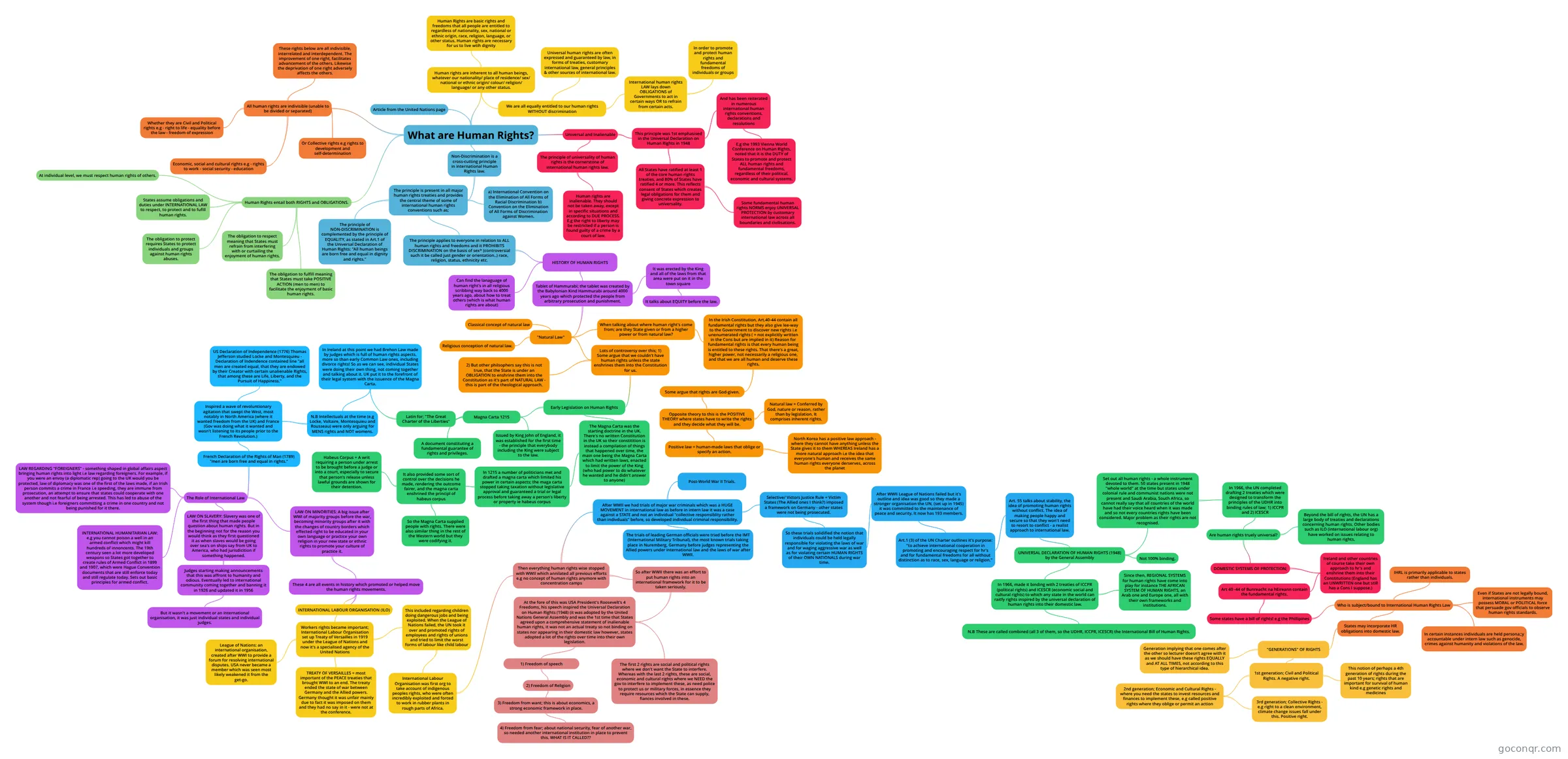
Mind map: Human rights
Conteúdo do mapa
What are Human Rights?
Article from the United Nations page
Human rights are inherent to all human beings, whatever our nationality/ place of residence/ sex/ national or ethnic origin/ colour/ religion/ language/ or any other status.
- We are all equally entitled to our human rights WITHOUT discrimination
- Universal human rights are often expressed and guaranteed by law, in forms of treaties, customary international law, general principles & other sources of international law.
- International human rights LAW lays down OBLIGATIONS of Governments to act in certain ways OR to refrain from certain acts.
- In order to promote and protect human rights and fundamental freedoms of individuals or groups
- Human Rights are basic rights and freedoms that all people are entitled to regardless of nationality, sex, national or ethnic origin, race, religion, language, or other status. Human rights are necessary for us to live wtih dignity
- We are all equally entitled to our human rights WITHOUT discrimination
Universal and Inalienable
- The principle of universality of human rights is the cornerstone of international human rights law.
- Human rights are inalienable. They should not be taken away, except in specific situations and according to DUE PROCESS. E.g the right to liberty may be restricted if a person is found guilty of a crime by a court of law.
- This principle was 1st emphasised in the Universal Declaration on Human Rights in 1948
- And has been reiterated in numerous international human rights conventions, declarations and resolutions
- E.g the 1993 Vienna World Conference on Human Rights, noted that it is the DUTY of States to promote and protect ALL human rights and fundamental freedoms, regardless of their political, economic and cultural systems.
- All States have ratified at least 1 of the core human rights treaties, and 80% of States have ratified 4 or more. This reflects consent of States which creates legal obligations for them and giving concrete expression to universality.
- Some fundamental human rights NORMS enjoy UNIVERSAL PROTECTION by customary international law across all boundaries and civilisations.
- And has been reiterated in numerous international human rights conventions, declarations and resolutions
- The principle of universality of human rights is the cornerstone of international human rights law.
Non-Discrimination is a cross-cutting principle in international Human Rights law.
- The principle is present in all major human rights treaties and provides the central theme of some of international human rights conventions such as;
- a) International Convention on the Elimination of All Forms of Racial Discrimination b) Convention on the Elimination of All Forms of Discrimination against Women.
- The principle applies to everyone in relation to ALL human rights and freedoms and it PROHIBITS DISCRIMINATION on the basis of sex* (controversial such it be called just gender or orientation..) race, religion, status, ethnicity etc.
- HISTORY OF HUMAN RIGHTS
- Tablet of Hammurabi; the tablet was created by the Babylonian Kind Hammurabi around 4000 years ago which protected the people from arbitrary prosecution and punishment.
- It was erected by the King and all of the laws from that area were put on it in the town square
- It talks about EQUITY before the law.
- "Natural Law"
- Classical concept of natural law
- Religious conception of natural law.
- When talking about where human right's come from; are they State given or from a higher power or from natural law?
- In the Irish Constitution, Art.40-44 contain all fundamental rights but they also give lee-way to the Government to discover new rights i.e unenumerated rights ( = not explicitly written in the Cons but are implied in it) Reason for fundamental rights is that every human being is entitled to these rights. That there's a great, higher power, not necessarily a religious one, and that we are all human and deserve these rights.
- Some argue that rights are God-given.
- Opposite theory to this is the POSITIVE THEORY where states have to write the rights and they decide what they will be.
- Positive law = human-made laws that oblige or specify an action.
- North Korea has a positive law approach - where they cannot have anything unless the State gives it to them WHEREAS Ireland has a more natural approach i.e the idea that everyone's human and receives the same human rights everyone derserves, across the planet
- Natural law = Conferred by God, nature or reason, rather than by legislation. It comprises inherent rights.
- Positive law = human-made laws that oblige or specify an action.
- Opposite theory to this is the POSITIVE THEORY where states have to write the rights and they decide what they will be.
- Some argue that rights are God-given.
- In the Irish Constitution, Art.40-44 contain all fundamental rights but they also give lee-way to the Government to discover new rights i.e unenumerated rights ( = not explicitly written in the Cons but are implied in it) Reason for fundamental rights is that every human being is entitled to these rights. That there's a great, higher power, not necessarily a religious one, and that we are all human and deserve these rights.
- Lots of controversy over this; 1) Some argue that we couldn't have human rights unless the state enshrines them into the Constitution for us.
- 2) But other philsophers say this is not true, that the State is under an OBLIGATION to enshrine them into the Constitution as it's part of NATURAL LAW - this is part of the theological approach.
- Early Legislation on Human Rights
- Magna Carta 1215
- A document constituting a fundamental guarantee of rights and privileges.
- Issued by King John of England, it was established for the first time - the principle that everybody including the King were subject to the law.
- Latin for; "The Great Charter of the Liberties"
- In Ireland at this point we had Brehon Law made by judges which is full of human rights aspects, more so than early Common Law ones, including divorce rights! So as we can see, individual States were doing their own thing, not coming together and talking about it. UK put it to the forefront of their legal system with the issuence of the Magna Carta.
- N.B Intellectuals at the time (e.g Locke, Voltaire, Montesquieu and Rousseau) were only arguing for MENS rights and NOT womens.
- Inspired a wave of revoluntionary agitation that swept the West, most notably in North America (where it wanted freedom from the UK) and France (Gov was doing what it wanted and wasn't listening to its people prior to the French Revolution.)
- US Declaration of Independence (1776) Thomas Jefferson studied Locke and Montesquieu - Declaration of Indendence contained line "all men are created equal, that they are endowed by their Creator with certain unalienable Rights, that among these are Life, Liberty, and the Pursuit of Happiness."
- French Declaration of the Rights of Man (1789) "men are born free and equal in rights."
- The Role of International Law
- LAW REGARDING "FOREIGNERS" - something shaped in global affairs aspect bringing human rights into light i.e law regarding foreigners. For example, if you were an envoy (a diplomatic rep) going to the UK would you be protected, law of diplomacy was one of the first of the laws made, if an Irish person commits a crime in France i.e speeding, they are immune from prosecution, an attempt to ensure that states could cooperate with one another and not fearful of being arrested. This has led to abuse of the system though i.e foreigners committing a crime in one country and not being punished for it there.
- INTERNATIONAL HUMANITARIAN LAW: e.g you cannot poison a well in an armed conflict which might kill hundreds of innoncents. The 19th century seen a lot more developed weapons so States got together to create rules of Armed Conflict in 1899 and 1907, which were Hague Convention documents that are still enforce today and still regulate today. Sets out basic principles for armed conflict.
- LAW ON SLAVERY: Slavery was one of the first thing that made people question about human rights. But in the beginning not for the reason you would think as they first questioned it as when slaves would be going over sea's on ships say from UK to America, who had jurisdicition if something happened.
- Judges starting making announcements that this was affront to humanity and odious. Eventually led to international community coming together and banning it in 1926 and updated it in 1956
- But it wasn't a movement or an international organisation, it was just individual states and individual judges.
- Judges starting making announcements that this was affront to humanity and odious. Eventually led to international community coming together and banning it in 1926 and updated it in 1956
- LAW ON MINORITIES: A big issue after WWI of majority groups before the war, becoming minority groups after it with the changes of country borders which effected right to be educated in your own language or practice your own religion in your new state or ethnic rights to promote your culture of practice it.
- These 4 are all events in history which promoted or helped move the human rights movements.
- Workers rights became important; International Labour Organisation set up Treaty of Versailles in 1919 under the League of Nations and now it's a specialised agency of the United Nations
- League of Nations: an international organisation, created after WWI to provide a forum for resolving international disputes. USA never became a member which was seen most likely weakened it from the get-go.
- TREATY OF VERSAILLES = most important of the PEACE treaties that brought WWI to an end. The treaty ended the state of war between Germany and the Allied powers. Germany thought it was unfair mainly due to fact it was imposed on them and they had no say in it - were not at the conference.
- This included regarding children doing dangerous jobs and being exploited. When the League of Nations failed, the UN took it over and promoted rights of employees and rights of unions and tried to limit the worst forms of labour like child labour
- International Labour Organisation was first org to take account of indigenous peoples rights, who were often incredibly exploited and forced to work in rubber plants in rough parts of Africa.
- Then everything human rights wise stopped with WWII which annilated all previous efforts e.g no concept of human rights anymore with concentration camps
- So after WWII there was an effort to put human rights into an international framework for it to be taken seriously.
- At the fore of this was USA President's Roosevelt's 4 Freedoms, his speech inspired the Universal Declaration on Human Rights (1948) (it was adopted by the United Nations General Assembly and was the 1st time that States agreed upon a comprehensive statement of inalienable human rights, it was not an actual treaty so not binding on states nor appearing in their domestic law however, states adopted a lot of the rights over time into their own legislation.
- 1) Freedom of speech
- 2) Freedom of Religion
- 3) Freedom from want; this is about economics, a strong economic framework in place.
- 4) Freedom from fear; about national security, fear of another war, so needed another international institution in place to prevent this. WHAT IS IT CALLED??
- 3) Freedom from want; this is about economics, a strong economic framework in place.
- 2) Freedom of Religion
- The first 2 rights are social and political rights where we don't want the State to interfere. Whereas with the last 2 rights, these are social, economic and cultural rights where we NEED the gov to interfere to implement these, as need police to protect us or military forces, in essence they require resources which the State can supply, fiances involved in these.
- 1) Freedom of speech
- At the fore of this was USA President's Roosevelt's 4 Freedoms, his speech inspired the Universal Declaration on Human Rights (1948) (it was adopted by the United Nations General Assembly and was the 1st time that States agreed upon a comprehensive statement of inalienable human rights, it was not an actual treaty so not binding on states nor appearing in their domestic law however, states adopted a lot of the rights over time into their own legislation.
- After WWII we had trials of major war criminals which was a HUGE MOVEMENT in international law as before in intern law it was a case against a STATE and not an individual "collective responsiblity rather than indivduals" before, so developed individual criminal responsibility.
- Post-World War II Trials.
- The trials of leading German officials were tried before the IMT (International Military Tribunal), the most known trials taking place in Nuremberg, Germany before judges representing the Allied powers under international law and the laws of war after WWII.
- Selective/ Victors Justice Rule = Victim States (The Allied ones I think?) imposed a framework on Germany - other states were not being prosecuted.
- So these trials solidified the notion that individuals could be held legally responsible for violating the laws of war and for waging aggressive war as well as for violating certain HUMAN RIGHTS of their OWN NATIONALS during war time.
- After WWII League of Nations failed but it's outline and idea was good so they made a stronger organisation the UN, (set up in 1945) it was committed to the maintenance of peace and security. It now has 193 members.
- Art.1 (3) of the UN Charter outlines it's purpose: "to achieve international cooperation in promoting and encouraging respect for hr's and for fundamental freedoms for all without distinction as to race, sex, language or religion."
- Art. 55 talks about stability, the idea of promoting human rights without conflict. The idea of making people happy and secure so that they won't need to resort to conflict - a realist approach to international law.
- UNIVERSAL DECLARATION OF HUMAN RIGHTS (1948) by the General Assembly
- Set out all human rights - a whole instrument devoted to them. 50 states present in 1948 "whole world" at the time but states under colonial rule and communist nations were not present and Saudi Arabia, South Africa, so cannot really say that all countries of the world have had their voice heard when it was made and so not every countries rights have been considered. Major problem as their rights are not recognised.
- In 1966, the UN completed drafting 2 treaties which were designed to transform the principles of the UDHR into binding rules of law; 1) ICCPR and 2) ICESCR
- Are human rights truely universal?
- DOMESTIC SYSTEMS OF PROTECTION;
- Ireland and other countries of course take their own approach to hr's and enshrine them into their Constitutions (England has an UNWRITTEN one but still has a Cons I suppose.)
- Art 40 -44 of Bunreacht na hEireann contain the fundamental rights.
- Some states have a bill of rights! e.g the Phillipines
- Who is subject/bound to International Human Rights Law
- IHRL is primarily applicable to states rather than individuals.
- Even if States are not legally bound, international instruments may possess MORAL or POLITICAL force that persuade gov officials to observe human rights standards.
- States may incorporate HR obligations into domestic law.
- "GENERATIONS" OF RIGHTS
- 1st generation; Civil and Political Rights. A negative right.
- 2nd generation; Economic and Cultural Rights - where you need the states to invest resources and finances to implement these, e.g called positive rights where they oblige or permit an action
- 3rd generation; Collective Rights - e.g right to a clean environment, climate change issues fall under this. Positive right.
- This notion of perhaps a 4th generation of rights during the past 10 years; rights that are important for survival of human kind e.g genetic rights and medicines
- 2nd generation; Economic and Cultural Rights - where you need the states to invest resources and finances to implement these, e.g called positive rights where they oblige or permit an action
- Generation implying that one comes after the other so lecturer doesn't agree with it as we should have these rights EQUALLY and AT ALL TIMES, not according to this type of hierarchical idea.
- 1st generation; Civil and Political Rights. A negative right.
- "GENERATIONS" OF RIGHTS
- In certain instances individuals are held persona;;y accountable under intern law such as genocide, crimes against humanity and violations of the law.
- Who is subject/bound to International Human Rights Law
- Some states have a bill of rights! e.g the Phillipines
- Art 40 -44 of Bunreacht na hEireann contain the fundamental rights.
- Ireland and other countries of course take their own approach to hr's and enshrine them into their Constitutions (England has an UNWRITTEN one but still has a Cons I suppose.)
- Beyond the bill of rights, the UN has a large body of treaties and declarations concerning human rights. Other bodies such as ILO (international labour org) have worked on issues relating to human rights.
- DOMESTIC SYSTEMS OF PROTECTION;
- Are human rights truely universal?
- In 1966, the UN completed drafting 2 treaties which were designed to transform the principles of the UDHR into binding rules of law; 1) ICCPR and 2) ICESCR
- Not 100% binding.
- In 1966, made it binding with 2 treaties of ICCPR (political rights) and ICESCR (economic social and cultural rights) to which any state in the world can raitfy rights inspired by the universal declaration of human rights into their domestic law.
- Since then, REGIONAL SYSTEMS for human rights have come into play for instance THE AFRICAN SYSTEM OF HUMAN RIGHTS, an Arab one and Europe one, all with their own frameworks and institutions.
- N.B These are called combined (all 3 of them, so the UDHR, ICCPR, ICESCR) the International Bill of Human Rights.
- Set out all human rights - a whole instrument devoted to them. 50 states present in 1948 "whole world" at the time but states under colonial rule and communist nations were not present and Saudi Arabia, South Africa, so cannot really say that all countries of the world have had their voice heard when it was made and so not every countries rights have been considered. Major problem as their rights are not recognised.
- UNIVERSAL DECLARATION OF HUMAN RIGHTS (1948) by the General Assembly
- Art. 55 talks about stability, the idea of promoting human rights without conflict. The idea of making people happy and secure so that they won't need to resort to conflict - a realist approach to international law.
- Art.1 (3) of the UN Charter outlines it's purpose: "to achieve international cooperation in promoting and encouraging respect for hr's and for fundamental freedoms for all without distinction as to race, sex, language or religion."
- After WWII League of Nations failed but it's outline and idea was good so they made a stronger organisation the UN, (set up in 1945) it was committed to the maintenance of peace and security. It now has 193 members.
- So these trials solidified the notion that individuals could be held legally responsible for violating the laws of war and for waging aggressive war as well as for violating certain HUMAN RIGHTS of their OWN NATIONALS during war time.
- So after WWII there was an effort to put human rights into an international framework for it to be taken seriously.
- Then everything human rights wise stopped with WWII which annilated all previous efforts e.g no concept of human rights anymore with concentration camps
- International Labour Organisation was first org to take account of indigenous peoples rights, who were often incredibly exploited and forced to work in rubber plants in rough parts of Africa.
- INTERNATIONAL LABOUR ORGANISATION (ILO)
- Workers rights became important; International Labour Organisation set up Treaty of Versailles in 1919 under the League of Nations and now it's a specialised agency of the United Nations
- These 4 are all events in history which promoted or helped move the human rights movements.
- The Role of International Law
- Inspired a wave of revoluntionary agitation that swept the West, most notably in North America (where it wanted freedom from the UK) and France (Gov was doing what it wanted and wasn't listening to its people prior to the French Revolution.)
- N.B Intellectuals at the time (e.g Locke, Voltaire, Montesquieu and Rousseau) were only arguing for MENS rights and NOT womens.
- In Ireland at this point we had Brehon Law made by judges which is full of human rights aspects, more so than early Common Law ones, including divorce rights! So as we can see, individual States were doing their own thing, not coming together and talking about it. UK put it to the forefront of their legal system with the issuence of the Magna Carta.
- The Magna Carta was the starting doctrine in the UK. There's no written Constitution in the UK so their constitition is instead a compilation of things that happened over time, the main one being the Magna Carta which had written laws, enacted to limit the power of the King (who had power to do whatever he wanted and he didn't answer to anyone)
- In 1215 a number of politicians met and drafted a magna carta which limited his power in certain aspects; the maga carta stopped taking taxation without legislative approval and guaranteed a trial or legal process before taking away a person's liberty or property ie habeus corpus
- It also provided some sort of control over the decisions he made, rendering the outcome fairer, and the magna carta enshrined the principl of habeus corpus
- Habeus Corpus = A writ requiring a person under arrest to be brought before a judge or into a court, especially to secure that person's release unless lawful grounds are shown for their detention.
- So the Magna Carta supplied people with rights. There were also similar thing in the rest of the Western world but they were codifying it.
- It also provided some sort of control over the decisions he made, rendering the outcome fairer, and the magna carta enshrined the principl of habeus corpus
- In 1215 a number of politicians met and drafted a magna carta which limited his power in certain aspects; the maga carta stopped taking taxation without legislative approval and guaranteed a trial or legal process before taking away a person's liberty or property ie habeus corpus
- Magna Carta 1215
- It was erected by the King and all of the laws from that area were put on it in the town square
- Can find the lanaguage of human right's in all religious scribbing way back to 4000 years ago, about how to treat others (which is what human rights are about)
- Tablet of Hammurabi; the tablet was created by the Babylonian Kind Hammurabi around 4000 years ago which protected the people from arbitrary prosecution and punishment.
- HISTORY OF HUMAN RIGHTS
- The principle of NON-DISCRIMINATION is complemented by the principle of EQUALITY, as stated in Art.1 of the Universal Declaration of Human Rights: "All human beings are born free and equal in dignity and rights."
- The principle is present in all major human rights treaties and provides the central theme of some of international human rights conventions such as;
All human rights are indivisible (unable to be divided or separated)
- Whether they are Civil and Political rights e.g - right to life - equality before the law - freedom of expression
- Economic, social and cultural rights e.g - rights to work - social security - education
- Or Collective rights e.g rights to development and self-determination
- These rights below are all indivisible, interrelated and interdependent. The improvement of one right, facilitates advancement of the others. Likewise the deprivation of one right adversely affects the others.
Human Rights entail both RIGHTS and OBLIGATIONS.
- States assume obligations and duties under INTERNATIONAL LAW to respect, to protect and to fufill human rights.
- The obligation to respect meaning that States must refrain from interfering with or curtailing the enjoyment of human rights.
- The obligation to protect requires States to protect individuals and groups against human rights abuses.
- The obligation to fulfill meaning that States must take POSITIVE ACTION (men to men) to facilitate the enjoyment of basic human rights.
- At individual level, we must respect human rights of others.
Informações
- Descrição
- International Justice LW357 Mapa Mental sobre What are Human Rights?, criado por hayley egan em 21-09-2017.
- Criado por
- hayley egan
- Visualizações
- 0
- Avaliação