
Mapa mental
Ventricular Arrhythmia
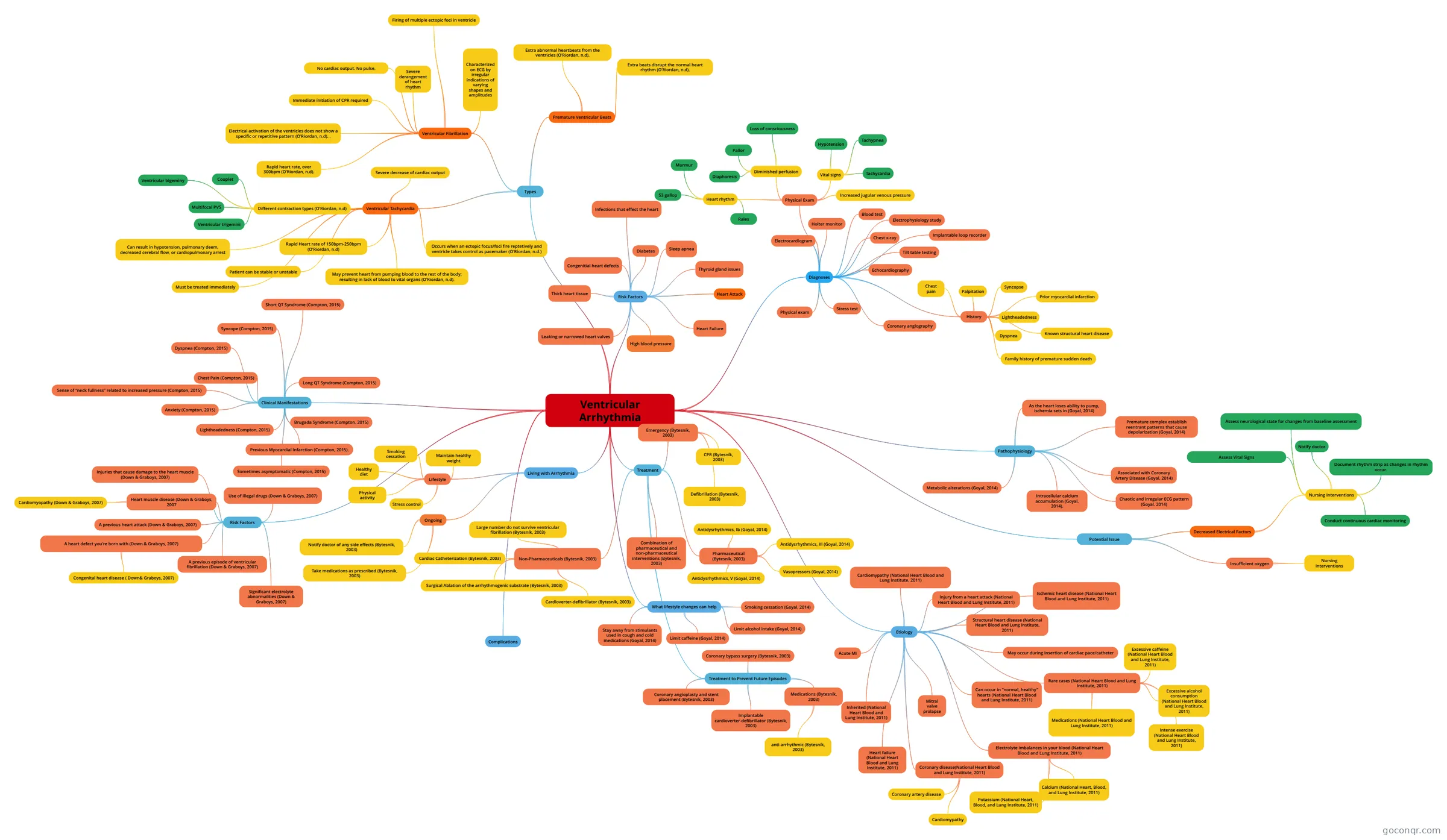
Mind map: Ventricular arrhythmia
Conteúdo do mapa
Ventricular Arrhythmia
Pathophysiology
- Associated with Coronary Artery Disease (Goyal, 2014)
- Intracellular calcium accumulation (Goyal, 2014).
- Metabolic alterations (Goyal, 2014)
- As the heart loses ability to pump, ischemia sets in (Goyal, 2014)
- Premature complex establish reentrant patterns that cause depolarization (Goyal, 2014)
- Chaotic and irregular ECG pattern (Goyal, 2014)
Clinical Manifestations
- Long QT Syndrome (Compton, 2015)
- Short QT Syndrome (Compton, 2015)
- Brugada Syndrome (Compton, 2015)
- Previous Myocardial Infarction (Compton, 2015).
- Lightheadedness (Compton, 2015)
- Syncope (Compton, 2015)
- Chest Pain (Compton, 2015)
- Anxiety (Compton, 2015)
- Sense of “neck fullness” related to increased pressure (Compton, 2015)
- Dyspnea (Compton, 2015)
- Sometimes asymptomatic (Compton, 2015)
Risk Factors
- A previous episode of ventricular fibrillation (Down & Graboys, 2007)
- A previous heart attack (Down & Graboys, 2007)
- A heart defect you're born with (Down & Graboys, 2007)
- Congenital heart disease ( Down& Graboys, 2007)
- Heart muscle disease (Down & Graboys, 2007
- Cardiomyopathy (Down & Graboys, 2007)
- Injuries that cause damage to the heart muscle (Down & Graboys, 2007)
- Use of illegal drugs (Down & Graboys, 2007)
- Significant electrolyte abnormalities (Down & Graboys, 2007)
Types
- Ventricular Tachycardia
- Rapid Heart rate of 150bpm-250bpm (O’Riordan, n.d)
- May prevent heart from pumping blood to the rest of the body; resulting in lack of blood to vital organs (O’Riordan, n.d).
- Occurs when an ectopic focus/foci fire reptetively and ventricle takes control as pacemaker (O'Riordan, n.d.)
- Different contraction types (O'Riordan, n.d)
- Multifocal PVS
- Ventricular trigemini
- Couplet
- Ventricular bigeminy
- Patient can be stable or unstable
- Can result in hypotension, pulmonary deem, decreased cerebral flow, or cardiopulmonary arrest
- Must be treated immediately
- Severe decrease of cardiac output
- Premature Ventricular Beats
- Extra abnormal heartbeats from the ventricles (O’Riordan, n.d).
- Extra beats disrupt the normal heart rhythm (O’Riordan, n.d).
- Ventricular Fibrillation
- Rapid heart rate, over 300bpm (O’Riordan, n.d).
- Electrical activation of the ventricles does not show a specific or repetitive pattern (O’Riordan, n.d). .
- Severe derangement of heart rhythm
- Characterized on ECG by irregular indications of varying shapes and amplitudes
- Firing of multiple ectopic foci in ventricle
- No cardiac output. No pulse.
- Immediate initiation of CPR required
- Ventricular Tachycardia
Potential Issue
- Decreased Electrical Factors
- Nursing Interventions
- Assess neurological state for changes from baseline assessment
- Conduct continuous cardiac monitoring
- Document rhythm strip as changes in rhythm occur.
- Assess Vital Signs
- Notify doctor
- Nursing Interventions
- Insufficient oxygen
- Nursing interventions
- Decreased Electrical Factors
Risk Factors
- Heart Attack
- Heart Failure
- Thick heart tissue
- Leaking or narrowed heart valves
- Congenitial heart defects
- High blood pressure
- Diabetes
- Sleep apnea
- Thyroid gland issues
- Infections that effect the heart
Living with Arrhythmia
- Ongoing
- Take medications as prescribed (Bytesnik, 2003)
- Notify doctor of any side effects (Bytesnik, 2003)
- Lifestyle
- Healthy diet
- Physical activity
- Smoking cessation
- Stress control
- Maintain healthy weight
- Ongoing
Treatment
- Pharmaceutical (Bytesník, 2003)
- Antidysrhythmics, Ib (Goyal, 2014)
- Antidysrhythmics, III (Goyal, 2014)
- Antidysrhythmics, V (Goyal, 2014)
- Vasopressors (Goyal, 2014)
- Non-Pharmaceuticals (Bytesnik, 2003)
- Cardiac Catheterization (Bytesník, 2003)
- Surgical Ablation of the arrhythmogenic substrate (Bytesník, 2003)
- Cardioverter-defibrillator (Bytesník, 2003)
- Large number do not survive ventricular fibrillation (Bytesník, 2003)
- Combination of pharmaceutical and non-pharmaceutical interventions (Bytesník, 2003)
- Emergency (Bytesník, 2003)
- CPR (Bytesník, 2003)
- Defibrillation (Bytesník, 2003)
- Treatment to Prevent Future Episodes
- Medications (Bytesník, 2003)
- anti-arrhythmic (Bytesník, 2003)
- Implantable cardioverter-defibrillator (Bytesník, 2003)
- Coronary angioplasty and stent placement (Bytesník, 2003)
- Coronary bypass surgery (Bytesnik, 2003)
- Medications (Bytesník, 2003)
- Pharmaceutical (Bytesník, 2003)
Diagnoses
- History
- Palpitation
- Lightheadedness
- Syncopse
- Chest pain
- Dyspnea
- Prior myocardial infarction
- Known structural heart disease
- Family history of premature sudden death
- Physical exam
- Electrocardiogram
- Holter monitor
- Blood test
- Chest x-ray
- Echocardiography
- Stress test
- Electrophysiology study
- Tilt table testing
- Coronary angiography
- Implantable loop recorder
- Physical Exam
- Vital signs
- Tachycardia
- Hypotension
- Tachypnea
- Diminished perfusion
- Pallor
- Loss of consciousness
- Diaphoresis
- Increased jugular venous pressure
- Heart rhythm
- Murmur
- S3 gallop
- Rales
- Vital signs
- History
What lifestyle changes can help
- Smoking cessation (Goyal, 2014)
- Limit alcohol intake (Goyal, 2014)
- Limit caffeine (Goyal, 2014)
- Stay away from stimulants used in cough and cold medications (Goyal, 2014)
Etiology
- Coronary disease(National Heart Blood and Lung Institute, 2011)
- Coronary artery disease
- Cardiomypathy
- Electrolyte imbalances in your blood (National Heart Blood and Lung Institute, 2011)
- Potassium (National Heart, Blood, and Lung Institute, 2011)
- Calcium (National Heart, Blood, and Lung Institute, 2011)
- Structural heart disease (National Heart Blood and Lung Institute, 2011)
- Injury from a heart attack (National Heart Blood and Lung Institute, 2011)
- Cardiomypathy (National Heart Blood and Lung Institute, 2011)
- Can occur in "normal, healthy" hearts (National Heart Blood and Lung Institute, 2011)
- Ischemic heart disease (National Heart Blood and Lung Institute, 2011)
- Heart failure (National Heart Blood and Lung Institute, 2011)
- Inherited (National Heart Blood and Lung Institute, 2011)
- Rare cases (National Heart Blood and Lung Institute, 2011)
- Medications (National Heart Blood and Lung Institute, 2011)
- Excessive caffeine (National Heart Blood and Lung Institute, 2011)
- Excessive alcohol consumption (National Heart Blood and Lung Institute, 2011)
- Intense exercise (National Heart Blood and Lung Institute, 2011)
- Acute MI
- May occur during insertion of cardiac pace/catheter
- Mitral valve prolapse
- Coronary disease(National Heart Blood and Lung Institute, 2011)
Complications
Informações
- Descrição
- Mapa Mental sobre Ventricular Arrhythmia, criado por Sophie Huften em 24-10-2017.
- Criado por
- Sophie Huften
- Visualizações
- 20
- Avaliação