
Mapa mental
Language Learning
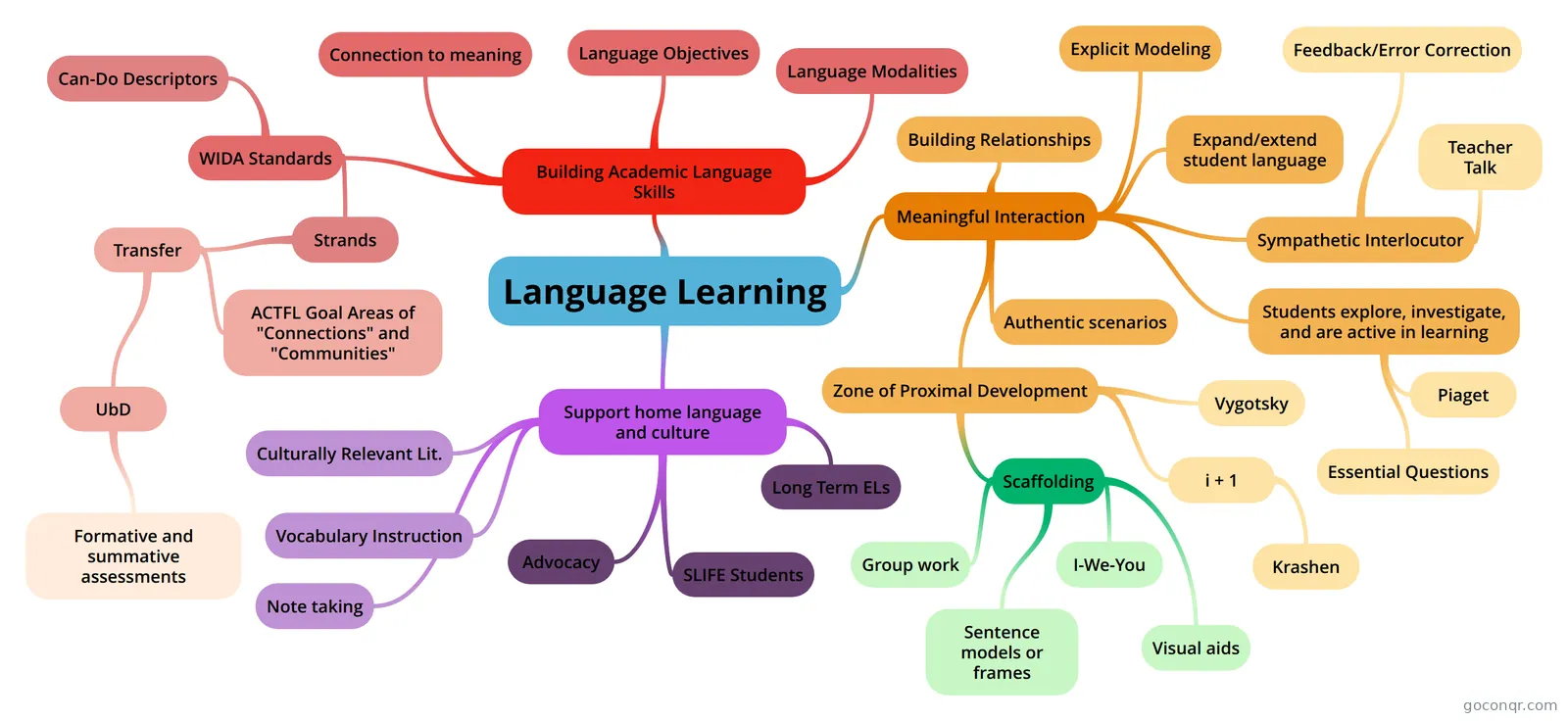
Mind map: Language Learning
Conteúdo do mapa
Language Learning
Support home language and culture
- Education that supports home language development (and views the home language as an asset) can lead to greater English proficiency.
- Culturally Relevant Lit.
- It is so important to incorporate culturally relevant lit in class. This can build on students' background knowledge. It also can show students that their school/teacher values their unique culture.
- Vocabulary Instruction
- Encourage students to translate or explain a new vocab word in their home language.
- Note taking
- Encourage students to translanguage while note taking -- writing notes in both English and a home language. This helps students truly understand content.
- SLIFE Students
- SLIFE students also have unique strengths and needs. These students may need intense support to develop their literacy skills (depending on their literacy skills in their home language). They will also need to support to learn how to "do school" -- this includes school behaviors, procedures, and what is expected of them.
- Long Term ELs
- LTELs have unique strengths and needs as they develop their academic language proficiency. These students may be highly proficient in speaking and listening, but struggle to advance their academic language, especially in writing and reading. Schools should identify these students and provide specialized supports.
- Advocacy
- As an ESL teacher, part of my job is to advocate on behalf of students and their families. This means connecting students to resources, validating their home languages and cultures, working with school/district admin to get the right supports and accommodations for students, and reaching out to integrate families into the school system.
Building Academic Language Skills
- Academic Language is critical for success in school and beyond.
- WIDA Standards
- WIDA is focused on academic language and achievement for ELLs.
- Can-Do Descriptors
- Asset-based approach to the things ELLs can do with language.
- Strands
- A map of where students can go/progress to with language skills.
- Transfer
- Transfer knowledge, skills, or language to new settings or disciplines.
- ACTFL Goal Areas of "Connections" and "Communities"
- These goal areas focus on using and applying language in other disciplines, as well as other settings (outside of school)
- UbD
- Understanding by Design believes that teachers must first start with the learning goal, then work backwards to decide what evidence to look for and what learning plan to implement. UbD also focuses on students learning "big ideas" and then transferring them to other areas.
- Formative and summative assessments
- Begin with the end in mind! Know what you want students to learn and how you'll measure it. Then, build in frequent formative assessments to check for understanding.
- Language Objectives
- What language will students need to access content? Objectives should include language function + grammatical structure + vocabulary.
- Language Modalities
- Remember to focus on building students' language skills in reading, writing, listening, and speaking. Sometimes with the focus on academic language, we forget to provide opportunities to practice speaking and listening.
- Connection to meaning
- Language should not be learned in isolation. It should be learned through meaning. Authentic communicative tasks is a great way to do this!
Meaningful Interaction
- Students learn language through meaningful interaction -- listening to input, negotiating meaning, and producing their own language.
- Sympathetic Interlocutor
- A sympathetic interlocutor allows meaningful interaction to happen by modifying input, constructing meaning, and offering support.
- Feedback/Error Correction
- It's important for teachers to offer feedback to students (but don't interrupt production of language) and effectively correct errors (recast isn't always that effective).
- Teacher Talk
- Teachers should monitor the quantity and quality of their own speech to best meet the needs of students.
- Students explore, investigate, and are active in learning
- Meaningful interaction means that students are using language in a spontaneous, authentic way -- not in situations where they are just repeating or memorizing.
- Piaget
- Piaget believed that students develop and construct knowledge by exploring and investigating.
- Essential Questions
- Big picture, open-ended questions that grab students' attention, promote curiosity, encourage critical thinking, and get students excited about learning.
- Zone of Proximal Development
- The place or level where students are able to learn new things and grow their language proficiency.
- Vygotsky
- The idea of ZPD was developed by Vygotsky.
- i + 1
- Similar to ZPD, i (input) + 1 is the idea that students learn when the input is slightly more challenging than their current ability.
- Krashen
- Krashen developed the idea of i + 1 as part of his Input Hypothesis.
- Scaffolding
- Providing support for students of varying language abilities so that all students can work and learn in their ZPD.
- Group work
- Sentence models or frames
- Visual aids
- I-We-You
- Gradual release of responsibility. First the teacher performs a learning task ("I"). Then, students and the teacher do it together ("we"). Finally, a student tries it on their own ("you").
- Building Relationships
- This is so important for creating and fostering classroom community. Often, relationship-building activities are also great oral language activities and can build students' speaking and listening skills.
- Explicit Modeling
- When doing a new activity or learning task, the teacher should explicitly model this so students see an example, understand the task, and know what's expected of them.
- Authentic scenarios
- Students should practice and learn language through authentic scenarios, not prescribed or artificial scenarios. Language must be tied to meaning.
- Expand/extend student language
- Find ways to prompt students to expand or extend their language. This leads to growth! Also a good way to differentiate instruction.
Informações
- Descrição
- Mapa Mental sobre Language Learning, criado por Lindsey King em 13-12-2017.
- Criado por
- Lindsey King
- Visualizações
- 6
- Avaliação