
Mapa mental
Editing
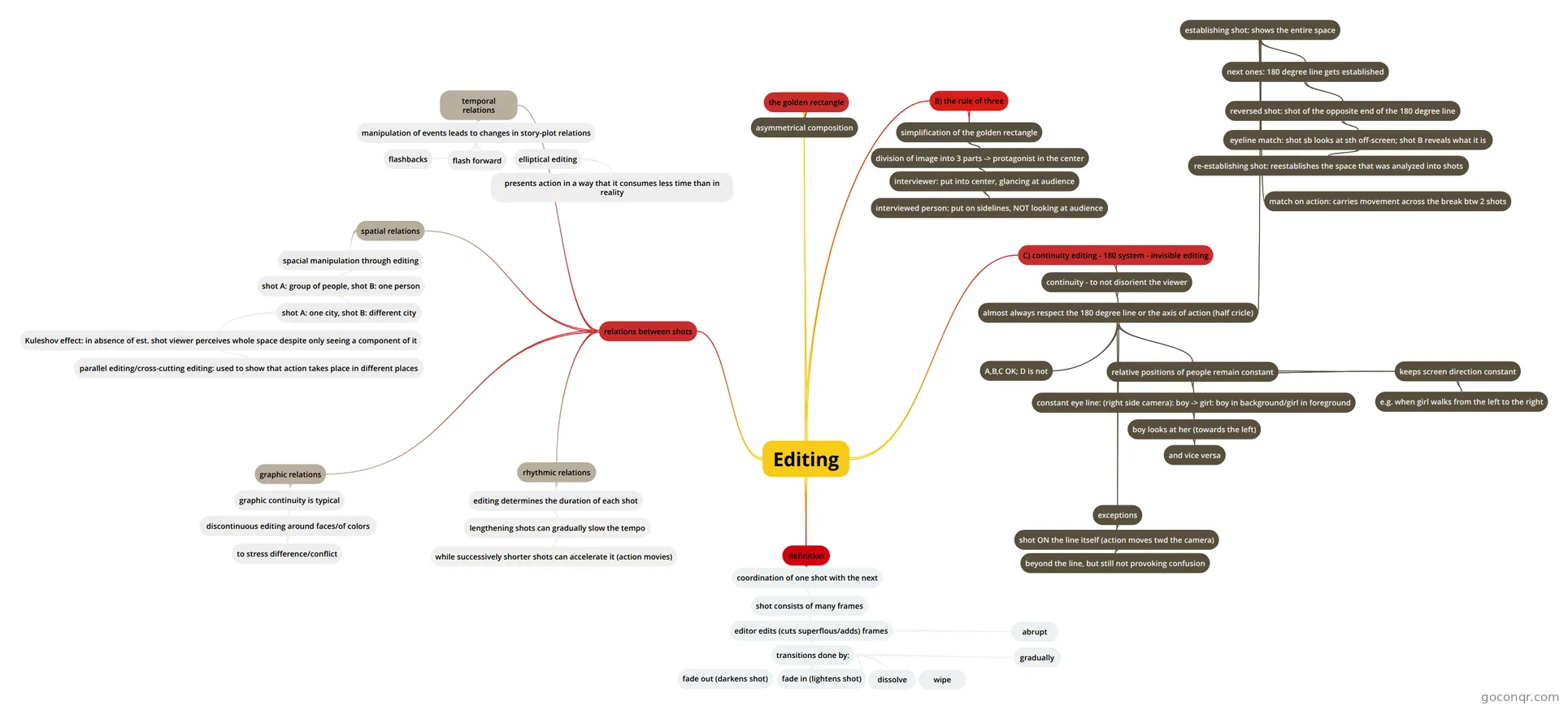
Mind map: Editing
Conteúdo do mapa
Editing
definition
- coordination of one shot with the next
- shot consists of many frames
- editor edits (cuts superflous/adds) frames
- transitions done by:
- fade out (darkens shot)
- fade in (lightens shot)
- dissolve
- wipe
- gradually
- abrupt
- transitions done by:
- editor edits (cuts superflous/adds) frames
- shot consists of many frames
- coordination of one shot with the next
relations between shots
- graphic relations
- graphic continuity is typical
- discontinuous editing around faces/of colors
- to stress difference/conflict
- discontinuous editing around faces/of colors
- graphic continuity is typical
- rhythmic relations
- editing determines the duration of each shot
- lengthening shots can gradually slow the tempo
- while successively shorter shots can accelerate it (action movies)
- lengthening shots can gradually slow the tempo
- editing determines the duration of each shot
- spatial relations
- spacial manipulation through editing
- shot A: group of people, shot B: one person
- shot A: one city, shot B: different city
- Kuleshov effect: in absence of est. shot viewer perceives whole space despite only seeing a component of it
- parallel editing/cross-cutting editing: used to show that action takes place in different places
- Kuleshov effect: in absence of est. shot viewer perceives whole space despite only seeing a component of it
- shot A: one city, shot B: different city
- shot A: group of people, shot B: one person
- spacial manipulation through editing
- temporal relations
- manipulation of events leads to changes in story-plot relations
- flashbacks
- flash forward
- elliptical editing
- presents action in a way that it consumes less time than in reality
- manipulation of events leads to changes in story-plot relations
- graphic relations
C) continuity editing - 180 system - invisible editing
- continuity - to not disorient the viewer
- almost always respect the 180 degree line or the axis of action (half cricle)
- A,B,C OK; D is not
- relative positions of people remain constant
- constant eye line: (right side camera): boy -> girl: boy in background/girl in foreground
- boy looks at her (towards the left)
- and vice versa
- boy looks at her (towards the left)
- keeps screen direction constant
- e.g. when girl walks from the left to the right
- constant eye line: (right side camera): boy -> girl: boy in background/girl in foreground
- establishing shot: shows the entire space
- next ones: 180 degree line gets established
- reversed shot: shot of the opposite end of the 180 degree line
- eyeline match: shot sb looks at sth off-screen; shot B reveals what it is
- re-establishing shot: reestablishes the space that was analyzed into shots
- eyeline match: shot sb looks at sth off-screen; shot B reveals what it is
- reversed shot: shot of the opposite end of the 180 degree line
- match on action: carries movement across the break btw 2 shots
- next ones: 180 degree line gets established
- exceptions
- shot ON the line itself (action moves twd the camera)
- beyond the line, but still not provoking confusion
- shot ON the line itself (action moves twd the camera)
- almost always respect the 180 degree line or the axis of action (half cricle)
- continuity - to not disorient the viewer
A) composition
- asymmetrical composition
- the golden rectangle
- asymmetrical composition
B) the rule of three
- simplification of the golden rectangle
- division of image into 3 parts -> protagonist in the center
- interviewer: put into center, glancing at audience
- interviewed person: put on sidelines, NOT looking at audience
- interviewer: put into center, glancing at audience
- division of image into 3 parts -> protagonist in the center
- simplification of the golden rectangle
Informações
- Descrição
- Mapa Mental sobre Editing, criado por Tere S. em 08-01-2018.
- Criado por
- Tere S.
- Visualizações
- 0
- Avaliação