
Mapa mental
Pearl
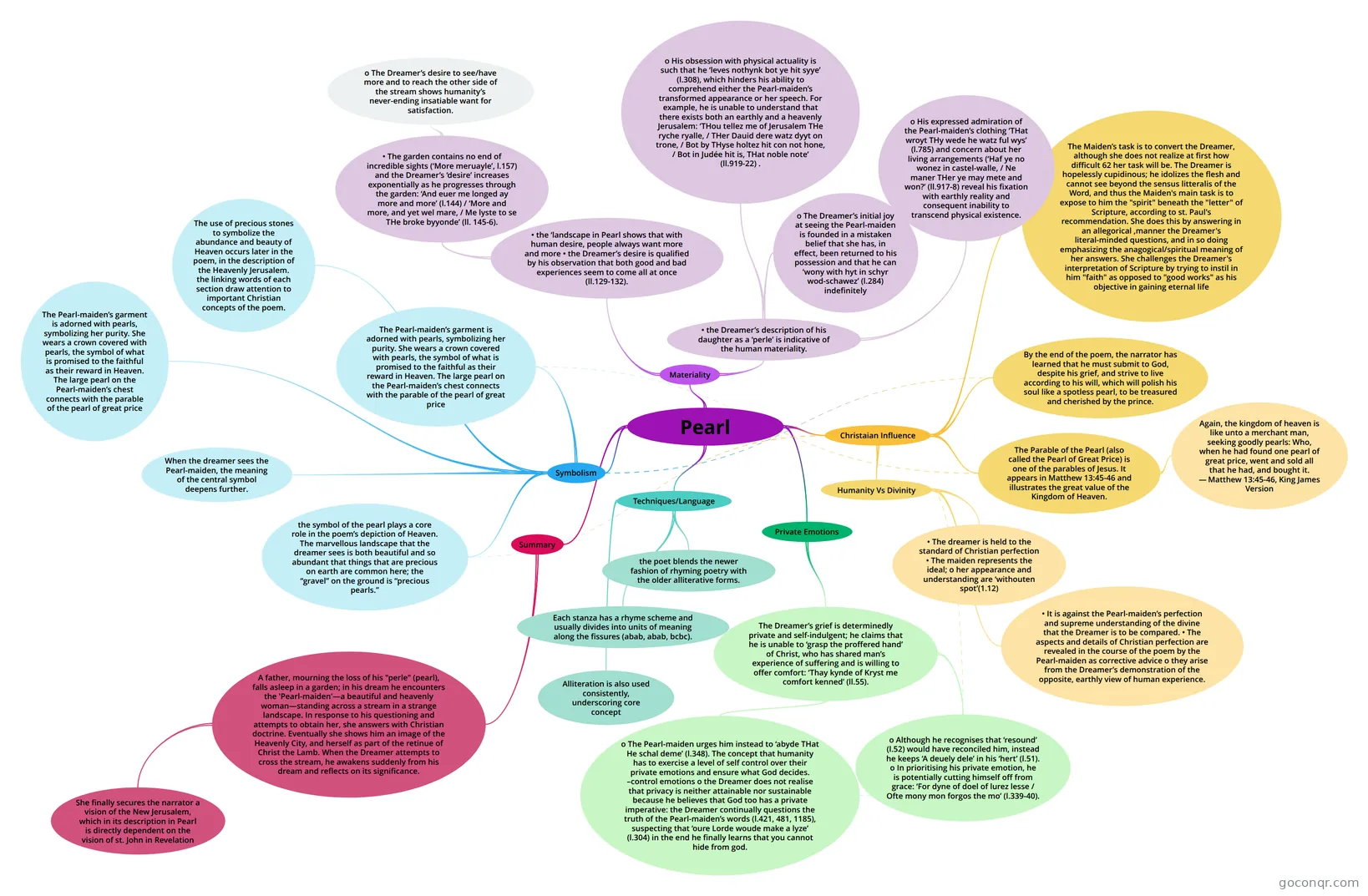
Mind map: Pearl poem
Conteúdo do mapa
Pearl
Techniques/Language
- Each stanza has a rhyme scheme and usually divides into units of meaning along the fissures (abab, abab, bcbc).
- Alliteration is also used consistently, underscoring core concept
- the poet blends the newer fashion of rhyming poetry with the older alliterative forms.
Summary
- A father, mourning the loss of his "perle" (pearl), falls asleep in a garden; in his dream he encounters the 'Pearl-maiden'—a beautiful and heavenly woman—standing across a stream in a strange landscape. In response to his questioning and attempts to obtain her, she answers with Christian doctrine. Eventually she shows him an image of the Heavenly City, and herself as part of the retinue of Christ the Lamb. When the Dreamer attempts to cross the stream, he awakens suddenly from his dream and reflects on its significance.
- She finally secures the narrator a vision of the New Jerusalem, which in its description in Pearl is directly dependent on the vision of st. John in Revelation
- A father, mourning the loss of his "perle" (pearl), falls asleep in a garden; in his dream he encounters the 'Pearl-maiden'—a beautiful and heavenly woman—standing across a stream in a strange landscape. In response to his questioning and attempts to obtain her, she answers with Christian doctrine. Eventually she shows him an image of the Heavenly City, and herself as part of the retinue of Christ the Lamb. When the Dreamer attempts to cross the stream, he awakens suddenly from his dream and reflects on its significance.
Christaian Influence
- The Parable of the Pearl (also called the Pearl of Great Price) is one of the parables of Jesus. It appears in Matthew 13:45-46 and illustrates the great value of the Kingdom of Heaven.
- Again, the kingdom of heaven is like unto a merchant man, seeking goodly pearls: Who, when he had found one pearl of great price, went and sold all that he had, and bought it. — Matthew 13:45-46, King James Version
- By the end of the poem, the narrator has learned that he must submit to God, despite his grief, and strive to live according to his will, which will polish his soul like a spotless pearl, to be treasured and cherished by the prince.
- The Maiden’s task is to convert the Dreamer, although she does not realize at first how difficult 62 her task will be. The Dreamer is hopelessly cupidinous; he idolizes the flesh and cannot see beyond the sensus litteralis of the Word, and thus the Maiden's main task is to expose to him the "spirit" beneath the "letter" of Scripture, according to st. Paul's recommendation. She does this by answering in an allegorical ,manner the Dreamer's literal-minded questions, and in so doing emphasizing the anagogical/spiritual meaning of her answers. She challenges the Dreamer's interpretation of Scripture by trying to instil in him "faith" as opposed to "good works" as his objective in gaining eternal life
- Humanity Vs Divinity
- • The dreamer is held to the standard of Christian perfection • The maiden represents the ideal; o her appearance and understanding are ‘withouten spot’(1.12)
- • It is against the Pearl-maiden’s perfection and supreme understanding of the divine that the Dreamer is to be compared. • The aspects and details of Christian perfection are revealed in the course of the poem by the Pearl-maiden as corrective advice o they arise from the Dreamer’s demonstration of the opposite, earthly view of human experience.
- The Parable of the Pearl (also called the Pearl of Great Price) is one of the parables of Jesus. It appears in Matthew 13:45-46 and illustrates the great value of the Kingdom of Heaven.
Symbolism
- the symbol of the pearl plays a core role in the poem’s depiction of Heaven. The marvellous landscape that the dreamer sees is both beautiful and so abundant that things that are precious on earth are common here; the “gravel” on the ground is “precious pearls.”
- When the dreamer sees the Pearl-maiden, the meaning of the central symbol deepens further.
- The Pearl-maiden’s garment is adorned with pearls, symbolizing her purity. She wears a crown covered with pearls, the symbol of what is promised to the faithful as their reward in Heaven. The large pearl on the Pearl-maiden’s chest connects with the parable of the pearl of great price
- The Pearl-maiden’s garment is adorned with pearls, symbolizing her purity. She wears a crown covered with pearls, the symbol of what is promised to the faithful as their reward in Heaven. The large pearl on the Pearl-maiden’s chest connects with the parable of the pearl of great price
- The use of precious stones to symbolize the abundance and beauty of Heaven occurs later in the poem, in the description of the Heavenly Jerusalem. the linking words of each section draw attention to important Christian concepts of the poem.
Materiality
- • the ‘landscape in Pearl shows that with human desire, people always want more and more • the Dreamer’s desire is qualified by his observation that both good and bad experiences seem to come all at once (ll.129-132).
- • The garden contains no end of incredible sights (‘More meruayle’, l.157) and the Dreamer’s ‘desire’ increases exponentially as he progresses through the garden: ‘And euer me longed ay more and more’ (l.144) / ‘More and more, and yet wel mare, / Me lyste to se THe broke byyonde’ (ll. 145-6).
- o The Dreamer’s desire to see/have more and to reach the other side of the stream shows humanity’s never-ending insatiable want for satisfaction.
- • The garden contains no end of incredible sights (‘More meruayle’, l.157) and the Dreamer’s ‘desire’ increases exponentially as he progresses through the garden: ‘And euer me longed ay more and more’ (l.144) / ‘More and more, and yet wel mare, / Me lyste to se THe broke byyonde’ (ll. 145-6).
- • the Dreamer’s description of his daughter as a ‘perle’ is indicative of the human materiality.
- o His expressed admiration of the Pearl-maiden’s clothing ‘THat wroyt THy wede he watz ful wys’ (l.785) and concern about her living arrangements (‘Haf ye no wonez in castel-walle, / Ne maner THer ye may mete and won?’ (ll.917-8) reveal his fixation with earthly reality and consequent inability to transcend physical existence.
- o His obsession with physical actuality is such that he ‘leves nothynk bot ye hit syye’ (l.308), which hinders his ability to comprehend either the Pearl-maiden’s transformed appearance or her speech. For example, he is unable to understand that there exists both an earthly and a heavenly Jerusalem: ‘THou tellez me of Jerusalem THe ryche ryalle, / THer Dauid dere watz dyyt on trone, / Bot by THyse holtez hit con not hone, / Bot in Judée hit is, THat noble note’ (ll.919-22) .
- o The Dreamer’s initial joy at seeing the Pearl-maiden is founded in a mistaken belief that she has, in effect, been returned to his possession and that he can ‘wony with hyt in schyr wod-schawez’ (l.284) indefinitely
- • the ‘landscape in Pearl shows that with human desire, people always want more and more • the Dreamer’s desire is qualified by his observation that both good and bad experiences seem to come all at once (ll.129-132).
Private Emotions
- The Dreamer’s grief is determinedly private and self-indulgent; he claims that he is unable to ‘grasp the proffered hand’ of Christ, who has shared man’s experience of suffering and is willing to offer comfort: ‘Thay kynde of Kryst me comfort kenned’ (ll.55).
- o Although he recognises that ‘resound’ (l.52) would have reconciled him, instead he keeps ‘A deuely dele’ in his ‘hert’ (l.51). o In prioritising his private emotion, he is potentially cutting himself off from grace: ‘For dyne of doel of lurez lesse / Ofte mony mon forgos the mo’ (l.339-40).
- o The Pearl-maiden urges him instead to ‘abyde THat He schal deme’ (l.348). The concept that humanity has to exercise a level of self control over their private emotions and ensure what God decides. –control emotions o the Dreamer does not realise that privacy is neither attainable nor sustainable because he believes that God too has a private imperative: the Dreamer continually questions the truth of the Pearl-maiden’s words (l.421, 481, 1185), suspecting that ‘oure Lorde woude make a lyze’ (l.304) in the end he finally learns that you cannot hide from god.
- The Dreamer’s grief is determinedly private and self-indulgent; he claims that he is unable to ‘grasp the proffered hand’ of Christ, who has shared man’s experience of suffering and is willing to offer comfort: ‘Thay kynde of Kryst me comfort kenned’ (ll.55).
Informações
- Descrição
- Mapa Mental sobre Pearl, criado por Shauna O Connell em 06-03-2018.
- Criado por
- Shauna O Connell
- Visualizações
- 0
- Avaliação