Mapa mental
Legitimacy (1)
Conteúdo do mapa
Legitimacy (1)
State Legitimatcy
- Beetham's 3 Criteria for Legitamacy
- 1. Power should be acquired and excercised according to established rules
- 2. Rules to be justifiable by reference to shared and accepted beliefs
- 3. Positions of authority are publicly acknowledged by subordinates through actions that confirm their acceptance
- Definitions
- Lipset, 1959
- Capacity of a political system to engender and maintain the belief that the existing institutions are most appropriate or the proper ones for society.
- Citizens more likely to accept, deter, consent, and submit to its decisions and rule; state can govern effectively
- Capacity of a political system to engender and maintain the belief that the existing institutions are most appropriate or the proper ones for society.
- Uphoff, 1989
- Authority & legitimacy differ in that one is a claim for compliance while the other is an acceptance of that claim.
- Lipset, 1959
- Basis for legitamacy
- Institutions/political culture (Lipset)
- 1. Belief that institutions must be appropriate for socieity
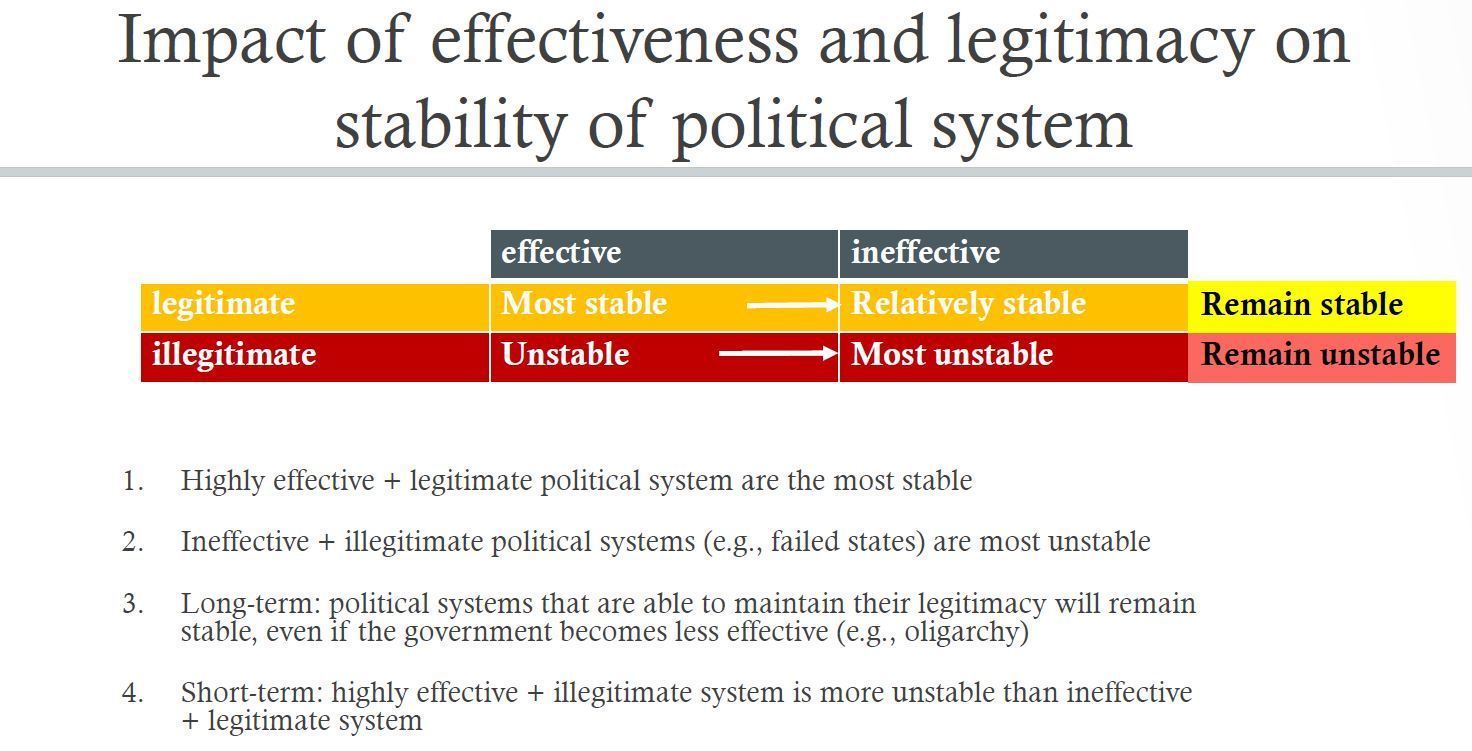
- 2. Effectiveness (performance/development/ progress)
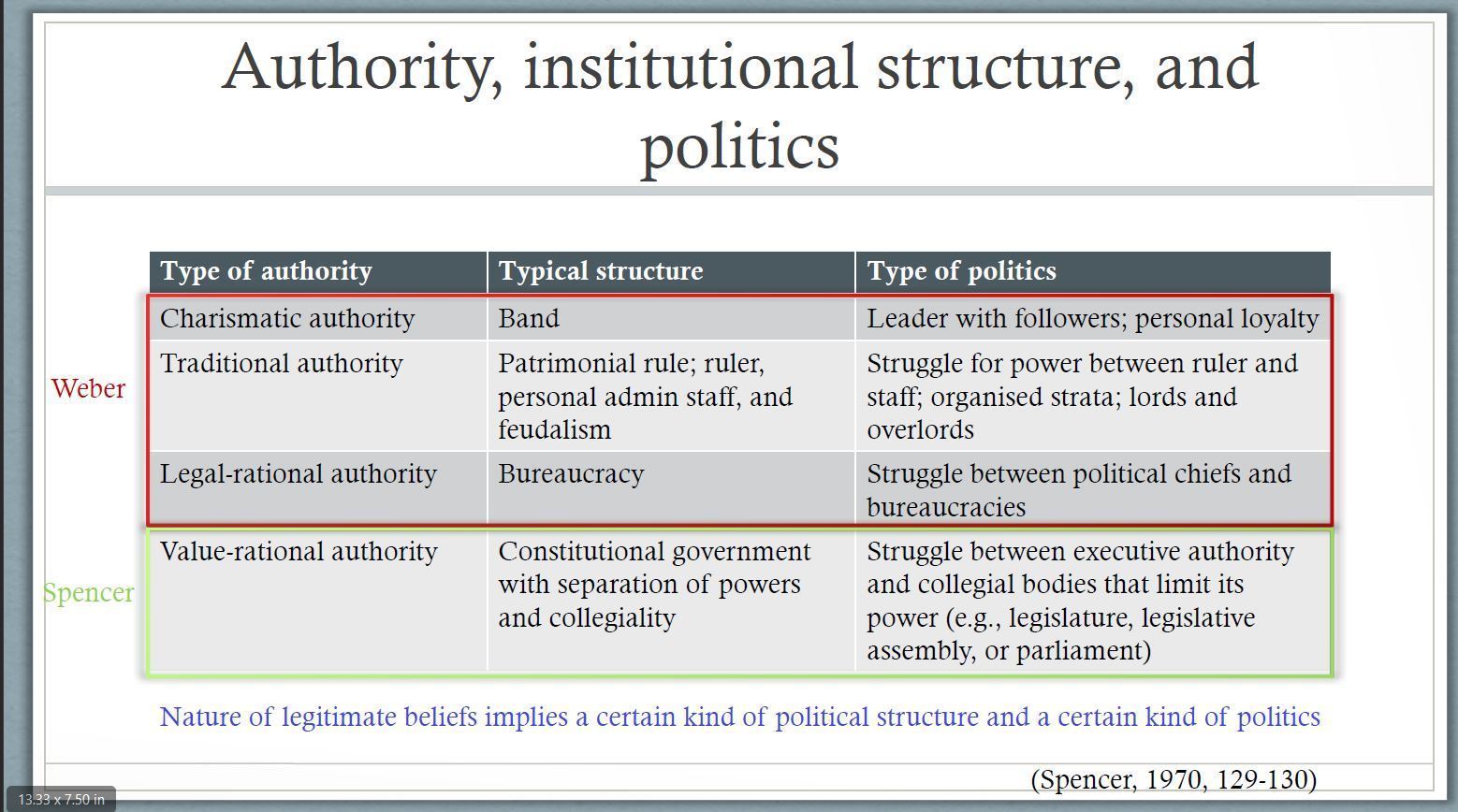
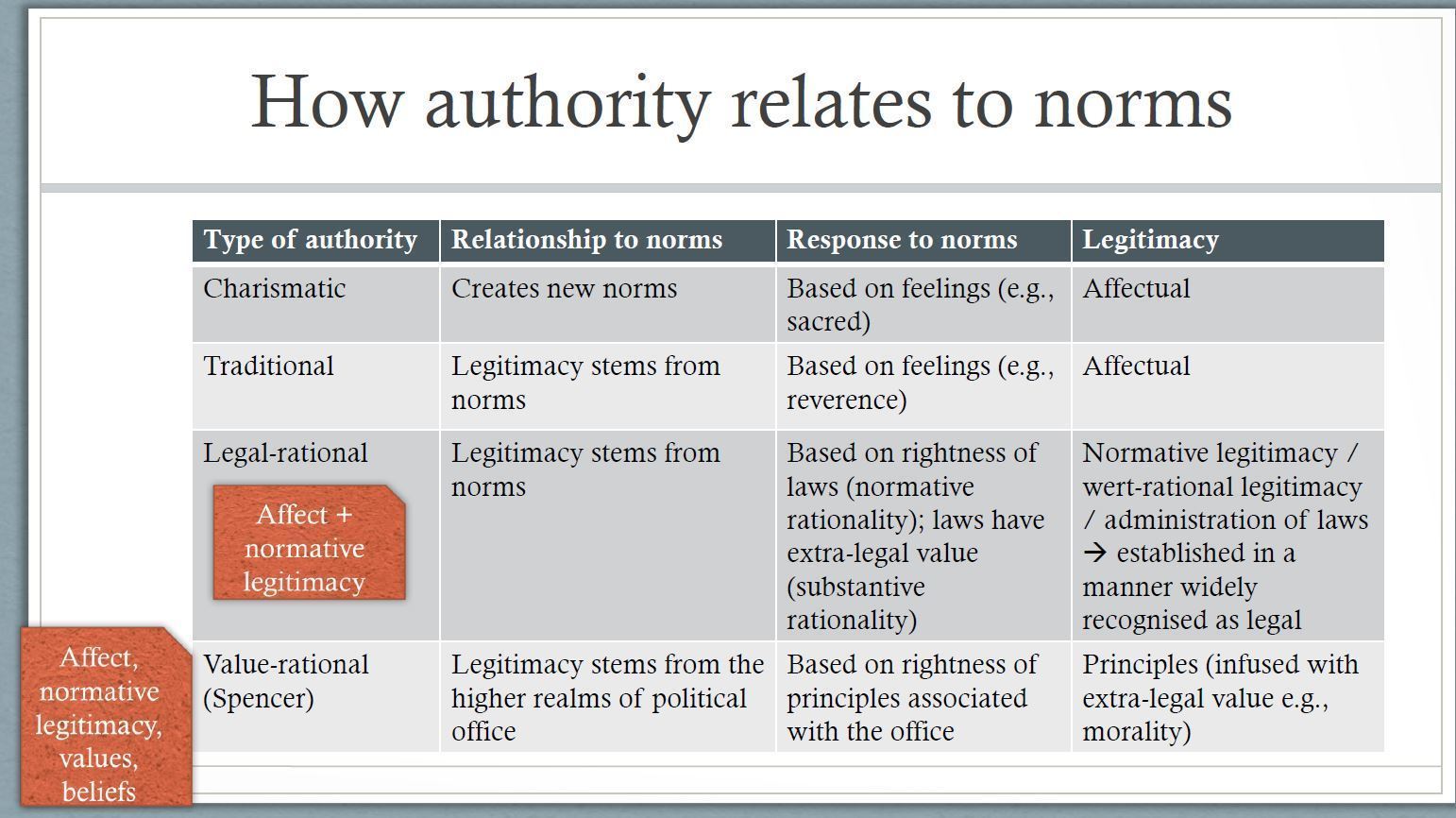
- Authority (Weber)
- 1. Charismatic authority
- 2. Legal-rational authority
- 3. Traditional Authority
- 4. Value-rational authority (Spenser, 1970)
- Institutions/political culture (Lipset)
- Beetham's 3 Criteria for Legitamacy
Democratic System Legitmacy
- Contributing Factors
- 1. Proven, prolonged effectiveness
- 2. Constant economic development
- 3. Presence of widely accepted political symbols
- a. preservation of traditional symbols of legitimacy b. development of strong, new symbols c. combination of traditional and new symbols
- Sources
- 1. effective political system w/ relatively equitable distribution of resources to major groups
- 2. Existence of moderate tension & conflict, that are facilitated by system's capacity to resolve
- 3. Cross-cutting cleavages, rather than self-enforcing ones that fuel political intolerance
- 4. Acknowledge rise of new states groups, incorporate political demands to existing political system
- 5. Discourage politics of intolerance, by discouraging ideological politics
- Sources in post-crisis of change
- 1. Continuity of important traditional integrative institutions during transitional period
- 2. Providing new groups access to legitimate political institutions
- 3. Extent to which secular political culture is institutionalized
- 4. Effective political system that provides some semblance of stability
- Crisis of legitimacy
- 1. Arises from deep cleavages in society
- Results in revolutionary call for change.
- Occurs when major conservative institutions are threatened
- Major groups in society do not have access to political system in the trasition
- 3. Emergent, politically active social groups are denied access to political process (entry to politics crisis)
- Contributing Factors
Lipset's Hypothesis
- 1. Political leaders need to resolve major issues dividing society before new ones arise
- 2. countries with low level of effectiveness and legitimacy will require constitutional factors that enhance its chances of developing into a stable democracy
- 3. two party systems > multi-party systems
- 4. Territorial elections > proportional representation
- 5.Federalism > unitary state