
Mapa mental
Dugga 1
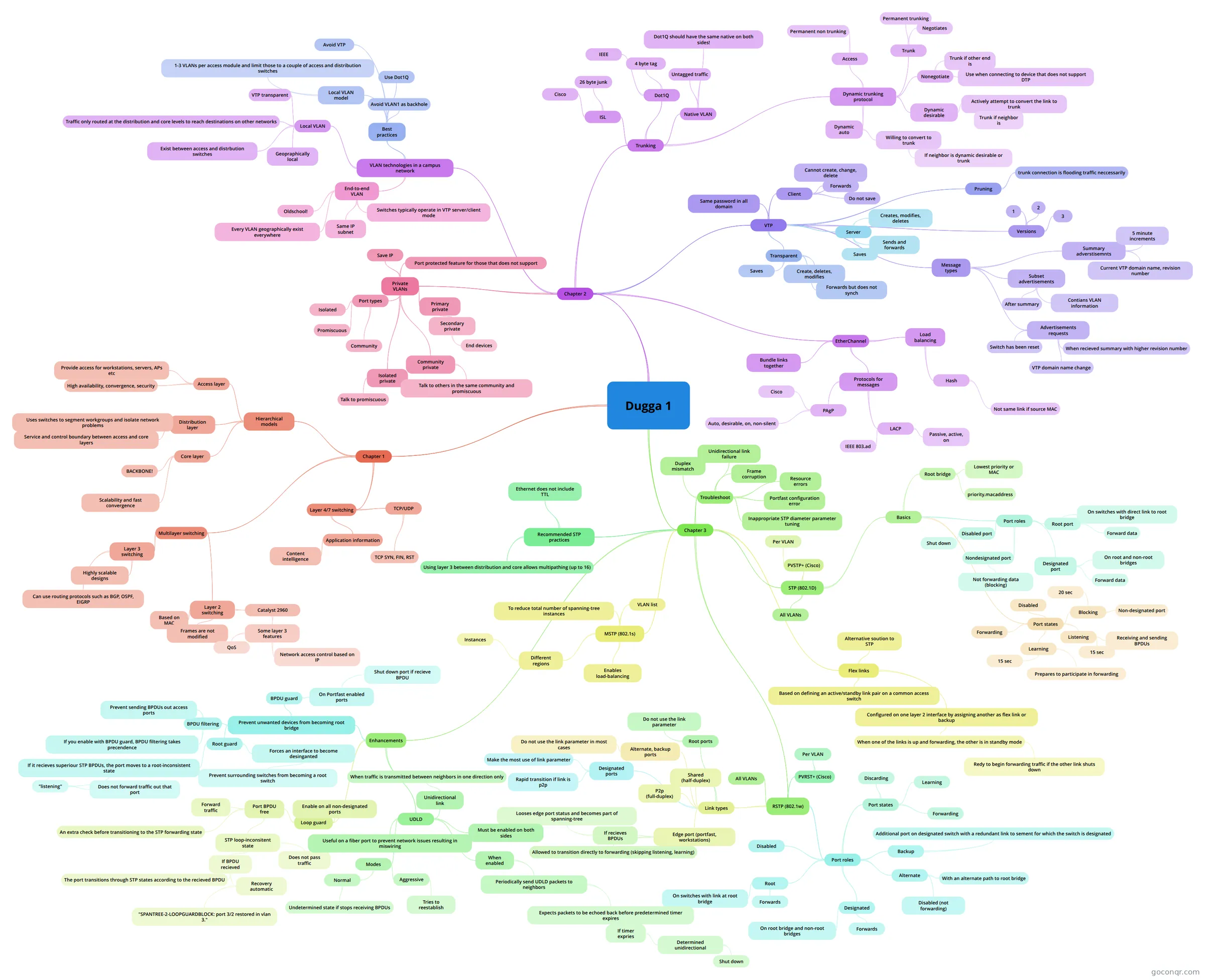
Mind map: campus network switching
Conteúdo do mapa
Dugga 1
Chapter 1
- Hierarchical models
- Access layer
- Provide access for workstations, servers, APs etc
- High availability, convergence, security
- Distribution layer
- Service and control boundary between access and core layers
- Uses switches to segment workgroups and isolate network problems
- Core layer
- BACKBONE!
- Scalability and fast convergence
- Access layer
- Layer 4/7 switching
- TCP/UDP
- TCP SYN, FIN, RST
- Application information
- Content intelligence
- TCP/UDP
- Multilayer switching
- Layer 2 switching
- Based on MAC
- Frames are not modified
- Catalyst 2960
- Some layer 3 features
- QoS
- Network access control based on IP
- Some layer 3 features
- Layer 3 switching
- Can use routing protocols such as BGP, OSPF, EIGRP
- Highly scalable designs
- Layer 2 switching
- Hierarchical models
Chapter 2
- VLAN technologies in a campus network
- End-to-end VLAN
- Oldschool!
- Every VLAN geographically exist everywhere
- Same IP subnet
- Switches typically operate in VTP server/client mode
- Local VLAN
- Exist between access and distrbution switches
- Traffic only routed at the distribution and core levels to reach destinations on other networks
- VTP transparent
- Geopraphically local
- Best practices
- Local VLAN model
- 1-3 VLANs per access module and limit those to a couple of access and distribution switches
- Avoid VLAN1 as backhole
- Use Dot1Q
- Avoid VTP
- Local VLAN model
- End-to-end VLAN
- Trunking
- ISL
- Cisco
- 26 byte junk
- Dot1Q
- IEEE
- 4 byte tag
- Native VLAN
- Untagged traffic
- Dot1Q should have the same native on both sides!
- Dynamic trunking protocol
- Access
- Permanent non trunking
- Trunk
- Permanent trunking
- Negotiates
- Nonegotiate
- Trunk if other end is
- Use when connecting to device that does not support DTP
- Dynamic desirable
- Actively attempt to convert the link to trunk
- Trunk if neighbor is
- Actively attempt to convert the link to trunk
- Dynamic auto
- Willing to convert to trunk
- If neighbor is dynamic desirable or trunk
- Willing to convert to trunk
- Access
- ISL
- VTP
- Client
- Cannot create, change, delete
- Forwards
- Do not save
- Server
- Creates, modifies, deletes
- Sends and forwards
- Saves
- Transparent
- Create, deletes, modifies
- Forwards but does not synch
- Saves
- Pruning
- trunk connection is flooding traffic neccessarily
- Versions
- 1
- 2
- 3
- Message types
- Summary adverstisemnts
- 5 minute increments
- Current VTP domain name, revision number
- Subset advertisements
- Contians VLAN information
- After summary
- Advertisements requests
- Switch has been reset
- VTP domain name change
- When recieved summary with higher revision number
- Summary adverstisemnts
- Same password in all domain
- Client
- Private VLANs
- Primary private
- Secondary private
- End devices
- Secondary private
- Community private
- Talk to others in the same community and promiscuous
- Isolated private
- Talk to promiscuous
- Port types
- Isolated
- Promiscuous
- Community
- Save IP
- Port protected feature for those that does not support
- Primary private
- EtherChannel
- Bundle links together
- Protocols for messages
- PAgP
- Cisco
- Auto, desirable, on, non-silent
- LACP
- IEEE 803.ad
- Passive, active, on
- PAgP
- Load balancing
- Hash
- Not same link if source MAC
- Hash
- VLAN technologies in a campus network
Chapter 3
- RSTP (802.1w)
- PVRST+ (Cisco)
- Per VLAN
- All VLANs
- Port roles
- Port states
- Discarding
- Learning
- Forwarding
- Root
- On switches with link at root bridge
- Forwards
- Designated
- On root bridge and non-root bridges
- Forwards
- Alternate
- With an alternate path to root bridge
- Disabled (not forwarding)
- Backup
- Additional port on designated switch with a redundant link to sement for which the switch is designated
- Disabled
- Port states
- Link types
- Shared (half-duplex)
- P2p (full-duplex)
- Edge port (portfast, workstations)
- Allowed to transition directly to forwarding (skipping listening, learning)
- If recieves BPDUs
- Looses edge port status and becomes part of spanning-tree
- Root ports
- Do not use the link parameter
- Alternate, backup ports
- Do not use the link parameter in most cases
- Designated ports
- Make the most use of link parameter
- Rapid transition if link is p2p
- PVRST+ (Cisco)
- MSTP (802.1s)
- VLAN list
- To reduce total number of spanning-tree instances
- Different regions
- Instances
- Enables load-balancing
- Recommended STP practices
- Ethernet does not include TTL
- Using layer 3 between distribution and core allows multipathing (up to 16)
- STP (802.1D)
- Basics
- Root bridge
- Lowest priority or MAC
- priority.macaddress
- Port roles
- Root port
- On switches with direct link to root bridge
- Forward data
- Designated port
- On root and non-root bridges
- Forward data
- Nondesignated port
- Not forwarding data (blocking)
- Disabled port
- Shut down
- Root port
- Port states
- Blocking
- Non-designated port
- 20 sec
- Listening
- Receiving and sending BPDUs
- 15 sec
- Learning
- Prepares to participate in forwarding
- 15 sec
- Forwarding
- Disabled
- Blocking
- Root bridge
- PVSTP+ (Cisco)
- Per VLAN
- All VLANs
- Basics
- Enhancements
- Prevent unwanted devices from becoming root bridge
- BPDU guard
- On Portfast enabled ports
- Shut down port if recieve BPDU
- On Portfast enabled ports
- BPDU filtering
- Prevent sending BPDUs out access ports
- If you enable with BPDU guard, BPDU filtering takes precendence
- Root guard
- Forces an interface to become desinganted
- Prevent surrounding switches from becoming a root switch
- If it recieves superiour STP BPDUs, the port moves to a root-inconsistent state
- "listening"
- Does not forward traffic out that port
- "listening"
- Forces an interface to become desinganted
- BPDU guard
- Loop guard
- Port BPDU free
- Forward traffic
- An extra check before transitioning to the STP forwarding state
- STP loop-inconsitent state
- If BPDU recieved
- The port transitions through STP states according to the recieved BPDU
- Recovery automatic
- "SPANTREE-2-LOOPGUARDBLOCK: port 3/2 restored in vlan 3."
- Does not pass traffic
- If BPDU recieved
- Enable on all non-designated ports
- Port BPDU free
- UDLD
- Unidirectional link
- When traffic is transmitted between neighbors in one direction only
- Useful on a fiber port to prevent network issues resulting in miswiring
- When enabled
- Periodically send UDLD packets to neighbors
- Expects packets to be echoed back before predetermined timer expires
- If timer expries
- Determined unidirectional
- Shut down
- Determined unidirectional
- If timer expries
- Expects packets to be echoed back before predetermined timer expires
- Periodically send UDLD packets to neighbors
- Modes
- Normal
- Undetermined state if stops receiving BPDUs
- Aggressive
- Tries to reestablish
- Normal
- Must be enabled on both sides
- Unidirectional link
- Prevent unwanted devices from becoming root bridge
- Flex links
- Alternative soution to STP
- Based on defining an active/standby link pair on a common access switch
- Configured on one layer 2 interface by assigning another as flex link or backup
- When one of the links is up and forwarding, the other is in standby mode
- Redy to begin forwarding traffic if the other link shuts down
- When one of the links is up and forwarding, the other is in standby mode
- Troubleshoot
- Duplex mismatch
- Unidirectional link failure
- Frame corruption
- Resource errors
- Portfast configuration error
- Inappropriate STP diameter parameter tuning
- RSTP (802.1w)
Informações
- Descrição
- Mapa Mental sobre Dugga 1, criado por Tess - em 21-09-2014.
- Criado por
- Tess -
- Visualizações
- 18
- Avaliação