
Mapa mental
Project Scope Management
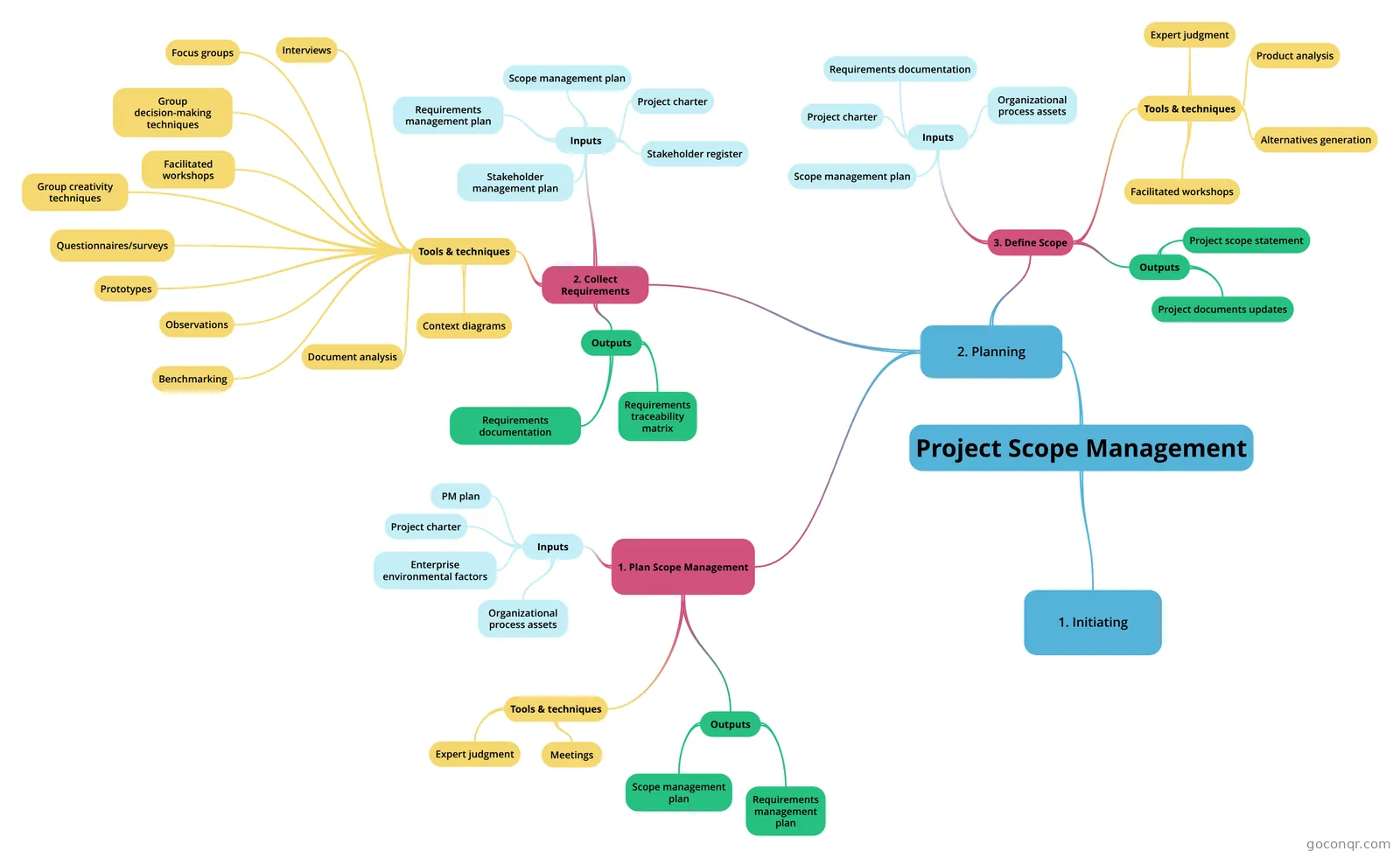
Mind map: Project scope management
Conteúdo do mapa
Project Scope Management
1. Initiating
2. Planning
- 1. Plan Scope Management
- Inputs
- PM plan
- Project approach & existing subsidiary plans
- Project charter
- Contains high-level project scope, requirements, and context
- Enterprise environmental factors
- Organizational culture, infrastructure, personnel administration, and marketplace conditions
- Organizational process assets
- Policies, procedures, historical information, templates, and lessons learned
- PM plan
- Tools & techniques
- Expert judgment
- Individuals with specialized knowledge, skills, experience, and training
- Meetings
- Typically with project manager, sponsor, project management team members, and other key stakeholders
- Expert judgment
- Outputs
- Scope management plan
- Process for preparing a project scope statement
- Process for creating a WBS, and describing how it will be maintained and approved
- Process that defines how deliverables will be accepted
- Process for how required changes to scope will be processed, and how this aligns to the change management processes of the project
- Requirements management plan
- How requirements will be planned, tracked, and reported
- Configuration management activities
- How requirements will be prioritized
- Metrics used to measure product requirements
- Traceability structure, and how requirement attributes will be captured and tracked within the requirements traceability matrix
- Scope management plan
- Inputs
- 2. Collect Requirements
- Inputs
- Scope management plan
- Requirements management plan
- Stakeholder management plan
- Documents the level at which stakeholders want to be engaged
- Project charter
- Stakeholder register
- Identifies stakeholders that should be contacted for information that would assist in gathering requirements
- Tools & techniques
- Interviews
- Focus groups
- Moderated by an experienced facilitator and includes the participation of prequalified stakeholders and subject matter experts
- Facilitated workshops
- Includes the participation of cross-functional stakeholders who actively document the requirements as a group
- Joint application design/development (JAD) or Quality function deployment (QFD)
- Group creativity techniques
- Brainstorming: ideas are collected from participants to produce the requirements
- Nominal group technique: ideas from brainstorming are prioritized and voted on
- Idea/mind mapping: ideas from brainstorming sessions are consolidated into a map
- Affinity diagram: ideas are sorted into groups
- Multicriteria decision analysis: an analytical approach for establishing criteria
- Group decision-making techniques
- Unanimity: everyone agrees
- Majority: more than 50% agrees
- Plurality: the largest block in a group decides
- Dictatorship: one person decides
- Questionnaires/surveys
- Allow for quick accumulation of responses and collection of information from large audiences
- Observations
- Used when a requirement is not easily verbalized
- Prototypes
- Allows for early feedback on the requirements for further refinement
- Benchmarking
- Comparing practices used by the project against other internal or external practices
- Context diagrams
- Developing a scope model
- Document analysis
- Analyzing existing documentation, and extracting requirements from them
- Outputs
- Requirements documentation
- Where the requirements are documented and prioritized
- May contain information such as a brief description, prioritized list, business need of a requirement, type of requirement (functional, quality, etc.), acceptance criteria, how the requirement impacts the organization, assumptions and constraints of the requirements
- Requirements traceability matrix
- A table that traces the life of the requirements, from their origin and how they link to the business needs, to their acceptance and delivery
- Requirements documentation
- Inputs
- 3. Define Scope
- Inputs
- Scope management plan
- Project charter
- Requirements documentation
- Organizational process assets
- Tools & techniques
- Expert judgment
- Product analysis
- To translate high-level product descriptions into deliverables
- Alternatives generation
- Explores the various approaches and ways of executing the project
- Facilitated workshops
- Includes the participation of cross-functional stakeholders who actively document the project and product scope
- Outputs
- Project scope statement
- Within the project boundary: 1. Product scope description 2. Acceptance criteria 3. Deliverables 4. Project exclusions (out of scope) 5. Constraints 6. Assumptions
- Project documents updates
- Project scope statement
- Inputs
- 1. Plan Scope Management
Informações
- Descrição
- Mapa Mental sobre Project Scope Management, criado por Katie Brewer em 29-06-2018.
- Criado por
- Katie Brewer
- Visualizações
- 4
- Avaliação
Mais sobre Project Scope Management