
Mapa mental
1.3 PROJECT COMPONENTS
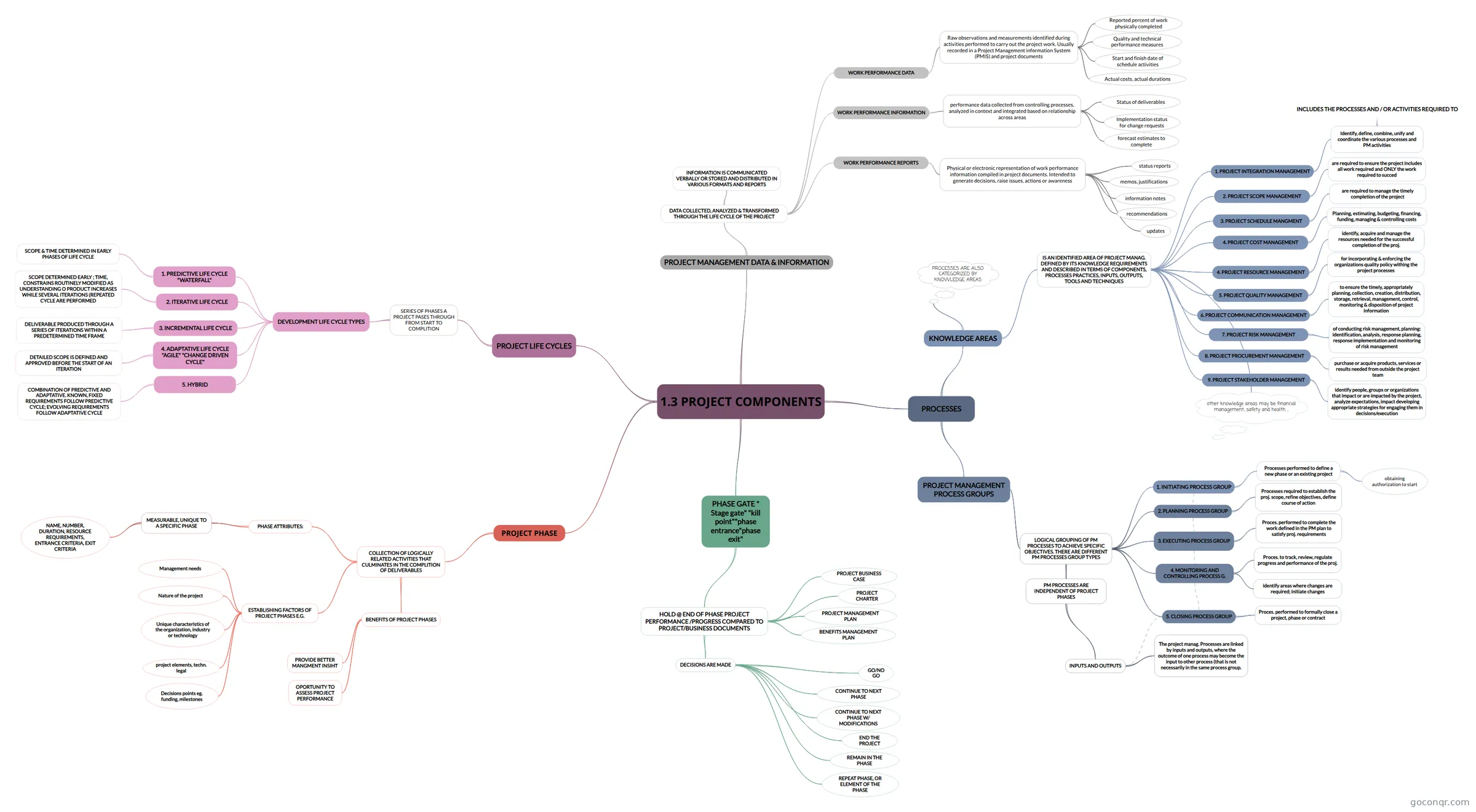
Mind map: project components
Conteúdo do mapa
1.3 PROJECT COMPONENTS
PROJECT LIFE CYCLES
- SERIES OF PHASES A PROJECT PASES THROUGH FROM START TO COMPLITION
- DEVELOPMENT LIFE CYCLE TYPES
- 1. PREDICTIVE LIFE CYCLE "WATERFALL"
- SCOPE & TIME DETERMINED IN EARLY PHASES OF LIFE CYCLE
- 2. ITERATIVE LIFE CYCLE
- SCOPE DETERMINED EARLY ; TIME, CONSTRAINS ROUTINELY MODIFIED AS UNDERSTANDING O PRODUCT INCREASES WHILE SEVERAL ITERATIONS (REPEATED CYCLE ARE PERFORMED
- 3. INCREMENTAL LIFE CYCLE
- DELIVERABLE PRODUCED THROUGH A SERIES OF ITERATIONS WITHIN A PREDETERMINED TIME FRAME
- 4. ADAPTATIVE LIFE CYCLE "AGILE" "CHANGE DRIVEN CYCLE"
- DETAILED SCOPE IS DEFINED AND APPROVED BEFORE THE START OF AN ITERATION
- 5. HYBRID
- COMBINATION OF PREDICTIVE AND ADAPTATIVE. KNOWN, FIXED REQUIREMENTS FOLLOW PREDICTIVE CYCLE; EVOLVING REQUIREMENTS FOLLOW ADAPTATIVE CYCLE
- 1. PREDICTIVE LIFE CYCLE "WATERFALL"
- DEVELOPMENT LIFE CYCLE TYPES
- SERIES OF PHASES A PROJECT PASES THROUGH FROM START TO COMPLITION
PROJECT PHASE
- COLLECTION OF LOGICALLY RELATED ACTIVITIES THAT CULMINATES IN THE COMPLITION OF DELIVERABLES
- PHASE ATTRIBUTES:
- MEASURABLE, UNIQUE TO A SPECIFIC PHASE
- NAME, NUMBER, DURATION, RESOURCE REQUIREMENTS, ENTRANCE CRITERIA, EXIT CRITERIA
- MEASURABLE, UNIQUE TO A SPECIFIC PHASE
- ESTABLISHING FACTORS OF PROJECT PHASES E.G.
- Management needs
- Nature of the project
- Unique characteristics of the organization, industry or technology
- project elements, techn. legal
- Decisions points eg. funding, milestones
- BENEFITS OF PROJECT PHASES
- PROVIDE BETTER MANGMENT INSIHT
- OPORTUNITY TO ASSESS PROJECT PERFORMANCE
- PHASE ATTRIBUTES:
- COLLECTION OF LOGICALLY RELATED ACTIVITIES THAT CULMINATES IN THE COMPLITION OF DELIVERABLES
PHASE GATE " Stage gate" "kill point""phase entrance"phase exit"
- HOLD @ END OF PHASE PROJECT PERFORMANCE /PROGRESS COMPARED TO PROJECT/BUSINESS DOCUMENTS
- PROJECT BUSINESS CASE
- PROJECT CHARTER
- PROJECT MANAGEMENT PLAN
- BENEFITS MANAGEMENT PLAN
- DECISIONS ARE MADE
- GO/NO GO
- CONTINUE TO NEXT PHASE
- CONTINUE TO NEXT PHASE W/ MODIFICATIONS
- END THE PROJECT
- REMAIN IN THE PHASE
- REPEAT PHASE, OR ELEMENT OF THE PHASE
- HOLD @ END OF PHASE PROJECT PERFORMANCE /PROGRESS COMPARED TO PROJECT/BUSINESS DOCUMENTS
PROCESSES
- PROJECT MANAGEMENT PROCESS GROUPS
- LOGICAL GROUPING OF PM PROCESSES TO ACHIEVE SPECIFIC OBJECTIVES. THERE ARE DIFFERENT PM PROCESSES GROUP TYPES
- PM PROCESSES ARE INDEPENDENT OF PROJECT PHASES
- INPUTS AND OUTPUTS
- The project manag. Processes are linked by inputs and outputs, where the outcome of one process may become the input to other process (that is not necessarily in the same process group.
- INPUTS AND OUTPUTS
- 1. INITIATING PROCESS GROUP
- Processes performed to define a new phase or an existing project
- obtaining authorization to start
- Processes performed to define a new phase or an existing project
- 2. PLANNING PROCESS GROUP
- Processes required to establish the proj. scope, refine objectives, define course of action
- 3. EXECUTING PROCESS GROUP
- Proces. performed to complete the work defined in the PM plan to satisfy proj. requirements
- 4. MONITORING AND CONTROLLING PROCESS G.
- Proces. to track, review, regulate progress and performance of the proj.
- identify areas where changes are required; initiate changes
- 5. CLOSING PROCESS GROUP
- Proces. performed to formally close a project, phase or contract
- PM PROCESSES ARE INDEPENDENT OF PROJECT PHASES
- LOGICAL GROUPING OF PM PROCESSES TO ACHIEVE SPECIFIC OBJECTIVES. THERE ARE DIFFERENT PM PROCESSES GROUP TYPES
- KNOWLEDGE AREAS
- IS AN IDENTIFIED AREA OF PROJECT MANAG. DEFINED BY ITS KNOWLEDGE REQUIREMENTS AND DESCRIBED IN TERMS OF COMPONENTS, PROCESSES PRACTICES, INPUTS, OUTPUTS, TOOLS AND TECHNIQUES
- 1. PROJECT INTEGRATION MANAGEMENT
- Identify, define, combine, unify and coordinate the various processes and PM activities
- INCLUDES THE PROCESSES AND / OR ACTIVITIES REQUIRED TO
- Identify, define, combine, unify and coordinate the various processes and PM activities
- 2. PROJECT SCOPE MANAGEMENT
- are required to ensure the project includes all work required and ONLY the work required to succed
- 5. PROJECT QUALITY MANAGEMENT
- for incorporating & enforcing the organizations quality policy withing the project processes
- 8. PROJECT PROCUREMENT MANAGEMENT
- purchase or acquire products, services or results needed from outside the project team
- 7. PROJECT RISK MANAGEMENT
- of conducting risk management, planning: identification, analysis, response planning, response implementation and monitoring of risk management
- 9. PROJECT STAKEHOLDER MANAGEMENT
- identify people, groups or organizations that impact or are impacted by the project, analyze expectations, impact developing appropriate strategies for engaging them in decisions/execution
- 4. PROJECT RESOURCE MANAGEMENT
- identify, acquire and manage the resources needed for the successful completion of the proj.
- 6. PROJECT COMMUNICATION MANAGEMENT
- to ensure the timely, appropriately planning, collection, creation, distribution, storage, retrieval, management, control, monitoring & disposition of project information
- 3. PROJECT SCHEDULE MANGMENT
- are required to manage the timely completion of the project
- other knowledge areas may be financial management, safety and health ...
- 4. PROJECT COST MANAGEMENT
- Planning, estimating, budgeting, financing, funding, managing & controlling costs
- 1. PROJECT INTEGRATION MANAGEMENT
- PROCESSES ARE ALSO CATEGORIZED BY KNOWLEDGE AREAS
- IS AN IDENTIFIED AREA OF PROJECT MANAG. DEFINED BY ITS KNOWLEDGE REQUIREMENTS AND DESCRIBED IN TERMS OF COMPONENTS, PROCESSES PRACTICES, INPUTS, OUTPUTS, TOOLS AND TECHNIQUES
- PROJECT MANAGEMENT PROCESS GROUPS
PROJECT MANAGEMENT DATA & INFORMATION
- DATA COLLECTED, ANALYZED & TRANSFORMED THROUGH THE LIFE CYCLE OF THE PROJECT
- INFORMATION IS COMMUNICATED VERBALLY OR STORED AND DISTRIBUTED IN VARIOUS FORMATS AND REPORTS
- WORK PERFORMANCE DATA
- Raw observations and measurements identified during activities performed to carry out the project work. Usually recorded in a Project Management information System (PMIS) and project documents
- Reported percent of work physically completed
- Quality and technical performance measures
- Start and finish date of schedule activities
- Actual costs, actual durations
- Raw observations and measurements identified during activities performed to carry out the project work. Usually recorded in a Project Management information System (PMIS) and project documents
- WORK PERFORMANCE INFORMATION
- performance data collected from controlling processes, analyzed in context and integrated based on relationship across areas
- Status of deliverables
- Implementation status for change requests
- forecast estimates to complete
- performance data collected from controlling processes, analyzed in context and integrated based on relationship across areas
- WORK PERFORMANCE REPORTS
- Physical or electronic representation of work performance information compiled in project documents. Intended to generate decisions, raise issues, actions or awareness
- status reports
- memos, justifications
- information notes
- recommendations
- updates
- Physical or electronic representation of work performance information compiled in project documents. Intended to generate decisions, raise issues, actions or awareness
- DATA COLLECTED, ANALYZED & TRANSFORMED THROUGH THE LIFE CYCLE OF THE PROJECT
Informações
- Descrição
- PMBOK CHAPTER 1 part 3
- Criado por
- ana cordoba
- Visualizações
- 5
- Avaliação
Mais sobre Project Life Cycle and Process Groups