
Mapa mental
Leadership
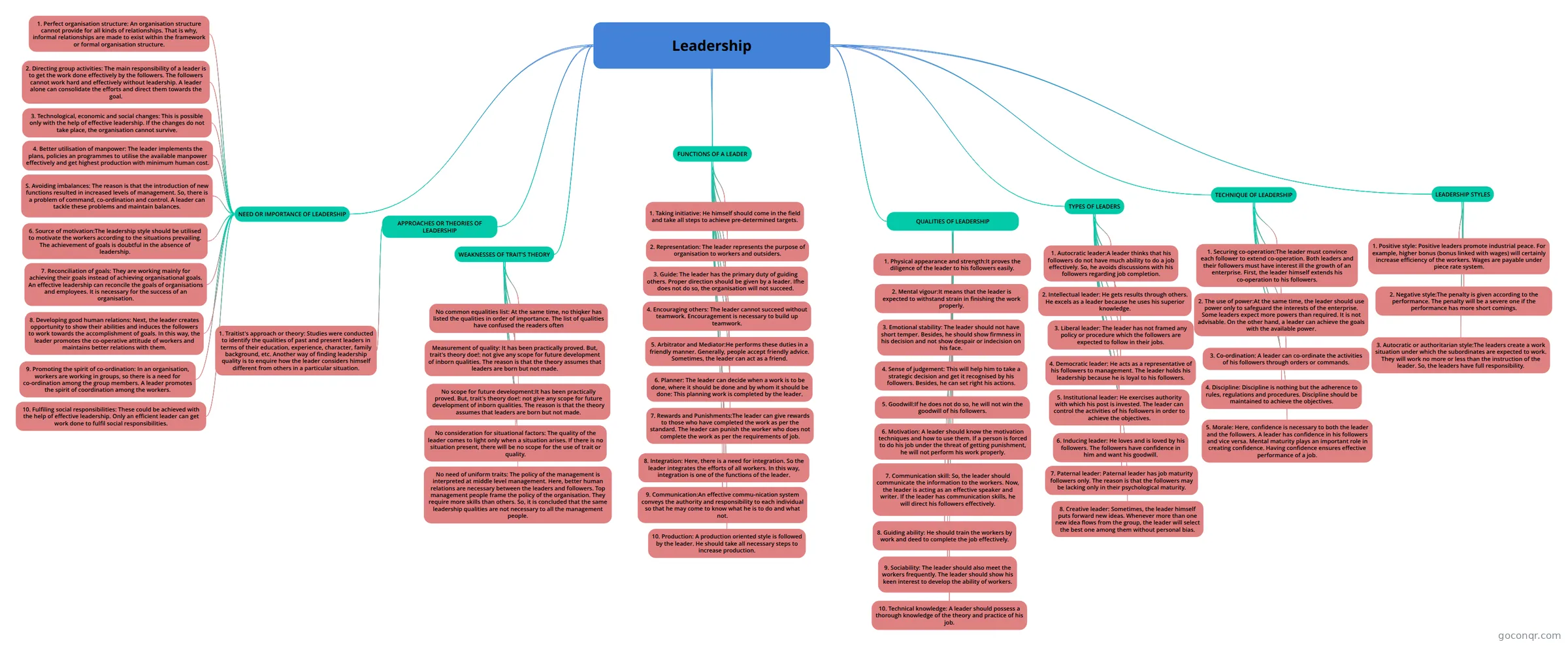
Mind map: Leadership
Conteúdo do mapa
Leadership
NEED OR IMPORTANCE OF LEADERSHIP
- 4. Better utilisation of manpower: The leader implements the plans, policies an programmes to utilise the available manpower effectively and get highest production with minimum human cost.
- S. Avoiding imbalances: The reason is that the introduction of new functions resulted in increased levels of management. So, there is a problem of command, co-ordination and control. A leader can tackle these problems and maintain balances.
- 3. Technological, economic and social changes: This is possible only with the help of effective leadership. If the changes do not take place, the organisation cannot survive.
- 2. Directing group activities: The main responsibility of a leader is to get the work done effectively by the followers. The followers cannot work hard and effectively without leadership. A leader alone can consolidate the efforts and direct them towards the goal.
- 10. Fulfiling social responsibilities: These could be achieved with the help of effective leadership. Only an efficient leader can get work done to fulfil social responsibilities.
- 1. Perfect organisation structure: An organisation structure cannot provide for all kinds of relationships. That is why, informal relationships are made to exist within the framework or formal organisation structure.
- 6. Source of motivation:The leadership style should be utilised to motivate the workers according to the situations prevailing. The achievement of goals is doubtful in the absence of leadership.
- 8. Developing good human relations: Next, the leader creates opportunity to show their abilities and induces the followers to work towards the accomplishment of goals. In this way, the leader promotes the co-operative attitude of workers and maintains better relations with them.
- 9. Promoting the spirit of co-ordination: In an organisation, workers are working in groups, so there is a need for co-ordination among the group members. A leader promotes the spirit of coordination among the workers.
- 7. Reconciliation of goals: They are working mainly for achieving their goals instead of achieving organisational goals. An effective leadership can reconcile the goals of organisations and employees. It is necessary for the success of an organisation.
APPROACHES OR THEORIES OF LEADERSHIP
- 1. Traitist's approach or theory: Studies were conducted to identify the qualities of past and present leaders in terms of their education, experience, character, family background, etc. Another way of finding leadership quality is to enquire how the leader considers himself different from others in a particular situation.
WEAKNESSES OF TRAIT'S THEORY
- No common equalities list: At the same time, no thiqker has listed the qualities in order of importance. The list of qualities have confused the readers often
- Measurement of quality: It has been practically proved. But, trait's theory doe!: not give any scope for future development of inborn qualities. The reason is that the theory assumes that leaders are born but not made.
- No scope for future development:It has been practically proved. But, trait's theory doe!: not give any scope for future development of inborn qualities. The reason is that the theory assumes that leaders are born but not made.
- No consideration for situational factors: The quality of the leader comes to light only when a situation arises. If there is no situation present, there will be no scope for the use of trait or quality.
- No need of uniform traits: The policy of the management is interpreted at middle level management. Here, better human relations are necessary between the leaders and followers. Top management people frame the policy of the organisation. They require more skills than others. So, it is concluded that the same leadership qualities are not necessary to all the management people.
FUNCTIONS OF A LEADER
- 1. Taking initiative: He himself should come in the field and take all steps to achieve pre-determined targets.
- 2. Representation: The leader represents the purpose of organisation to workers and outsiders.
- 3. Guide: The leader has the primary duty of guiding others. Proper direction should be given by a leader. Ifhe does not do so, the organisation will not succeed.
- 4. Encouraging others: The leader cannot succeed without teamwork. Encouragement is necessary to build up teamwork.
- 5. Arbitrator and Mediator:He performs these duties in a friendly manner. Generally, people accept friendly advice. Sometimes, the leader can act as a friend.
- 6. Planner: The leader can decide when a work is to be done, where it should be done and by whom it should be done: This planning work is completed by the leader.
- 7. Rewards and Punishments:The leader can give rewards to those who have completed the work as per the standard. The leader can punish the worker who does not complete the work as per the requirements of job.
- 8. Integration: Here, there is a need for integration. So the leader integrates the efforts of all workers. In this way, integration is one of the functions of the leader.
- 9. Communication:An effective commu-nication system conveys the authority and responsibility to each individual so that he may come to know what he is to do and what not.
- 10. Production: A production oriented style is followed by the leader. He should take all necessary steps to increase production.
QUALITIES OF LEADERSHIP
- 1. Physical appearance and strength:It proves the diligence of the leader to his followers easily.
- 2. Mental vigour:It means that the leader is expected to withstand strain in finishing the work properly.
- 3. Emotional stability: The leader should not have short temper. Besides, he should show firmness in his decision and not show despair or indecision on his face.
- 4. Sense of judgement: This will help him to take a strategic decision and get it recognised by his followers. Besides, he can set right his actions.
- 5. Goodwill:If he does not do so, he will not win the goodwill of his followers.
- 6. Motivation: A leader should know the motivation techniques and how to use them. If a person is forced to do his job under the threat of getting punishment, he will not perform his work properly.
- 7. Communication skill: So, the leader should communicate the information to the workers. Now, the leader is acting as an effective speaker and writer. If the leader has communication skills, he will direct his followers effectively.
- 8. Guiding ability: He should train the workers by work and deed to complete the job effectively.
- 9. Sociability: The leader should also meet the workers frequently. The leader should show his keen interest to develop the ability of workers.
- 10. Technical knowledge: A leader should possess a thorough knowledge of the theory and practice of his job.
TYPES OF LEADERS
- 1. Autocratic leader:A leader thinks that his followers do not have much ability to do a job effectively. So, he avoids discussions with his followers regarding job completion.
- 2. Intellectual leader: He gets results through others. He excels as a leader because he uses his superior knowledge.
- 3. Liberal leader: The leader has not framed any policy or procedure which the followers are expected to follow in their jobs.
- 4. Democratic leader: He acts as a representative of his followers to management. The leader holds his leadership because he is loyal to his followers.
- 5. Institutional leader: He exercises authority with which his post is invested. The leader can control the activities of his followers in order to achieve the objectives.
- 6. Inducing leader: He loves and is loved by his followers. The followers have confidence in him and want his goodwill.
- 7. Paternal leader: Paternal leader has job maturity followers only. The reason is that the followers may be lacking only in their psychological maturity.
- 8. Creative leader: Sometimes, the leader himself puts forward new ideas. Whenever more than one new idea flows from the group, the leader will select the best one among them without personal bias.
TECHNIQUE OF LEADERSHIP
- 1. Securing co-operation:The leader must convince each follower to extend co-operation. Both leaders and their followers must have interest ill the growth of an enterprise. First, the leader himself extends his co-operation to his followers.
- 2. The use of power:At the same time, the leader should use power only to safeguard the interests of the enterprise. Some leaders expect more powers than required. It is not advisable. On the other hand, a leader can achieve the goals with the available power.
- 3. Co-ordination: A leader can co-ordinate the activities of his followers through orders or commands.
- 4. Discipline: Discipline is nothing but the adherence to rules, regulations and procedures. Discipline should be maintained to achieve the objectives.
- 5. Morale: Here, confidence is necessary to both the leader and the followers. A leader has confidence in his followers and vice versa. Mental maturity plays an important role in creating confidence. Having confidence ensures effective performance of a job.
LEADERSHIP STYLES
- 1. Positive style: Positive leaders promote industrial peace. For example, higher bonus (bonus linked with wages) will certainly increase efficiency of the workers. Wages are payable under piece rate system.
- 2. Negative style:The penalty is given according to the performance. The penalty will be a severe one if the performance has more short comings.
- 3. Autocratic or authoritarian style:The leaders create a work situation under which the subordinates are expected to work. They will work no more or less than the instruction of the leader. So, the leaders have full responsibility.
Informações
- Descrição
- Mapa Mental sobre Leadership, criado por ximena Jimenez em 20-11-2018.
- Criado por
- ximena Jimenez
- Visualizações
- 2
- Avaliação