
Mapa mental
The Audiolingual Method
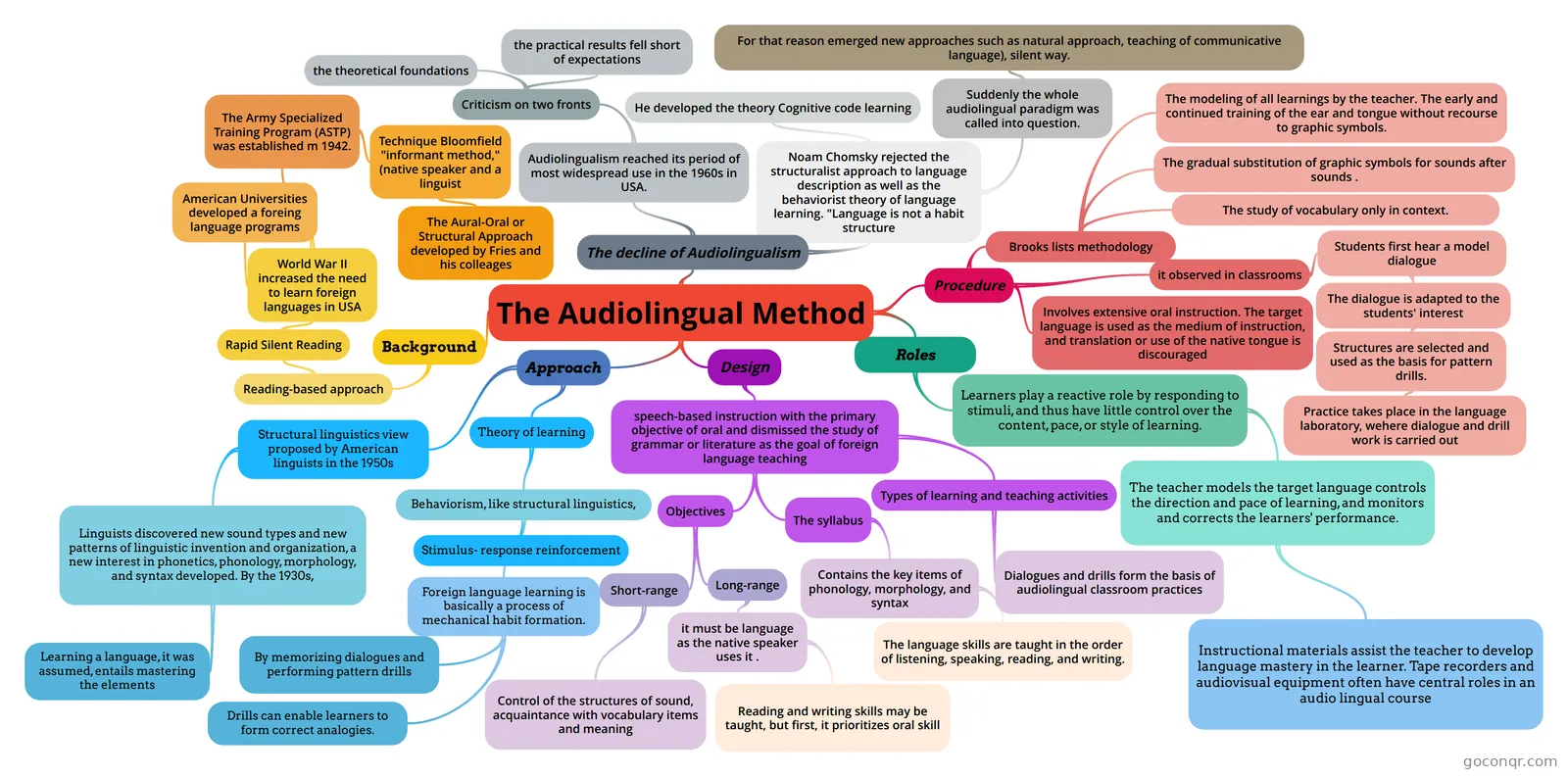
Mind map: The Audiolingual Method
Conteúdo do mapa
The Audiolingual Method
Background
- Reading-based approach
- Rapid Silent Reading
- World War II increased the need to learn foreign languages in USA
- The Army Specialized Training Program (ASTP) was established m 1942.
- Technique Bloomfield "informant method," (native speaker and a linguist
- The Aural-Oral or Structural Approach developed by Fries and his colleages
- Technique Bloomfield "informant method," (native speaker and a linguist
- American Universities developed a foreing language programs
- The Army Specialized Training Program (ASTP) was established m 1942.
- World War II increased the need to learn foreign languages in USA
- Rapid Silent Reading
- Reading-based approach
Approach
- Structural linguistics view proposed by American linguists in the 1950s
- Linguists discovered new sound types and new patterns of linguistic invention and organization, a new interest in phonetics, phonology, morphology, and syntax developed. By the 1930s,
- Learning a language, it was assumed, entails mastering the elements
- Linguists discovered new sound types and new patterns of linguistic invention and organization, a new interest in phonetics, phonology, morphology, and syntax developed. By the 1930s,
- Theory of learning
- Behaviorism, like structural linguistics,
- Stimulus- response reinforcement
- Foreign language learning is basically a process of mechanical habit formation.
- Drills can enable learners to form correct analogies.
- By memorizing dialogues and performing pattern drills
- Behaviorism, like structural linguistics,
- Structural linguistics view proposed by American linguists in the 1950s
Design
- speech-based instruction with the primary objective of oral and dismissed the study of grammar or literature as the goal of foreign language teaching
- Objectives
- Short-range
- Control of the structures of sound, acquaintance with vocabulary items and meaning
- Long-range
- it must be language as the native speaker uses it .
- Reading and writing skills may be taught, but first, it prioritizes oral skill
- it must be language as the native speaker uses it .
- Short-range
- The syllabus
- Contains the key items of phonology, morphology, and syntax
- The language skills are taught in the order of listening, speaking, reading, and writing.
- Contains the key items of phonology, morphology, and syntax
- Types of learning and teaching activities
- Dialogues and drills form the basis of audiolingual classroom practices
- Objectives
- speech-based instruction with the primary objective of oral and dismissed the study of grammar or literature as the goal of foreign language teaching
Roles
- Learners play a reactive role by responding to stimuli, and thus have little control over the content, pace, or style of learning.
- The teacher models the target language controls the direction and pace of learning, and monitors and corrects the learners' performance.
- Instructional materials assist the teacher to develop language mastery in the learner. Tape recorders and audiovisual equipment often have central roles in an audio lingual course
- The teacher models the target language controls the direction and pace of learning, and monitors and corrects the learners' performance.
- Learners play a reactive role by responding to stimuli, and thus have little control over the content, pace, or style of learning.
Procedure
- Involves extensive oral instruction. The target language is used as the medium of instruction, and translation or use of the native tongue is discouraged
- Brooks lists methodology
- The modeling of all learnings by the teacher. The early and continued training of the ear and tongue without recourse to graphic symbols.
- The gradual substitution of graphic symbols for sounds after sounds .
- The study of vocabulary only in context.
- it observed in classrooms
- Students first hear a model dialogue
- The dialogue is adapted to the students' interest
- Structures are selected and used as the basis for pattern drills.
- Practice takes place in the language laboratory, wehere dialogue and drill work is carried out
- Structures are selected and used as the basis for pattern drills.
- The dialogue is adapted to the students' interest
- Students first hear a model dialogue
The decline of Audiolingualism
- Audiolingualism reached its period of most widespread use in the 1960s in USA.
- Criticism on two fronts
- the theoretical foundations
- the practical results fell short of expectations
- Criticism on two fronts
- Noam Chomsky rejected the structuralist approach to language description as well as the behaviorist theory of language learning. "Language is not a habit structure
- He developed the theory Cognitive code learning
- Suddenly the whole audiolingual paradigm was called into question.
- For that reason emerged new approaches such as natural approach, teaching of communicative language), silent way.
- Audiolingualism reached its period of most widespread use in the 1960s in USA.
Informações
- Descrição
- Mapa Mental sobre The Audiolingual Method, criado por mayra aucapiña em 13-12-2018.
- Criado por
- mayra aucapiña
- Visualizações
- 1
- Histórico
-
- Criado por mayra aucapiña · 4 out 2018
- Copiado por mayra aucapiña · 13 dez 2018
- Avaliação
Mais sobre Traditional Language Teaching Methods