
Mapa mental
The Event Industry
Conteúdo do mapa
The Event Industry
Chapter 1: Introduction to the Meetings, Expositions, Events, and Conventions Industry
- Accepted Practices Exchange (APEX): an initiative of the CIC that has brought together all stakeholders in the development and implementation of the industry-wide accepted practices to create and enhance efficiencies throughout the meetings, conventions, and exhibitions industry.
- Results of accepted practices implementation will be: • Time and cost savings • Eased communication and sharing of data • Enhanced Customer Service • Streamlined systems and processes • Less duplication of effort and increased operational efficiencies. • Betted educated, more professional employees.
- CMP is an important title to have in the industry.
- What is a meeting? A gathering for business, educational, or social purposes.
- - When someone adds displays of materials or products to a meeting, the meeting then has a trade show or exposition/exhibit component. - When sporting, social, or life cycle activities are added, then a generic term that encompasses them all is events. - Even broader and more generic term is: gathering.
- The Organizational Structure of the Hospitality Industry
- Lodging
- Food and Beverage
- Transportation
- • Air • Water • Ground
- Attractions
- • Natural: Includes mountains, seashores, lakes, forests, swamps, climate, and rivers. • Person-made: Consist of things made or constructed by human beings, including buildings such as monuments, museums, theme parks, zoos, aquariums, and some restaurants and shopping venues.
- Entertainment
- Shopping
- History
- Despite its LONG history, meeting planning as a recognized profession did not develop until 1972, when the MPI (Meeting Professionals International) was founded.
- The government didn't even list "meeting planner" as a recognized profession until the late 1980s.
- Despite its LONG history, meeting planning as a recognized profession did not develop until 1972, when the MPI (Meeting Professionals International) was founded.
- Economic Impact
- Supports 1.7 million jobs in the U.S.
- 1 in every 86 individuals is employed in some aspect of the industry.
- Create nearly $40 billion in tax revenue at the federal, state, and local level.
- Why have meetings and events?
- Face-to-face meetings have the benefit of including all forms of communication, including verbal and nonverbal.
- When we meet, we build “communities of practice.” Through these we are able to: strengthen skills, impact change, observe accomplishments, and learn about new products in our field.
- MEEC is a “relationship industry,” that is, one built on who you know and with whom you do business.
- Accepted Practices Exchange (APEX): an initiative of the CIC that has brought together all stakeholders in the development and implementation of the industry-wide accepted practices to create and enhance efficiencies throughout the meetings, conventions, and exhibitions industry.
Chapter 2: Meeting, Exhibition, Event and Convention Organizers and Sponsors
- Who holds the meetings? The 3 most significant entities that organize and sponsor gatherings: corporations, associations, and the government.
- Corporations
- Legally chartered enterprises that conduct business on behalf of their owners with the purpose of making a profit and increasing its value.
- Public corporations: sell stock on the open market.
- Private corporations: stocks are not sold on the open market.
- Types of corporate gatherings and events:
- Stockholders Meeting: Attendees are presented with reports on the state of the corporation and have the opportunity to vote on issues of significance.
- Board Meeting: The board of directors is the governing body of a corporation that typically meets several times a year.
- Management Meetings: Every major division of a corporation may have a need to bring its decision makers and other important personnel together to develop plans, review performance, or improve their processes.
- Training Meetings: As companies undergo change, it may be necessary to hold training meetings to bring their managers and key employees up-to-date on improved methods of job performance or to gain skills needed to operate new systems and equipment.
- Incentive Trips: Form of reward for their top performers based on certain criteria.
- Sales training and product launches: These events are often held to upgrade the performance of the sales staff, distributors, and retailers, and to introduce new products and services to distribution networks and the general public.
- Professional and technical training: These meetings may be held to bring managers and other up-to-date on issues relevant to their role within the company and to enhance the knowledge of their service providers.
- Legally chartered enterprises that conduct business on behalf of their owners with the purpose of making a profit and increasing its value.
- Associations
- The act of being associated for certain common purposes, whether for professional, industrial, educational, scientific, or social reasons.
- Major differences between association and corporate gatherings: - Attendance is voluntary, not mandatory. - Attendees are responsible for their registration, transportation, hotel, and related expenses. - Tend to be large, ranging from several hundred to tens of thousands of attendees.
- Types of associations: - Local - State - Regional - National - International - Professional - Not-for-profits - SMERFs: Social, Military, Educational, Religious, and Fraternal.
- Types of association gatherings and events:
- Conventions: Assemblies of people for a common purpose.
- Orlando: Second largest convention center in the U.S.
- Board Meetings: Board of directors typically meet several times a year to provide collective advice and direction to the association. (Usually the smallest meeting held.)
- Committee Meetings: Many association committees will hold smaller meetings to discuss the affairs related to their purpose.
- Regional Conferences: Organizations with a regional structure often schedule one or more events each year to bring together members who are in the same geographic area.
- Training Meetings: Associations often offer their members opportunities to upgrade their professional skills and knowledge through meetings targeted to specific topics.
- Educational Seminars: Association meetings led by an expert and allowing participants to share their views and experiences.
- Conventions: Assemblies of people for a common purpose.
- Government
- Governmental entities at all levels have continuing needs to hold gatherings, since they have continuing needs to communicate and interact with many constituent bodies.
- Meetings may involve the attendance of world leaders, with large groups of protestors and supporters, or a small group of elected officials holding a legislative retreat.
- The purpose of many government meetings is the training of government workers.
- Attendance by employees at government meeting would generally be mandatory, while attendance by the general public would be voluntary.
- EVERYTHING IS ABOUT SECURITY!
- Governmental entities at all levels have continuing needs to hold gatherings, since they have continuing needs to communicate and interact with many constituent bodies.
CHAPTER 3: Destination Marketing Organizations (DMOs)
- DMOs are often called convention and visitor bureaus (CVBs) are non-profit organizations charged with representing a specific destination and helping the long-term development of communities through a travel and tourism strategy.
- The DMO is each city has 3 prime responsibilities: - To encourage groups to hold meetings, conventions, and trade shows in the city or area it represents. - To assist those groups with their meetings and meeting preparations. - To encourage tourists to visit and enjoy the historic, cultural, and recreational opportunities that the destination offers.
- A DMO does NOT organize meetings, events, and conventions. However, it assists planner and visitors in learning about the destination and area attractions.
- The purpose of a DMO:
- Membership organizations bringing together local businesses that rely on tourism and meetings for revenue.
- Serve as the “official” contact point for their destination.
- For conventions, they are often the intermediary between sponsoring organization and hospitality businesses.
- Offer unbiased information about a destination’s services and facilities.
Chapter 4: Meeting and Convention Venues
- Hotels
- The second most common place for a meeting.
- Meetin g spaces vary widely in size and variety.
- By linking sleeping room use with meeting space availability, hoteliers found they could induce meeting planners to use their facilities because the meeting space was free, at least to them.
- The planner’s ultimate goal is to get credit for every room night the hotel sells that it would not have sold if the meeting were held somewhere else.
- Seasonality and fluctuating occupancy levels can have a significant impact on the cost of using a facility.
- Off-season prices may be as little as half of its peak-season price.
- By paying attention to patters, planners can find true bargains.
- Convention Centers
- Designed to handle larger events that could be supported at a hotel.
- Their very size is both their strength and their weakness.
- Most are owned by government entities.
- How does a convention make money? Taxpayers will not support a big building if it makes no money.
- Charge for everything they provide on a pay-per-use basis.
- Room rental, by the square foot per day, is the center’s biggest single revenue source.
- Massive portion of budgets is spent on energy.
- Conference Centers
- Small, well-appointed facilities specifically designed to enhance classroom-style learning.
- Many employ a pricing strategy called: complete meeting package.
- Means that whatever the facility owns, the planner may use at no additional charge.
- A planner deciding whether to use the package or buy their own equipment needs to look beyond the costs, they need to evaluate the proper use of their time.
- Difference between a convention center and an executive/conference center: Executive center is guided toward educational purposes. Convention center: nothing is bolted in floor, rebuild and take down as desired.
- Retreat Facilities
- More likely to be owned by a family or closely held corporation.
- Focus on smaller portion of the conference center market.
- Often specialize in unique extracurricular learning opportunities.
- Cruise Ships
- Often underrated as meeting venues.
- The quality of planning for a cruise event has a greater impact on the success of the meeting than it does with any other type of venue.
- Have been long considered ideal venues for incentive trips.
- Many offer complete meeting packages. Include everything except the bar tab and taxes.
- Special Use Facilities (Theaters, amphitheaters, arenas, stadiums, and sports facilities.)
- Most of these facilities are focused on events for the general (ticket-buying) public, and a closed event for an invited audience can be a welcome change for their staff.
- Typically owned by government agencies or are public-private partnerships.
- There is generally a fixed fee for the use of the facility and a specific subset of its equipment and services.
- Colleges and Universities
- Few colleges are equipped for major meetings.
- More college campuses are offering conference services to willing clients, particularly those looking for an economical or budget conscious option.
- Match the venue (location) with the goals and objectives of the meeting (who are they and why are they here?).
- "If that’s what you want, I’ll do it BUT let me show you something else and walk you through it.”
- Hotels
Chapter 5: Exhibitions
- History
- Germany and France has the first recorded history of organizing the earliest organized fairs.
- The industry blossomed in the late 1800s.
- To increase awareness and value to exhibitions, a group of industry professionals created the National Association of Exposition Managers in 1978.
- Has more than 8,500 members sponsoring, hosting, and organizing exhibits worldwide.
- Types of Shows
- Trade Show: typically a business-to-business event.
- Private and not open to the public.
- Consumer or Public Show: expositions open to the public and offer a wide variety of products for sale.
- Used by a consumer-based industry to bring their goods directly to their market’s end user.
- Consolidation Show: open to both industry buyers and the general public.
- Exhibitors are manufacturers or distributors.
- Trade Show: typically a business-to-business event.
- Economic Forecast
- Attendance, number of exhibits, amount of space, and revenue have seen a decline since 2007.
- Industry professionals predict a slow-to-moderate growth between 2010 and 2012 as the trade show industry transforms the face-to-face experience.
- Performance declined in all four key metrics between 2007-2008 based on survey of more than 300 events.
- Four key metrics: net square feet (NSF), attendees, exhibitors, and revenue.
- Exhibition Management: Key Players
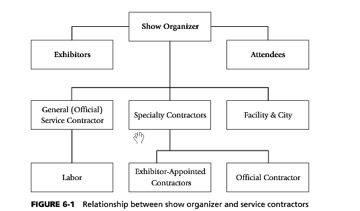
- Exhibition Organizer: may be a trade association, a company subcontracted to the trade association, or a separate company organizing the how as a profit-making venture.
- Responsible for all aspects of managing the show - Implementing the show, marketing it to buyers and sellers, and gathering together all the resources needed for success.
- Facility Manager: known as a convention service manager or event manager: will assist the show manager in arranging the show’s logistical details.
- Size of facility, services available (telecommunications, dining, setup and teardown times), cost, availability or service contractors, preferences of exhibitors and attendees, logistical considerations (airline services, local transportation, parking), and lodging and entertainment in the area.
- General Service Contractor: known as an official exhibit service contractor or decorator: provides products and services to the exhibition management company and the show’s exhibitors.
- Services are often key to the success of a show.
- Exhibition Organizer: may be a trade association, a company subcontracted to the trade association, or a separate company organizing the how as a profit-making venture.
- Consideration in Planning the Show
- Location - A balance must be attained between location, cost, and the ideal attendance level.
- Shipping and Storage - Materials need to be transported: air freight and over-the-road freight.
- Marketing and Promotion - Attendance is key to success! - Primary responsibility of exhibition management companies is to target and market the right audience.
- Technology - Advances have made trade show and exhibition management easier and more productive.
- Risk and Crisis Management - Show organizers and exhibitors need to have a risk management program. -A crisis is different from a risk in that it poses a critical situation that may cause dangers to visitors and exhibitors.
- Crisis management plan should address: prevention, control, and reporting.
- Exhibitors’ Perspective
- Exhibition booths are constructed to exhibit products and to convey a message.
- Layout may also vary by the objectives a company has in mind for the trade show. (Do they want to just meet people? Do they want to sell product/service?)
- Companies must select the shows with the right buyers in attendance.
- History
CHAPTER 6: Service Contractors
- Involved in every aspect of the event from move in, to running the show, to teardown, and move out.
- If you’re using a service contractor, you need to micromanage them. Detailed schedules: keeps everyone involved on track and organized.
- Know EVERY SINGLE DETAIL and hold people accountable!
- EVENTS ARE ALL ABOUT MOVEMENT. How are they moving people in? How are they moving people out? THAT MAKES A GOOD SERVICE CONTRACTOR.
- Everyone involved in a show should be aware of local laws and policies in the city, state/province, country that your show/event regarding use of unionized personnel.
- Evolution of Service Contractors
- One of the major changes has been increasing the scope of their work to center on meeting the needs of exhibitors.
- Exhibitors are reacting by getting much more specific about their wants and needs, and they are also becoming much more discreet and selective when choosing a service contractor.
- One of the major changes has been increasing the scope of their work to center on meeting the needs of exhibitors.
- Organization of a Services Contracting Company
- Different departments are grouped by a common activity or function that support the mission of the company.
- The department that controls and directs the company can be called “administration.” May include GM or CEO, marketing, assistants, receptionists, etc.
- Different departments are grouped by a common activity or function that support the mission of the company.
- Relationship Between Contractors and Event Organizers
- Negotiations will vary by the relationships one has with the contractor and the venue.
CHAPTER 7: Destination Management Companies
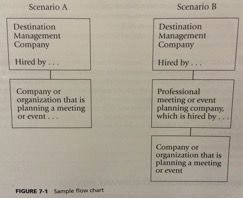
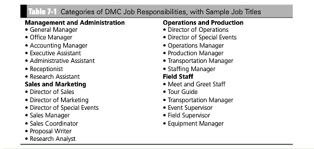
- A professional services company possessing extensive local knowledge, expertise and resources, specializing in the design and implementation of events, activities, tours, transportations and program logistics.
- Services Provided By DMCs
- Meeting and event planners work closely with DMCs to provide recommendations for destination resources that will best fit and satisfy the goals for a gathering.
- Planners rely on DMCs to provide unique and creative event concepts that will accomplish the specific goals of the event, be consistent with other activities carried out in the client’s program, and stay within the client’s budget.
- DMC vs DMO
- DMOs optimize the exposure of a destination, leading it to develop innovative experiences for tourists, enabling the community to develop a sustainable infrastructure to ensure positive returns on investments.
- DMOs work with the interests of both the community at large and the private companies that provide many of these services.
- DMCs will often get leads on new accounts through requests by meeting and event planners that have gone through a DMO.
- Once it has been established that the DMC has the expertise to meet the client’s needs, it will respond to the client’s request for proposal (RFP).
- DMOs optimize the exposure of a destination, leading it to develop innovative experiences for tourists, enabling the community to develop a sustainable infrastructure to ensure positive returns on investments.
- A strategically located office is a basic necessity to winning and operating business. Convenient proximity to major hotels, convention facilities, tourist attractions, and event venues is a must.
- The most valuable asset a DMC has is its history of success!
- DMCs receive business from several categories of customers: corporate, association, incentive-based, or special events clients.
CHAPTER 8: Special Events Management
- A one time event staged for the purpose of celebration.
- Special event is an umbrella term that encompasses all functions that bring people together for a unique purpose.
- It all begins with a relationship!
- Understanding the vision of a client begins and evolves by developing an important relationship between the client and the planner. They must have clear lines of communication.
- The use of the term “special event” in modern history is credited to a Disney imaginer named Robert Janni.
- Planning Tools for a Special Event
- The first tool is a vision statement of your event. This statement should clearly identify the “who, what, when, where, and why” of the event. The “who” of planning an event are those people or organizations that would like to host and organize it.
- Understanding community infrastructure is a key ingredient for a successful event. Without a “buy-in” from the city leadership, a community is less inclined to be supportive.
- Profit for the vendor and a memorable experience for the attendee are two main objectives for a special event.
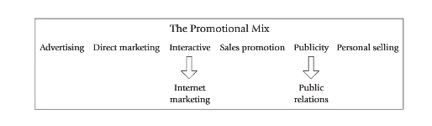
- Understanding and utilizing the promotional mix model is pivotal in order to meet the goals of the event marketing plan.
- Publicity is considered a credible form of promotion, but it’s not always under the control of the organization or host of the event.
- Sponsorships help to ensure profitable success for an event
- Generating media coverage for a special event is one of the most effective methods for attracting attendees.
- Understanding the Target Market
- Consumers have changed; much more selective and sophisticated about the events they will attend.
- The event must be based on the overall needs and desires of the target market.
- The Special Event Budget
- Marketing costs: costs associated with attracting attendees can make up a large portion of the budget.
- Rental costs: renting a facility such as a convention center requires payment of a daily rental charge.
- Security costs: actual costs will depend on the city and the amount of security needed.
- Production costs: costs associated with staging an event.
- Labor costs: the city where the special event is being held will affect the labor costs involved in the setup and breakdown of the event.
- Talent costs: some type of talent or performer.
- It is always best to have written reports to refer to for next year’s event.
CHAPTER 9: Planning and Producing MEEC Gatherings
- The first two things a planner needs to determine is: WHO is the group? And WHY are they here?
- Followed by WHAT is the objective of this event?
- All meetings and events should begin with clear, concise, and measurable objectives.
- Good meeting objectives should focus on the attendees.
- All meetings and events should begin with clear, concise, and measurable objectives.
- Followed by WHAT is the objective of this event?
- A needs analysis is a method of determining the expectations for a particular meeting.
- Ask senior management attendees what they want and design the event around those expectations.
- A planner must keep a detailed group history of who attended the meeting, their likes and dislikes, and all pertinent info that can be used to improve future meetings.
- Developing SMART Objectives
- Specific: only one major concept is covered per objective.
- Measurable: must be able to quantify or measure that you have, or have not, achieved the objective.
- Achievable: is it possible to accomplish the objective?
- Relevant: is the objective important to the overall goals of the organization?
- Time: the objective should include when the objective must be completed.
- Objectives will guide the planning in deciding the physical location for the event, type of facility to use, transportation options, and many other meeting components.
- Budgetary Concerns
- Step 1: establish financial goals.
- Three possible financial goals: •Break even: revenue collected from all activities cover the expenses. No profit expected. •Make profit: revenue collected exceed expenses. •Deficit: expenses exceed revenues.
- Step 2: identify expense.
- Step 3: identify revenue sources. (FUNDING)
- Step 1: establish financial goals.
- Cost Control
- The most important factor is to make sure that the facility understands which person from the sponsoring organization has the authority to make additions or changes to what has been ordered.
- Another cost control measure is to accurately estimate the number of meals that will be served.
- Session Scheduling: TIMING IS CRITICAL.
- Speaker Arrangements: Speaker guidelines or speaker kits should be developed to inform the speakers of the logistics to speak at an event as well as to clearly define the expectations of the organization.
- The first two things a planner needs to determine is: WHO is the group? And WHY are they here?
CHAPTER 10: Food and Beverage
- The quality of the food and beverage function can impact the overall impressions of a meeting.
- Catered Events
- On-premise Catering: defined as being held in a facility that has its own permanent kitchens and function rooms.
- Off-premise Catering: transports food (prepared or to be prepared on site) to a location such as a tented area, museum, park, or attraction.
- There are MANY ways to serve a meal, from self-service to VIP white-glove service.
- Change of menu is necessary to keep pace with the changing tastes of the public.
- Servers should know the ingredients and preparation method of every item on the menu.
- Many attendees have allergies or are restricted from eating certain items like sugar or salt due to health concerns.
- Attrition
- The planner agrees in the contract to buy a specific number of meals or to spend a specific amount of money on group food and beverage; the caterer’s obligation is to provide the service and the food.
- If the guarantee is not met, the planner must pay the difference.
- Meeting planners should know how much revenue their meeting produces before negotiating an attrition clause.
- Beverage Events
- Reason for beverage receptions: socializing (to loosen guests up) and networking (to look for a job or business leads).
- Categories of liquor: Well: sometimes called House Liquors; less expensive. Call: priced in the midrange and are generally asked for by the name. Premium: high-quality, expensive liquors.
CHAPTER 11: Legal Issues in the MEEC Industry
- Negotiation
- The real “winner” may be the party who is better prepared entering the negotiation and has a good idea of what he or she wants.
- Bluff, but DO NOT lie.
- LISTEN. And DO NOT get emotional.
- BE THOROUGH.
- READ THE SMALL PRINT.
- Contracts
- Essential elements of a contract: o An offer by one party. o Acceptance of the offer as presented. (Typically done by signing the contract.) o Consideration. (Usually expressed in monetary terms.)
- KNOW WHAT THE SCOPE OF THE CONTRACT IS.
- A valid written contract MUST contain the identity of the parties, and identification or recitation of the subject matter and terms of agreement, and a statement of consideration.
- Parol evidence: evidence of oral agreement.
- Attrition clauses provide for the payment of damages to the hotel when a meeting organizer fails to fully utilize the room block specified in the contract.
- Cancellation: This is the provision that provides for damages should the meeting be canceled for reasons other than those specified.
- Termination (Sometimes called a force majeure or Act of God clause): This permits either party to termination the contract without damages if fulfillment of the obligations imposed in the agreement is rendered impossible by occurrences outside of the control of either party.
- No matter how carefully a contract is written, disputes may occur either because the parties might disagree as to their individual rights and obligations or because one of the parties may perform less than had been promised.
- Arbitration: settlement of a dispute by a person or persons chosen to hear both sides and come to a decision.
- Risk management is part of the meeting planning process.
- STAGES: Preparedness: organizer would have assessed and analyzed the possible risks during the planning stage. Mitigation: the planner would try to determine what he or she could do to decrease the probability that rain would occur, and to decrease the consequences if it did rain. Response: figuring out both WHEN to respond and HOW. Recovery: a risk that results in loss or harm can cause damage to property, people, or to more intangible aspects – like the organizer or planner’s reputation. Recovery might include refunding exhibitor’s or attendee’s fees or filing a claim with the insurance company.
- COPYRIGHT LAWS ARE VERY IMPORTANT.
- “There is no right way to do the wrong thing.”
- Negotiation
CHAPTER 12: Technology and the Meeting ProfessionaL
- Tech-savvy meeting professionals have more tools than ever before to help research, promote, and organize their event.
- World Wide Web developed in the mid-late 1990s.
- RFPs and the web: allow planners to input their specs easily, and allow the web to be the conduit for distributing the info to potential cities and hotels.
- Over ½ of all meetings are booked without formal site inspection due to the capabilities of a virtual tour.
- The Meetings Industry Megasite: managed by two of the most popular industry publications; essential tool for planners in their site selection quest.
- The past years have seen the rise of social network sites as a critical tool as to how we market and communicate with our clients, customers, and constituents.
- Social networks are at the root of the MEEC industry’s success.
- The 3 big players: Facebook (event pages), Twitter (use of hashtags), and LinkedIn (individual networking tool; business network).
- Social networks are at the root of the MEEC industry’s success.
- An event web site is to today what the conference marketing brochure was a generation ago: a place to provide info, create interest, and get people to register for the conference.
- Must include: a clear and easy way to find info, should clearly state the 5 W’s about the conference (who, what, where, when, and why), and the ability to make the sale aka the payment process on the registration form.
- RSS: most important approach to the Web today: it’s a tool where a site creates or gathers a feed of info about a specific topic, and publishes it as an RSS feed.
- Online registration: CRITICAL BENEFIT: enhanced the marketing and communication of the event organizer. BUT NOT ALL MEETINGS USE ONLINE REGISTRATION; some prefer traditional approaches.
- Setting up infrastructure: tech-savvy planner understands enough about the technologies that support their event that they know what the need to plan for (even negotiate) during the initial stages of planning.
- A facility that allows for the attendees’ computer to pick up a wireless signal, whether it is in their guest room or in the public space, is still AN IMPORTANT service to provide.
- The General Session is a critical part of any annual meeting or conference. Marketing success depends on the quality of the keynotes, who establish the tone of a conference.
CHAPTER 13: Green Meetings and Social Responsibilities
- The Green Movement: First started in the 1960s with environmentalists advocating the sustainable management of resources and the protection of the natural environment through changes in public policy and individual behavior.
- Green meeting: a common expression meaning environmentally responsible.
- Why go green?
- it makes good business sense to go green.
- Companies that choose to do so are reporting higher gross margins, higher return on sales, higher return on assets, and a stronger cash flow.
- Social responsibility: idea that businesses should contribute to the welfare of their communities both locally and globally is one of the trends of the millennium.
- it makes good business sense to go green.
- Opportunities to Go Green
- Create standards.
- Use technology.
- Reduce, reuse, recycle.
- Use paper wisely.
- Save energy.
- Greenwashing: refers to any misrepresentation by a company that leads the consumer to believe that its policies and products are environmentally responsible, when its claims are false, misleading, or cannot be verified.
- Also used to identify when companies are spending more money on the campaign to notify customers of their environmentally friendly efforts, than the efforts themselves.
- Meeting industry continues to respond to this challenge; one of the first steps was to identify greenwashing. “Six Sins of Greenwashing”
- In order to prevent greenwashing, meeting planners must be aware, knowledgeable, and not afraid to ask questions.
- ASTM/APEX Green Meeting Standards: completed in 2012, cover nine individual topic areas: accommodations, audiovisual, communication, exhibits, food and beverage, on-site office, destinations, meeting venue, and transportation.
- Certification in Green Meetings & Events, designed to assist meeting professionals with all stages of the meeting planning process in a way that promotes social and environmental responsibility.
- Carbon Footprint Calculator: allows planners to easily see which destination sites have the least amount of carbon emissions generated by air travel based on points of origin.
- Going Green is a phrase referring to individual action that a person (or company) can consciously take to curb harmful effects on the environment through consumer habits, behavior, and lifestyle.
- Sustainability is a more encompassing term that includes implementing and executing a plan to save resources while improving performance.
- The Green Movement: First started in the 1960s with environmentalists advocating the sustainable management of resources and the protection of the natural environment through changes in public policy and individual behavior.
Imagens e arquivos do mapa
Informações
- Descrição
- Mapa Mental sobre The Event Industry, criado por annielaflores em 20-11-2014.
- Criado por
- annielaflores
- Visualizações
- 34
- Avaliação