
Mapa mental
NEGOTIATIONS AND LICENSING
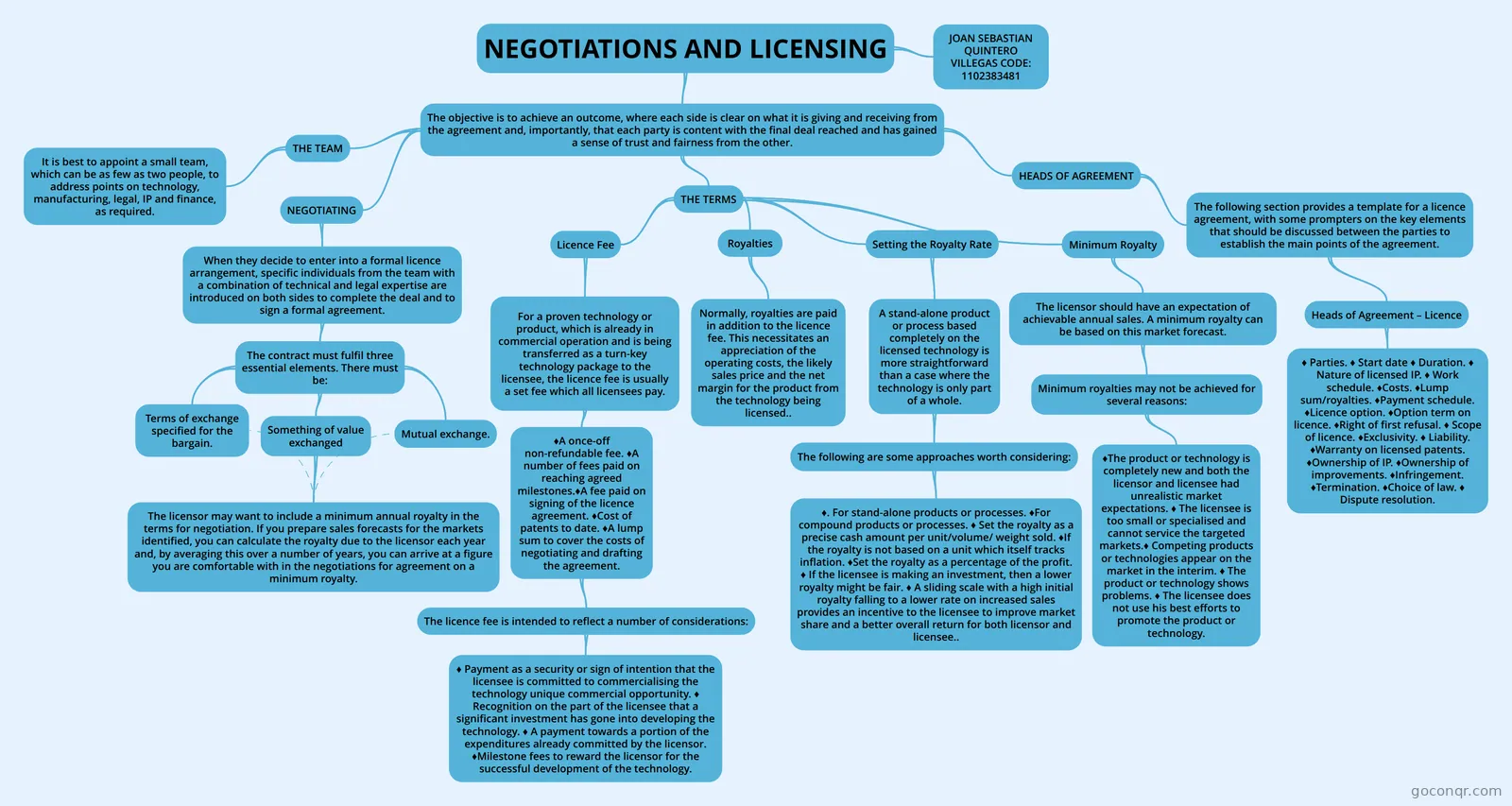
Mind map: negotiations and licensing
Conteúdo do mapa
NEGOTIATIONS AND LICENSING
The objective is to achieve an outcome, where each side is clear on what it is giving and receiving from the agreement and, importantly, that each party is content with the final deal reached and has gained a sense of trust and fairness from the other.
- THE TEAM
- It is best to appoint a small team, which can be as few as two people, to address points on technology, manufacturing, legal, IP and finance, as required.
- NEGOTIATING
- When they decide to enter into a formal licence arrangement, specific individuals from the team with a combination of technical and legal expertise are introduced on both sides to complete the deal and to sign a formal agreement.
- The contract must fulfil three essential elements. There must be:
- Terms of exchange specified for the bargain.
- Something of value exchanged
- The licensor may want to include a minimum annual royalty in the terms for negotiation. If you prepare sales forecasts for the markets identified, you can calculate the royalty due to the licensor each year and, by averaging this over a number of years, you can arrive at a figure you are comfortable with in the negotiations for agreement on a minimum royalty.
- Mutual exchange.
- The contract must fulfil three essential elements. There must be:
- When they decide to enter into a formal licence arrangement, specific individuals from the team with a combination of technical and legal expertise are introduced on both sides to complete the deal and to sign a formal agreement.
- THE TERMS
- Licence Fee
- For a proven technology or product, which is already in commercial operation and is being transferred as a turn-key technology package to the licensee, the licence fee is usually a set fee which all licensees pay.
- ♦A once-off non-refundable fee. ♦A number of fees paid on reaching agreed milestones.♦A fee paid on signing of the licence agreement. ♦Cost of patents to date. ♦A lump sum to cover the costs of negotiating and drafting the agreement.
- The licence fee is intended to reflect a number of considerations:
- ♦ Payment as a security or sign of intention that the licensee is committed to commercialising the technology unique commercial opportunity. ♦ Recognition on the part of the licensee that a significant investment has gone into developing the technology. ♦ A payment towards a portion of the expenditures already committed by the licensor. ♦Milestone fees to reward the licensor for the successful development of the technology.
- The licence fee is intended to reflect a number of considerations:
- ♦A once-off non-refundable fee. ♦A number of fees paid on reaching agreed milestones.♦A fee paid on signing of the licence agreement. ♦Cost of patents to date. ♦A lump sum to cover the costs of negotiating and drafting the agreement.
- For a proven technology or product, which is already in commercial operation and is being transferred as a turn-key technology package to the licensee, the licence fee is usually a set fee which all licensees pay.
- Royalties
- Normally, royalties are paid in addition to the licence fee. This necessitates an appreciation of the operating costs, the likely sales price and the net margin for the product from the technology being licensed..
- Setting the Royalty Rate
- A stand-alone product or process based completely on the licensed technology is more straightforward than a case where the technology is only part of a whole.
- The following are some approaches worth considering:
- ♦. For stand-alone products or processes. ♦For compound products or processes. ♦ Set the royalty as a precise cash amount per unit/volume/ weight sold. ♦If the royalty is not based on a unit which itself tracks inflation. ♦Set the royalty as a percentage of the profit. ♦ If the licensee is making an investment, then a lower royalty might be fair. ♦ A sliding scale with a high initial royalty falling to a lower rate on increased sales provides an incentive to the licensee to improve market share and a better overall return for both licensor and licensee..
- The following are some approaches worth considering:
- A stand-alone product or process based completely on the licensed technology is more straightforward than a case where the technology is only part of a whole.
- Minimum Royalty
- The licensor should have an expectation of achievable annual sales. A minimum royalty can be based on this market forecast.
- Minimum royalties may not be achieved for several reasons:
- ♦The product or technology is completely new and both the licensor and licensee had unrealistic market expectations. ♦ The licensee is too small or specialised and cannot service the targeted markets.♦ Competing products or technologies appear on the market in the interim. ♦ The product or technology shows problems. ♦ The licensee does not use his best efforts to promote the product or technology.
- Minimum royalties may not be achieved for several reasons:
- The licensor should have an expectation of achievable annual sales. A minimum royalty can be based on this market forecast.
- Licence Fee
- HEADS OF AGREEMENT
- The following section provides a template for a licence agreement, with some prompters on the key elements that should be discussed between the parties to establish the main points of the agreement.
- Heads of Agreement – Licence
- ♦ Parties. ♦ Start date ♦ Duration. ♦ Nature of licensed IP. ♦ Work schedule. ♦Costs. ♦Lump sum/royalties. ♦Payment schedule. ♦Licence option. ♦Option term on licence. ♦Right of first refusal. ♦ Scope of licence. ♦Exclusivity. ♦ Liability. ♦Warranty on licensed patents. ♦Ownership of IP. ♦Ownership of improvements. ♦Infringement. ♦Termination. ♦Choice of law. ♦ Dispute resolution.
- Heads of Agreement – Licence
- The following section provides a template for a licence agreement, with some prompters on the key elements that should be discussed between the parties to establish the main points of the agreement.
- THE TEAM
JOAN SEBASTIAN QUINTERO VILLEGAS CODE: 1102383481
Informações
- Descrição
- Mapa Mental sobre NEGOTIATIONS AND LICENSING, criado por Joan Sebastian Quintero Villegas em 01-05-2019.
- Criado por
- Joan Sebastian Quintero Villegas
- Visualizações
- 0
- Avaliação
Mais sobre Licensing Negotiations