
Mapa mental
IKEA Casestudy - Key Topics
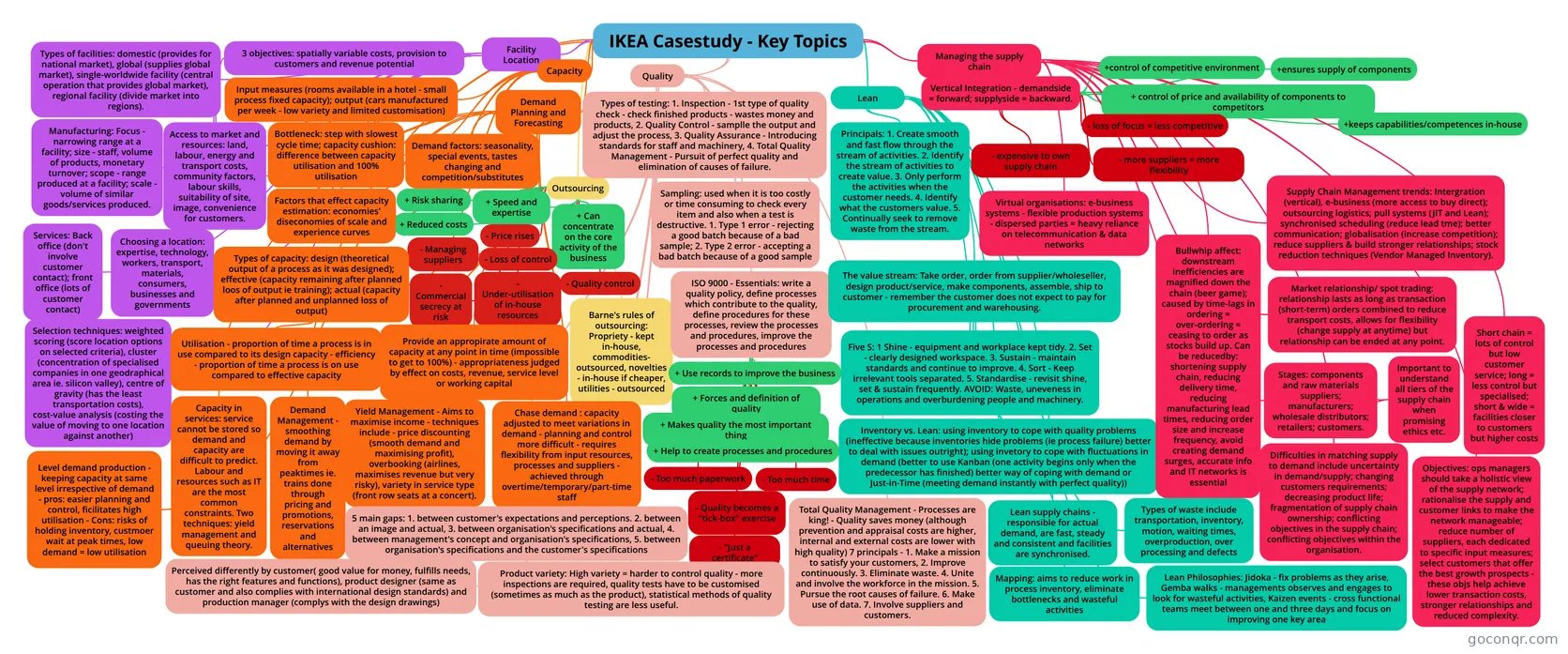
Mind map: IKEA case study key topics
Conteúdo do mapa
IKEA Casestudy - Key Topics
Demand Planning and Forecasting
- Provide an appropirate amount of capacity at any point in time (impossible to get to 100%) - appropriateness judged by effect on costs, revenue, service level or working capital
- Demand factors: seasonality, special events, tastes changing and competition/substitutes
- Level demand production - keeping capacity at same level irrespective of demand - pros: easier planning and control, ficilitates high utilisation - Cons: risks of holding inventory, custmoer wait at peak times, low demand = low utilisation
- Chase demand : capacity adjusted to meet variations in demand - planning and control more difficult - requires flexibility from input resources, processes and suppliers - achieved through overtime/temporary/part-time staff
- Capacity in services: service cannot be stored so demand and capacity are difficult to predict. Labour and resources such as IT are the most common constraints. Two techniques: yield management and queuing theory.
- Yield Management - Aims to maximise income - techniques include - price discounting (smooth demand and maximising profit), overbooking (airlines, maximises revenue but very risky), variety in service type (front row seats at a concert).
Managing the supply chain
- Stages: components and raw materials suppliers; manufacturers; wholesale distributors; retailers; customers.
- Important to understand all tiers of the supply chain when promising ethics etc.
- DIfficulties in matching supply to demand include uncertainty in demand/supply; changing customers requirements; decreasing product life; fragmentation of supply chain ownership; conflicting objectives in the supply chain; conflicting objectives within the organisation.
- Supply Chain Management trends: Intergration (vertical), e-business (more access to buy direct); outsourcing logistics; pull systems (JIT and Lean); synchronised scheduling (reduce lead tme); better communication; globalisation (increase competition); reduce suppliers & build stronger relationships; stock reduction techniques (Vendor Managed Inventory).
- Short chain = lots of control but low customer service; long = less control but specialised; short & wide = facilities closer to customers but higher costs
- Objectives: ops managers should take a holistic view of the supply network; rationalise the supply and customer links to make the network manageable; reduce number of suppliers, each dedicated to specific input measures; select customers that offer the best growth prospects - these objs help achieve lower transaction costs, stronger relationships and reduced complexity.
- Bullwhip affect: downstream inefficiencies are magnified down the chain (beer game); caused by time-lags in ordering = over-ordering = ceasing to order as stocks build up. Can be reducedby: shortening supply chain, reducing delivery time, reducing manufacturing lead times, reducing order size and increase frequency, avoid creating demand surges, accurate info and IT networks is essential
- Market relationship/ spot trading: relationship lasts as long as transaction (short-term) orders combined to reduce transport costs, allows for flexibility (change supply at anytime) but relationship can be ended at any point.
- Virtual organisations: e-business systems - flexible production systems - dispersed parties = heavy reliance on telecommunication & data networks
- Vertical Integration - demandside = forward; supplyside = backward.
- +control of competitive environment
- +ensures supply of components
- + control of price and availability of components to competitors
- +keeps capabilities/competences in-house
- - loss of focus = less competitive
- - more suppliers = more flexibility
- - expensive to own supply chain
- Stages: components and raw materials suppliers; manufacturers; wholesale distributors; retailers; customers.
Facility Location
- Access to market and resources: land, labour, energy and transport costs, community factors, labour skills, suitability of site, image, convenience for customers.
- 3 objectives: spatially variable costs, provision to customers and revenue potential
- Choosing a location: expertise, technology, workers, transport, materials, consumers, businesses and governments
- Selection techniques: weighted scoring (score location options on selected criteria), cluster (concentration of specialised companies in one geodraphical area ie. silicon valley), centre of gravity (has the least transportation costs), cost-value analysis (costing the value of moving to one location against another)
- Types of facilities: domestic (provides for national market), global (supplies global market), single-worldwide facility (central operation that provides global market), regional facility (divide market into regions).
- Manufacturing: Focus - narrowing range at a facility; size - staff, volume of products, monetary turnover; scope - range produced at a facility; scale - volume of similar goods/services produced.
- Services: Back office (don't involve customer contact); front office (lots of customer contact)
- Access to market and resources: land, labour, energy and transport costs, community factors, labour skills, suitability of site, image, convenience for customers.
Quality
- Perceived differently by customer( good value for money, fulfills needs, has the right features and functions), product designer (same as customer and also complies with international design standards) and production manager (complys with the design drawings)
- 5 main gaps: 1. between customer's expectations and perceptions. 2. between an image and actual, 3. between organisation's specifications and actual, 4. between management's concept and organisation's specifications, 5. between organisation's specifications and the customer's specifications
- Types of testing: 1. Inspection - 1st type of quality check - check finished products - wastes money and products, 2. Quality Control - samplle the output and adjust the process, 3. Quality Assurance - Introducing standards for staff and machinery, 4. Total Quality Management - Pursuit of perfect quality and elimination of causes of failure.
- ISO 9000 - Essentials: write a quality policy, define processes which contribute to the quality, define procedures for these processes, review the processes and procedures, improve the processes and procedures
- + Forces and definition of quality
- + Use records to improve the business
- + Makes quality the most important thing
- + Help to create processes and procedures
- - Too much paperwork
- - Too much time
- - Quality becomes a "tick-box" exercise
- - "Just a certificate"
- Sampling: used when it is too costly or time consuming to check every item and also when a test is destructive. 1. Type 1 error - rejecting a good batch because of a bad sample; 2. Type 2 error - accepting a bad batch because of a good sample
- Total Quality Management - Processes are king! - Quality saves money (although prevention and appraisal costs are higher, internal and external costs are lower with high quality) 7 principals - 1. Make a mission to satisfy your customers, 2. Improve continuously. 3. Eliminate waste. 4. Unite and involve the workforce in the mission. 5. Pursue the root causes of failure. 6. Make use of data. 7. Involve suppliers and customers.
- Product variety: High variety = harder to control quality - more inspections are required, quality tests have to be customised (sometimes as much as the product), statistical methods of quality testing are less useful.
Capacity
- Input measures (rooms available in a hotel - small process fixed capacity); output (cars manufactured per week - low variety and limited customisation)
- Types of capacity: design (theoretical output of a process as it was designed); effective (capacity remaining after planned loos of output ie training); actual (capacity after planned and unplanned loss of output)
- Utilisation - proportion of time a process is in use compared to its design capacity - efficiency - proportion of time a process is on use compared to effective capacity
- Bottleneck: step with slowest cycle time; capacity cushion: difference between capacity utilisation and 100% utilisation
- Factors that effect capacity estimation: economies' diseconomies of scale and experience curves
Outsourcing
- + Speed and expertise
- + Can concentrate on the core activity of the business
- + Risk sharing
- + Reduced costs
- - Loss of control
- - Quality control
- - Price rises
- - Under-utilisation of in-house resources
- - Commercial secrecy at risk
- - Managing suppliers
- Barne's rules of outsourcing: Propriety - kept in-house, commodities- outsourced, novelties - in-house if cheaper, utilities - outsourced
Lean
- Principals: 1. Create smooth and fast flow through the stream of activities. 2. Identify the stream of activities to create value. 3. Only perform the activities when the customer needs. 4. Identify what the customers value. 5. Continually seek to remove waste from the stream.
- The value stream: Take order, order from supplier/wholeseller, design product/service, make components, assemble, ship to customer - remember the customer does not expect to pay for procurement and warehousing.
- Mapping: aims to reduce work in process inventory, eliminate bottlenecks and wasteful activities
- Inventory vs. Lean: using inventory to cope with quality problems (ineffective because inventories hide problems (ie process failure) better to deal with issues outright); using invetory to cope with fluctuations in demand (better to use Kanban (one activity begins only when the predecessor has finished) better way of coping with demand or Just-in-Time (meeting demand instantly with perfect quality))
- Five S: 1 Shine - equipment and workplace kept tidy. 2. Set - clearly designed workspace. 3. Sustain - maintain standards and continue to improve. 4. Sort - Keep irrelevant tools separated. 5. Standardise - revisit shine, set & sustain frequently. AVOID: Waste, uneveness in operations and overburdening people and machinery.
- Types of waste include transportation, inventory, motion, waiting times, overproduction, over processing and defects
- Lean Philosophies: Jidoka - fix problems as they arise, Gemba walks - managements observes and engages to look for wasteful activities, Kaizen events - cross functional teams meet between one and three days and focus on improving one key area
- Lean supply chains - responsible for actual demand, are fast, steady and consistent and facilities are synchronised.
Demand Management - smoothing demand by moving it away from peaktimes ie. trains done through pricing and promotions, reservations and alternatives
Informações
- Descrição
- Mapa Mental sobre IKEA Casestudy - Key Topics, criado por magda-junqueira em 23-12-2014.
- Criado por
- magda-junqueira
- Visualizações
- 3
- Avaliação