
Mapa mental
Gross Descriptions for Necropsy
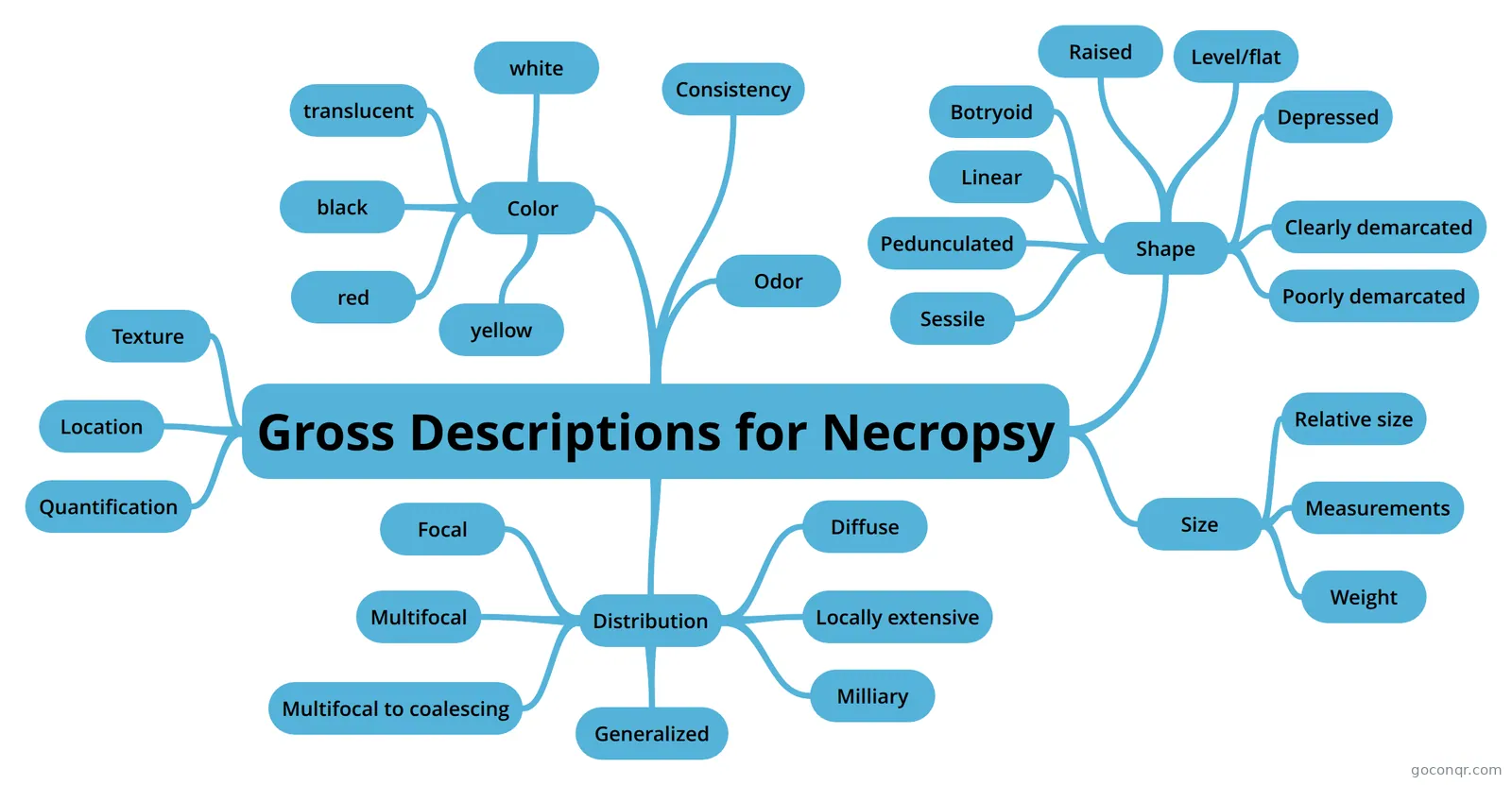
Mind map: gross descriptions for necropsy
Conteúdo do mapa
Gross Descriptions for Necropsy
Location
- start with organ then anatomical location (lobes, surfaces, cortex vs medulla, bilateral-symmectrical, bilateral-asymmetrical)
Quantification
- number effected don't use a number that is too high to count
Distribution
- Focal
- single lesion
- Multifocal
- multiple, discrete lesions separated by unaffected parenchyma
- Multifocal to coalescing
- the multifocal lesions occasionally merge
- Generalized
- numerous foci scattered relatively evenly throughout the entire organ
- Milliary
- very numerous, small multiple foci
- Locally extensive
- lesion is convergent and involves large percentage of the tissue
- Diffuse
- the entire organ is involved
- Focal
Size
- for all lesions either inflammatory or neoplastic
- Measurements
- in metric in 3D
- Weight
- compare to normal or to the unaffected paired organ
- Relative size
Shape
- Botryoid
- multiple grape-like clusters
- Level/flat
- neither raised nor depressed
- Depressed
- below adjacent surfaces
- Raised
- elevated
- Linear
- strips running lengthwise
- Clearly demarcated
- defined borders
- Poorly demarcated
- no defined borders
- Pedunculated
- narrow stalk-like base
- Sessile
- broad base of attachment
- Botryoid
Color
- only described in abnormal tissue/organ primary colors only and combine colors as necessary can use modifiers like dull, shiny, opaque
- white
- lack of blood, leukocytic infiltrate, connective tissue deposition (collagen), fibrosis (scars), necrosis (in some cases), presence of fat infliltrate
- translucent
- air in tissue (emphysema) fluid in tissue (edema)
- yellow
- jaundice due to hemolysis, liver disease, bile duct obstruction pseudoicterus due to high ingestion of beta carotene and in horses due to anorexia, dehydration, young animal
- black
- melanin, old hemorrhage (melena), pseudomelanosis (this is a post mortem production of hydrogen sulfide)
- red
- due to congestion, hemorrhage, bruising
Consistency
- soft, firm, hard spongy, resilient, tense, turgic, porous, fluctuant
Texture
- smooth, gritty, mucoid, granular, sandy, sticky, slippery, wet
Odor
- some diseases have specific odor characteristics
Informações
- Descrição
- taken from Gross Descriptions under the laboratory tab on ecollege
- Criado por
- Marjorie P
- Visualizações
- 21
- Avaliação