
Mapa mental
Biodiversity part 2
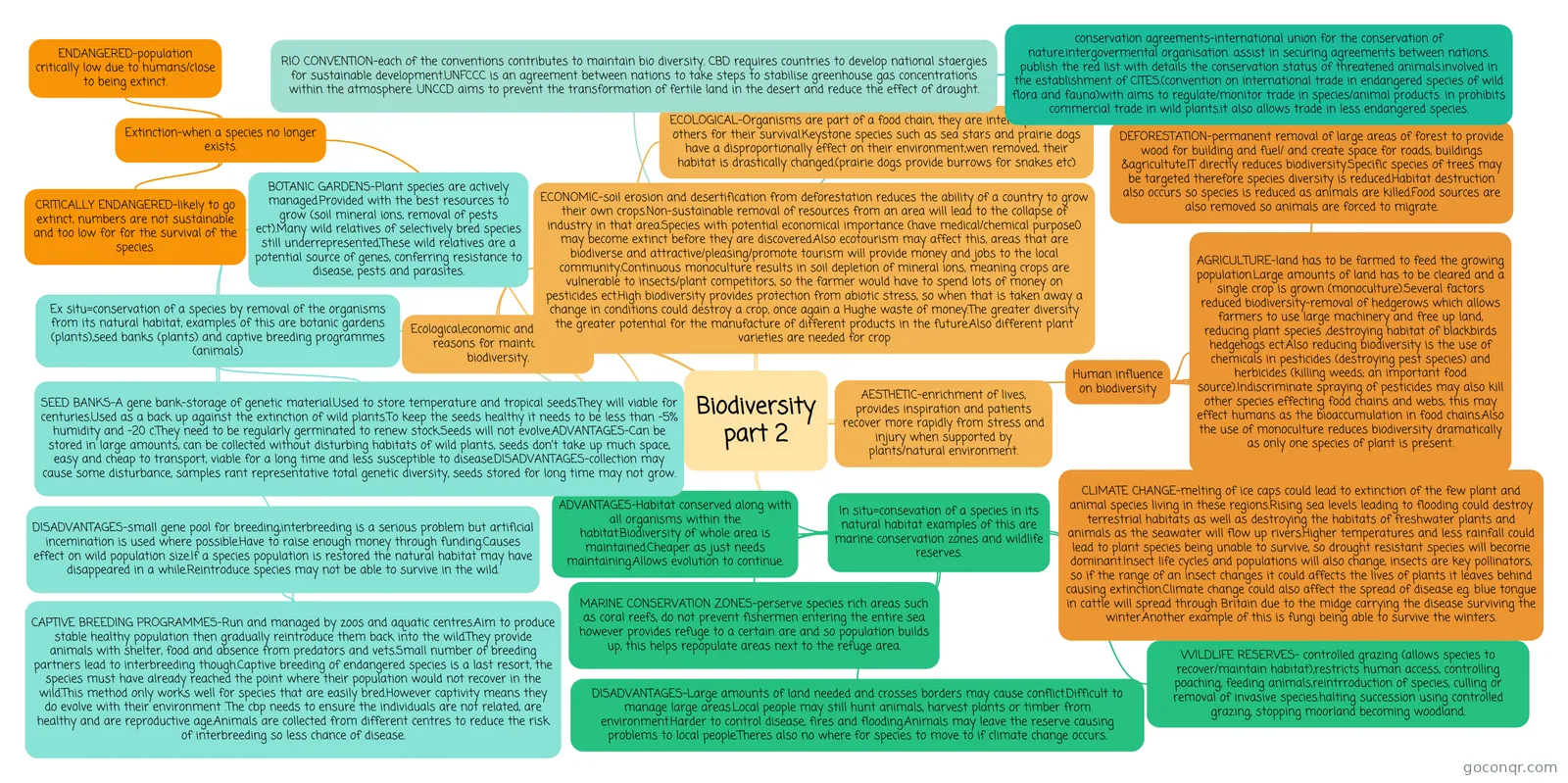
Mind map: Biodiversity part 2
Conteúdo do mapa
Biodiversity part 2
Extinction-when a species no longer exists.
- ENDANGERED-population critically low due to humans/close to being extinct.
- CRITICALLY ENDANGERED-likely to go extinct, numbers are not sustainable and too low for for the survival of the species.
Human influence on biodiversity
- DEFORESTATION-permanent removal of large areas of forest to provide wood for building and fuel/ and create space for roads, buildings &agricultute.IT directly reduces biodiversity.Specific species of trees may be targeted therefore species diversity is reduced.Habitat destruction also occurs so species is reduced as animals are killed.Food sources are also removed so animals are forced to migrate.
- AGRICULTURE-land has to be farmed to feed the growing population.Large amounts of land has to be cleared and a single crop is grown (monoculture).Several factors reduced biodiversity-removal of hedgerows which allows farmers to use large machinery and free up land, reducing plant species ,destroying habitat of blackbirds hedgehogs ect.Also reducing biodiversity is the use of chemicals in pesticides (destroying pest species) and herbicides (killing weeds; an important food source).Indiscriminate spraying of pesticides may also kill other species effecting food chains and webs, this may effect humans as the bioaccumulation in food chains.Also the use of monoculture reduces biodiversity dramatically as only one species of plant is present.
- CLIMATE CHANGE-melting of ice caps could lead to extinction of the few plant and animal species living in these regions.Rising sea levels leading to flooding could destroy terrestrial habitats as well as destroying the habitats of freshwater plants and animals as the seawater will flow up rivers.Higher temperatures and less rainfall could lead to plant species being unable to survive, so drought resistant species will become dominant.Insect life cycles and populations will also change, insects are key pollinators, so if the range of an insect changes it could affects the lives of plants it leaves behind causing extinction.Climate change could also affect the spread of disease eg. blue tongue in cattle will spread through Britain due to the midge carrying the disease surviving the winter.Another example of this is fungi being able to survive the winters.
Ecological,economic and aesthetic reasons for maintaining biodiversity.
- AESTHETIC-enrichment of lives, provides inspiration and patients recover more rapidly from stress and injury when supported by plants/natural environment.
- ECONOMIC-soil erosion and desertification from deforestation reduces the ability of a country to grow their own crops.Non-sustainable removal of resources from an area will lead to the collapse of industry in that area.Species with potential economical importance (have medical/chemical purpose0 may become extinct before they are discovered.Also ecotourism may affect this, areas that are biodiverse and attractive/pleasing/promote tourism will provide money and jobs to the local community.Continuous monoculture results in soil depletion of mineral ions, meaning crops are vulnerable to insects/plant competitors, so the farmer would have to spend lots of money on pesticides ect.High biodiversity provides protection from abiotic stress, so when that is taken away a change in conditions could destroy a crop, once again a Hughe waste of money.The greater diversity the greater potential for the manufacture of different products in the future.Also different plant varieties are needed for crop
- ECOLOGICAL-Organisms are part of a food chain, they are interdependent on others for their survival.Keystone species such as sea stars and prairie dogs have a disproportionally effect on their environment,wen removed, their habitat is drastically changed.(prairie dogs provide burrows for snakes etc)
In situ=consevation of a species in its natural habitat examples of this are marine conservation zones and wildlife reserves.
- WILDLIFE RESERVES- controlled grazing (allows species to recover/maintain habitat),restricts human access, controlling poaching, feeding animals,reintrroduction of species, culling or removal of invasive species.halting succession using controlled grazing, stopping moorland becoming woodland.
- MARINE CONSERVATION ZONES-perserve species rich areas such as coral reefs, do not prevent fishermen entering the entire sea however provides refuge to a certain are and so population builds up, this helps repopulate areas next to the refuge area.
- ADVANTAGES-Habitat conserved along with all organisms within the habitat.Biodiversity of whole area is maintained.Cheaper as just needs maintaining.Allows evolution to continue.
- DISADVANTAGES-Large amounts of land needed and crosses borders may cause conflict.Difficult to manage large areas.Local people may still hunt animals, harvest plants or timber from environment.Harder to control disease, fires and flooding.Animals may leave the reserve causing problems to local people.Theres also no where for species to move to if climate change occurs.
Ex situ=conservation of a species by removal of the organisms from its natural habitat, examples of this are botanic gardens (plants),seed banks (plants) and captive breeding programmes (animals)
- BOTANIC GARDENS-Plant species are actively managed.Provided with the best resources to grow (soil mineral ions, removal of pests ect).Many wild relatives of selectively bred species still underrepresented,These wild relatives are a potential source of genes, conferring resistance to disease, pests and parasites.
- SEED BANKS-A gene bank-storage of genetic material.Used to store temperature and tropical seeds.They will viable for centuries.Used as a back up against the extinction of wild plants.To keep the seeds healthy it needs to be less than -5% humidity and -20 c.They need to be regularly germinated to renew stock.Seeds will not evolve.ADVANTAGES-Can be stored in large amounts, can be collected without disturbing habitats of wild plants, seeds don't take up much space, easy and cheap to transport, viable for a long time and less susceptible to disease.DISADVANTAGES-collection may cause some disturbance, samples rant representative total genetic diversity, seeds stored for long time may not grow.
- CAPTIVE BREEDING PROGRAMMES-Run and managed by zoos and aquatic centres.Aim to produce stable healthy population then gradually reintroduce them back into the wild.They provide animals with shelter, food and absence from predators and vets.Small number of breeding partners lead to interbreeding though.Captive breeding of endangered species is a last resort, the species must have already reached the point where their population would not recover in the wild.This method only works well for species that are easily bred.However captivity means they do evolve with their environment .The cbp needs to ensure the individuals are not related, are healthy and are reproductive age.Animals are collected from different centres to reduce the risk of interbreeding so less chance of disease.
- DISADVANTAGES-small gene pool for breeding,interbreeding is a serious problem but artificial incemination is used where possible.Have to raise enough money through funding.Causes effect on wild population size.If a species population is restored the natural habitat may have disappeared in a while.Reintroduce species may not be able to survive in the wild.
conservation agreements-international union for the conservation of nature.intergovermental organisation. assist in securing agreements between nations. publish the red list with details the conservation status of threatened animals.involved in the establishment of CITES.(convention on international trade in endangered species of wild flora and fauna)with aims to regulate/monitor trade in species/animal products. in prohibits commercial trade in wild plants.it also allows trade in less endangered species.
RIO CONVENTION-each of the conventions contributes to maintain bio diversity. CBD requires countries to develop national staergies for sustainable development.UNFCCC is an agreement between nations to take steps to stabilise greenhouse gas concentrations within the atmosphere. UNCCD aims to prevent the transformation of fertile land in the desert and reduce the effect of drought.
Informações
- Descrição
- Mapa Mental sobre Biodiversity part 2, criado por tiffany wrigley em 08-06-2019.
- Criado por
- tiffany wrigley
- Visualizações
- 0
- Avaliação
Mais sobre Human impact and threats to biodiversity