
Mapa mental
Three Approaches to Argument
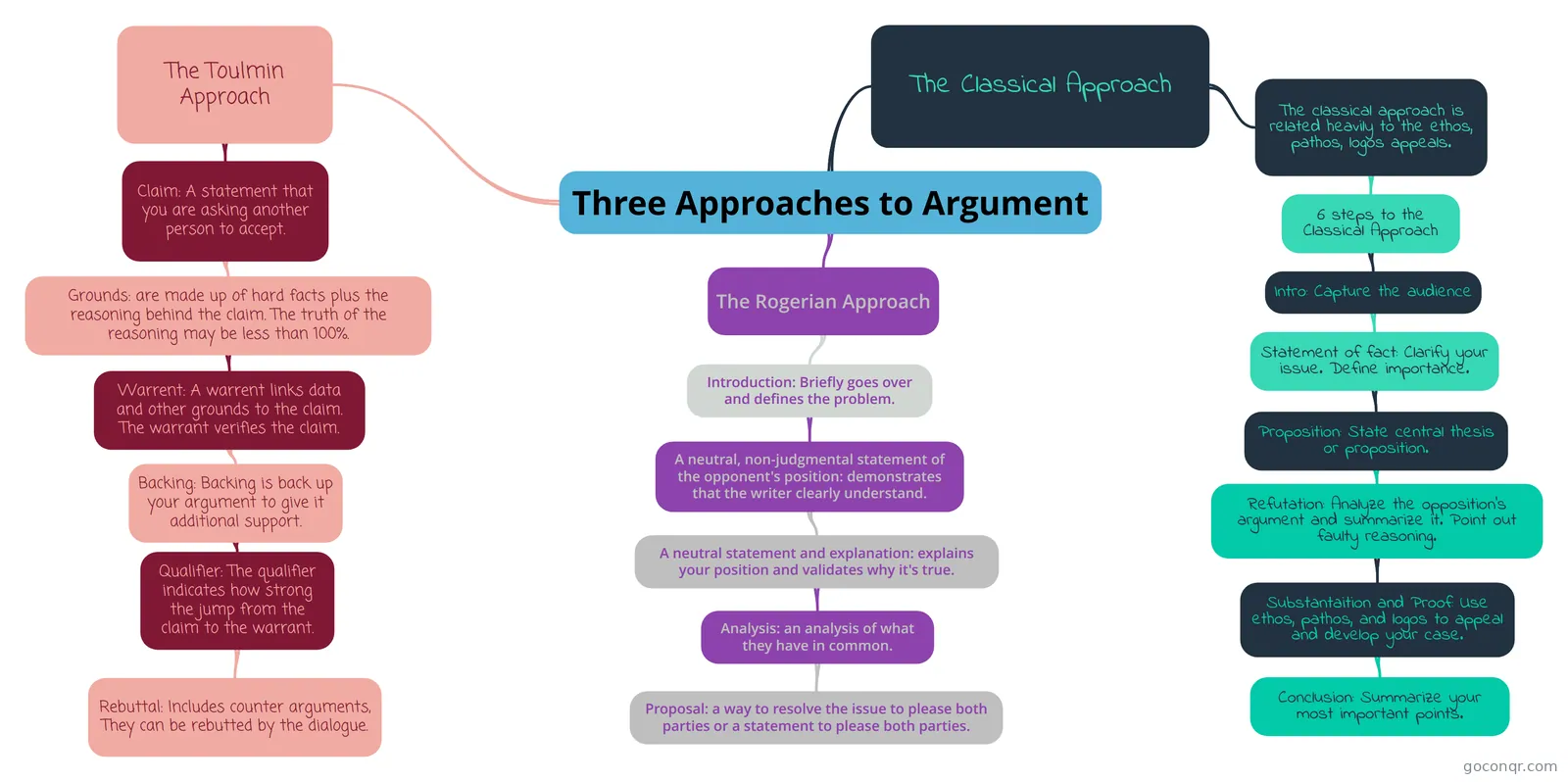
Mind map: Three approaches to argument
Conteúdo do mapa
Three Approaches to Argument
The Rogerian Approach
- Introduction: Briefly goes over and defines the problem.
- A neutral, non-judgmental statement of the opponent's position: demonstrates that the writer clearly understand.
- A neutral statement and explanation: explains your position and validates why it's true.
- Analysis: an analysis of what they have in common.
- Proposal: a way to resolve the issue to please both parties or a statement to please both parties.
- Analysis: an analysis of what they have in common.
- A neutral statement and explanation: explains your position and validates why it's true.
- A neutral, non-judgmental statement of the opponent's position: demonstrates that the writer clearly understand.
- Introduction: Briefly goes over and defines the problem.
The Classical Approach
- The classical approach is related heavily to the ethos, pathos, logos appeals.
- 6 steps to the Classical Approach
- Intro: Capture the audience
- Statement of fact: Clarify your issue. Define importance.
- Proposition: State central thesis or proposition.
- Refutation: Analyze the opposition's argument and summarize it. Point out faulty reasoning.
- Substantaition and Proof: Use ethos, pathos, and logos to appeal and develop your case.
- Conclusion: Summarize your most important points.
- Substantaition and Proof: Use ethos, pathos, and logos to appeal and develop your case.
- Refutation: Analyze the opposition's argument and summarize it. Point out faulty reasoning.
- Proposition: State central thesis or proposition.
- Statement of fact: Clarify your issue. Define importance.
- Intro: Capture the audience
- 6 steps to the Classical Approach
- The classical approach is related heavily to the ethos, pathos, logos appeals.
The Toulmin Approach
- Claim: A statement that you are asking another person to accept.
- Grounds: are made up of hard facts plus the reasoning behind the claim. The truth of the reasoning may be less than 100%.
- Warrent: A warrent links data and other grounds to the claim. The warrant verifies the claim.
- Backing: Backing is back up your argument to give it additional support.
- Qualifier: The qualifier indicates how strong the jump from the claim to the warrant.
- Rebuttal: Includes counter arguments, They can be rebutted by the dialogue.
- Qualifier: The qualifier indicates how strong the jump from the claim to the warrant.
- Backing: Backing is back up your argument to give it additional support.
- Warrent: A warrent links data and other grounds to the claim. The warrant verifies the claim.
- Grounds: are made up of hard facts plus the reasoning behind the claim. The truth of the reasoning may be less than 100%.
- Claim: A statement that you are asking another person to accept.
Informações
- Descrição
- Mapa Mental sobre Three Approaches to Argument, criado por 1052613 em 02-02-2015.
- Criado por
- 1052613
- Visualizações
- 3
- Avaliação
Mais sobre Argument Structure and Reasoning