
Mapa mental
Romantic Literature
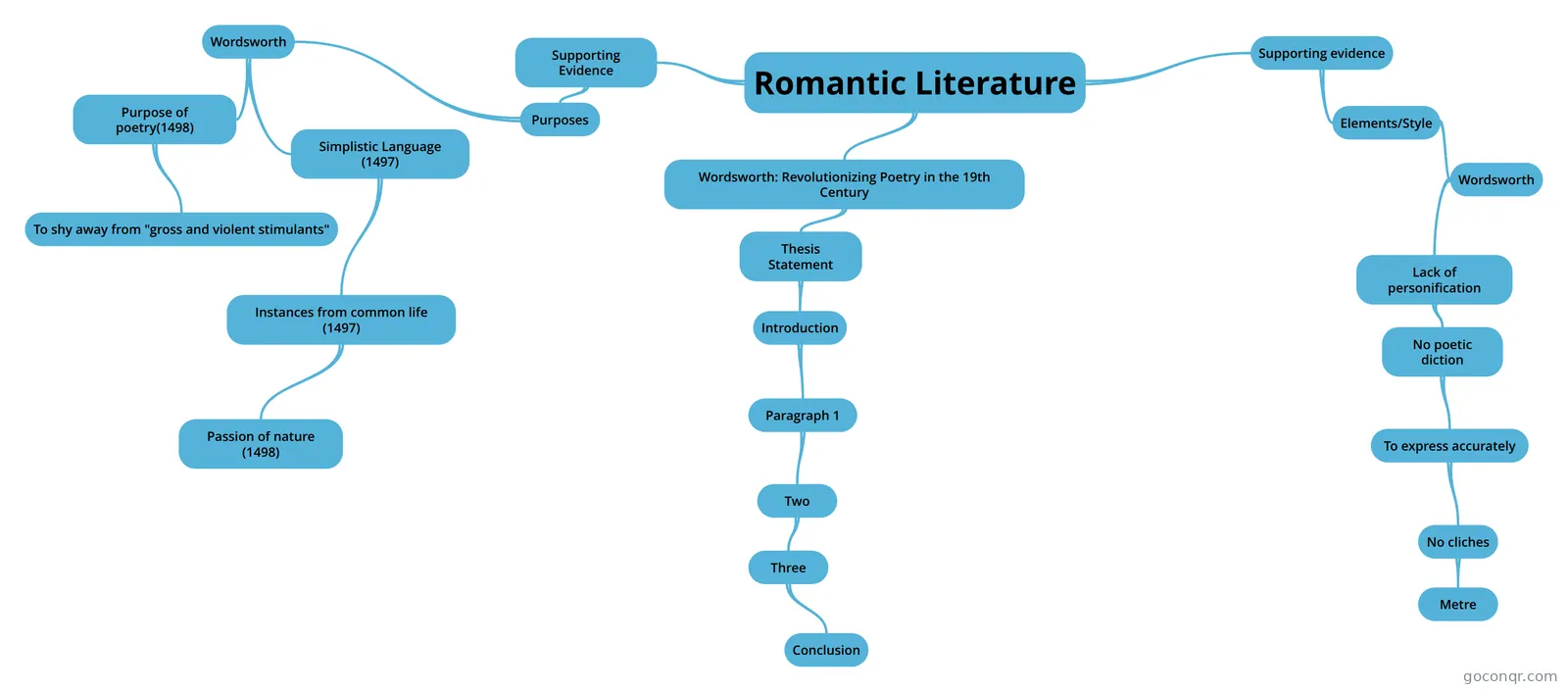
Mind map: Romantic literature
Conteúdo do mapa
Romantic Literature
Supporting Evidence
- Purposes
- Wordsworth
- Purpose of poetry(1498)
- Not every poem began with a purpose but he found that the feelings he elicited from the poems had purpose
- "For all good poetry is the spontaneous overflow of powerful feelings" (1498)
- "the manner in which our feelings and ideas are associated in a state of excitement... when [the mind] agitated by the great and simple affections of our nature." (1499) ** Ties into the passions of nature
- To shy away from "gross and violent stimulants"
- He wanted to get away from the references to kissing butts and poop jokes and the grosser side that some poets have explored and to get back to more (1499/1500)
- "The invaluable works... are driven into neglect by frantic novels, sickly and stupid German tragedies, and deluges of idle and extravagant stories in verse" (1500) **ties into simplistic language
- Simplistic Language (1497)
- He wanted to use simpler language so that poetry was for everyone, including the common person, as opposed to only the wealthier classes
- "Such a language... is a more permanent, and a far more philosophical language, than that which is frequently substituted for it by poets" (1498)
- Instances from common life (1497)
- He wanted to move away from the extravagant poems of the past and the fantastical qualities that they had and move more into the beauty of nature and the realistic world.
- "the passions of men are incorporated with the beautiful and permanent forms of nature" (1498)
- Passion of nature (1498)
- "for all good poetry is the spontaneous overflow of powerful feelings" (1498)
- "the essential passions of the heart find a better soil in which they can attain their maturity are less under restraint, and speak a plainer and more emphatic language" (1498)
- "to illustrate the manner in which our feeling sadn ideas are associated in a state of excitement. "(1499)
- Purpose of poetry(1498)
- Wordsworth
- Purposes
Supporting evidence
- Elements/Style
- Wordsworth
- Lack of personification
- Other poets personified death, Melancholy, Vengeance (Vanity of Human WIshes Johnson) etc. Wordworth chose to "adopt the language of men" (1500) instead.
- No poetic diction
- Language of men but also because he enjoyed straying from what was considered typical poetry (1501)
- To express accurately
- "to look steadily at my subject, consequently, I hope that in these poems little falsehood of description, and that my ideas are expressed in language fitted to their respective importance" (1501)
- No cliches
- "having abstained from the use of many expressions, in themselves proper and beautiful, but which have been foolishly repeated by bad poets, till such feelings of disgust are connected with them." (1501)
- Metre
- Wordsworth liked metre and rhyme and the arrangement of a poem and its verses.
- "there neither is, nor can be, any essential difference between the language of prose and metrical composition" (1502)
- Lack of personification
- Wordsworth
- Elements/Style
Wordsworth: Revolutionizing Poetry in the 19th Century
- Thesis Statement
- Wordsworth's way of thinking about poetry and art differed vastly from those of his predecessors which is what led him to shape, create, and influence the Romantic period and Romantic authors alike.
- Introduction
- Thesis statement, a few other sentences about Wordswortth and his views
- Paragraph 1
- Mentions ways that Wordsworth differs from Pope and Johnson. Include the purposes and elements of Romantic literature. This is him shaping and creating the romantic period
- Two
- Talk about Wordsworth's work and how we modeled the Romantic period.
- Three
- Work of others that Wordsworth inspired that were also writing following his examples. Show evidence in their work that they follow the same routes. Did this inspire female writers?
- Conclusion
- Thesis Statement
Informações
- Descrição
- Mapa Mental sobre Romantic Literature, criado por tiannapage26 em 07-02-2015.
- Criado por
- tiannapage26
- Visualizações
- 15
- Avaliação