
Mapa mental
Socialism notes
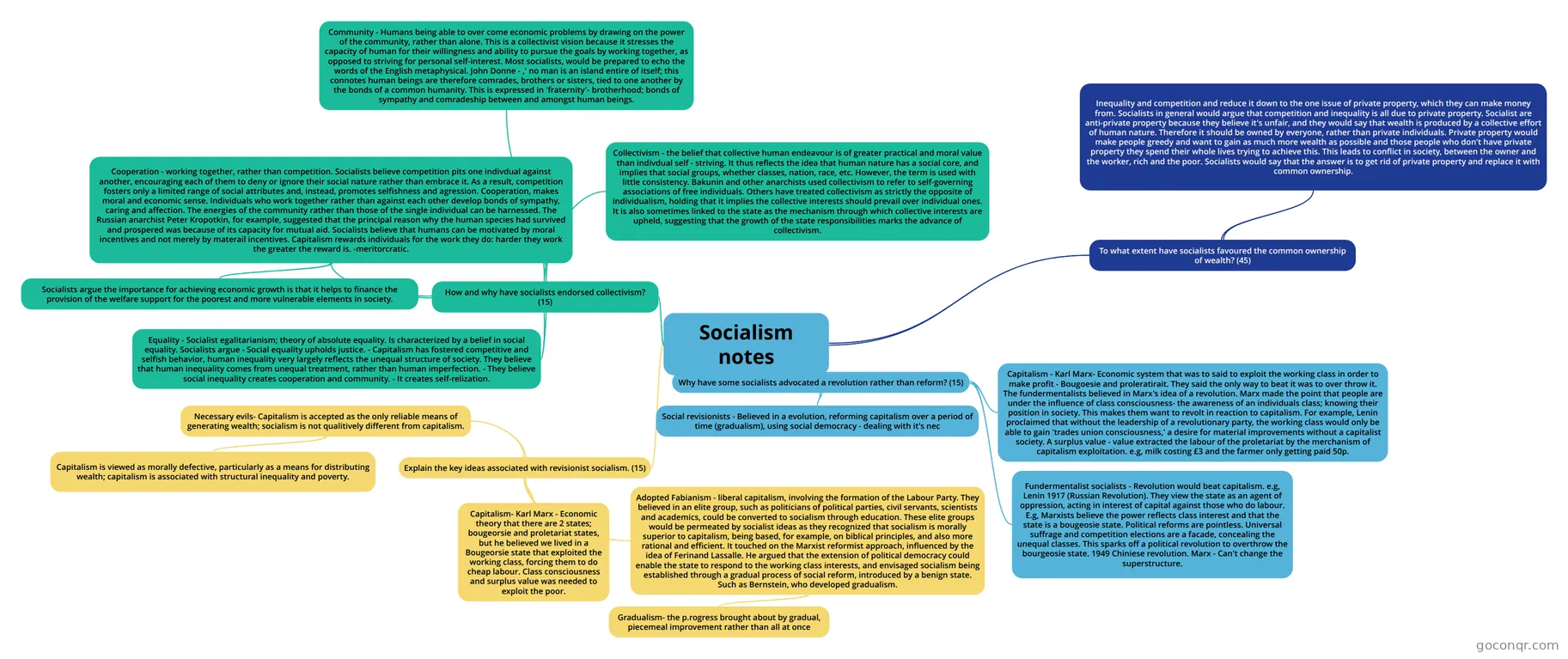
Mind map: socialism notes
Conteúdo do mapa
Socialism notes
Why have some socialists advocated a revolution rather than reform? (15)
- Capitalism - Karl Marx- Economic system that was to said to exploit the working class in order to make profit - Bougoesie and proleratirait. They said the only way to beat it was to over throw it. The fundermentalists believed in Marx's idea of a revolution. Marx made the point that people are under the influence of class consciousness- the awareness of an individuals class; knowing their position in society. This makes them want to revolt in reaction to capitalism. For example, Lenin proclaimed that without the leadership of a revolutionary party, the working class would only be able to gain 'trades union consciousness,' a desire for material improvements without a capitalist society. A surplus value - value extracted the labour of the proletariat by the merchanism of capitalism exploitation. e.g, milk costing £3 and the farmer only getting paid 50p.
- Fundermentalist socialists - Revolution would beat capitalism. e.g, Lenin 1917 (Russian Revolution). They view the state as an agent of oppression, acting in interest of capital against those who do labour. E.g, Marxists believe the power reflects class interest and that the state is a bougeosie state. Political reforms are pointless. Universal suffrage and competition elections are a facade, concealing the unequal classes. This sparks off a political revolution to overthrow the bourgeosie state. 1949 Chiniese revolution. Marx - Can't change the superstructure.
- Social revisionists - Believed in a evolution, reforming capitalism over a period of time (gradualism), using social democracy - dealing with it's nec
How and why have socialists endorsed collectivism? (15)
- Collectivism - the belief that collective human endeavour is of greater practical and moral value than indivdual self - striving. It thus reflects the idea that human nature has a social core, and implies that social groups, whether classes, nation, race, etc. However, the term is used with little consistency. Bakunin and other anarchists used collectivism to refer to self-governing associations of free individuals. Others have treated collectivism as strictly the opposite of individualism, holding that it implies the collective interests should prevail over individual ones. It is also sometimes linked to the state as the mechanism through which collective interests are upheld, suggesting that the growth of the state responsibilities marks the advance of collectivism.
- Community - Humans being able to over come economic problems by drawing on the power of the community, rather than alone. This is a collectivist vision because it stresses the capacity of human for their willingness and ability to pursue the goals by working together, as opposed to striving for personal self-interest. Most socialists, would be prepared to echo the words of the English metaphysical. John Donne - ,' no man is an island entire of itself; this connotes human beings are therefore comrades, brothers or sisters, tied to one another by the bonds of a common humanity. This is expressed in 'fraternity'- brotherhood; bonds of sympathy and comradeship between and amongst human beings.
- Cooperation - working together, rather than competition. Socialists believe competition pits one indivdual against another, encouraging each of them to deny or ignore their social nature rather than embrace it. As a result, competition fosters only a limited range of social attributes and, instead, promotes selfishness and agression. Cooperation, makes moral and economic sense. Individuals who work together rather than against each other develop bonds of sympathy, caring and affection. The energies of the community rather than those of the single individual can be harnessed. The Russian anarchist Peter Kropotkin, for example, suggested that the principal reason why the human species had survived and prospered was because of its capacity for mutual aid. Socialists believe that humans can be motivated by moral incentives and not merely by materail incentives. Capitalism rewards individuals for the work they do: harder they work the greater the reward is. -meritorcratic.
- Socialists argue the importance for achieving economic growth is that it helps to finance the provision of the welfare support for the poorest and more vulnerable elements in society.
- Equality - Socialist egalitarianism; theory of absolute equality. Is characterized by a belief in social equality. Socialists argue - Social equality upholds justice. - Capitalism has fostered competitive and selfish behavior, human inequality very largely reflects the unequal structure of society. They believe that human inequality comes from unequal treatment, rather than human imperfection. - They believe social inequality creates cooperation and community. - It creates self-relization.
Explain the key ideas associated with revisionist socialism. (15)
- Adopted Fabianism - liberal capitalism, involving the formation of the Labour Party. They believed in an elite group, such as politicians of political parties, civil servants, scientists and academics, could be converted to socialism through education. These elite groups would be permeated by socialist ideas as they recognized that socialism is morally superior to capitalism, being based, for example, on biblical principles, and also more rational and efficient. It touched on the Marxist reformist approach, influenced by the idea of Ferinand Lassalle. He argued that the extension of political democracy could enable the state to respond to the working class interests, and envisaged socialism being established through a gradual process of social reform, introduced by a benign state. Such as Bernstein, who developed gradualism.
- Gradualism- the p.rogress brought about by gradual, piecemeal improvement rather than all at once
- Capitalism- Karl Marx - Economic theory that there are 2 states; bougeorsie and proletariat states, but he believed we lived in a Bougeorsie state that exploited the working class, forcing them to do cheap labour. Class consciousness and surplus value was needed to exploit the poor.
- Necessary evils- Capitalism is accepted as the only reliable means of generating wealth; socialism is not qualitively different from capitalism.
- Capitalism is viewed as morally defective, particularly as a means for distributing wealth; capitalism is associated with structural inequality and poverty.
- Adopted Fabianism - liberal capitalism, involving the formation of the Labour Party. They believed in an elite group, such as politicians of political parties, civil servants, scientists and academics, could be converted to socialism through education. These elite groups would be permeated by socialist ideas as they recognized that socialism is morally superior to capitalism, being based, for example, on biblical principles, and also more rational and efficient. It touched on the Marxist reformist approach, influenced by the idea of Ferinand Lassalle. He argued that the extension of political democracy could enable the state to respond to the working class interests, and envisaged socialism being established through a gradual process of social reform, introduced by a benign state. Such as Bernstein, who developed gradualism.
To what extent have socialists favoured the common ownership of wealth? (45)
- Inequality and competition and reduce it down to the one issue of private property, which they can make money from. Socialists in general would argue that competition and inequality is all due to private property. Socialist are anti-private property because they believe it's unfair, and they would say that wealth is produced by a collective effort of human nature. Therefore it should be owned by everyone, rather than private individuals. Private property would make people greedy and want to gain as much more wealth as possible and those people who don't have private property they spend their whole lives trying to achieve this. This leads to conflict in society, between the owner and the worker, rich and the poor. Socialists would say that the answer is to get rid of private property and replace it with common ownership.
Informações
- Descrição
- Mapa Mental sobre Socialism notes, criado por Agnes Meakin em 17-02-2015.
- Criado por
- Agnes Meakin
- Visualizações
- 4
- Avaliação
Mais sobre Socialism, Marxism and Communism