
Mapa mental
Unemployment
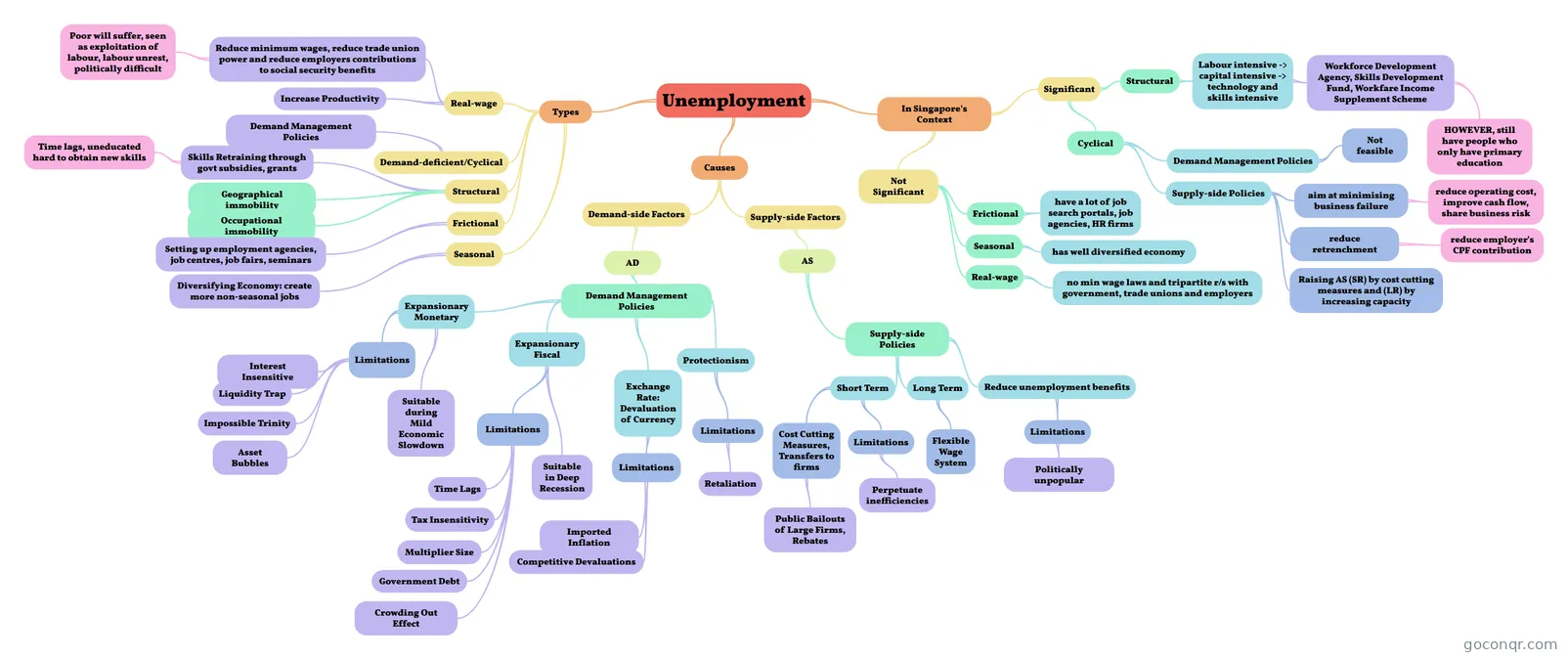
Mind map: Unemployment
Conteúdo do mapa
Unemployment
- Situation where people are actively seeking employment but are unable/unwilling to accept jobs that are available
Types
- Real-wage
- occurs when the wages are set above the free market equilibrium, resulting in labour surplus aka unemployment
- Reduce minimum wages, reduce trade union power and reduce employers contributions to social security benefits
- Poor will suffer, seen as exploitation of labour, labour unrest, politically difficult
- Increase Productivity
- Demand-deficient/Cyclical
- when the AD is insufficient to enable production to enable full employment
- Demand Management Policies
- Structural
- when the people in the contracting industry is unable to shift to the expanding industry due to either geographical / occupational immobility
- Geographical immobility
- people unable to move to expanding industry due to -high financial cost -high personal cost -physical barriers -language barriers -discrimination -legal restrictions -can also be due to length and cost of training which is difficult to implement if the workforce is uneducated
- Occupational immobility
- people unable to move to expanding industries due to: -lack of relevant skills/education esp from primary to tertiary industry
- Skills Retraining through govt subsidies, grants
- Time lags, uneducated hard to obtain new skills
- Frictional
- due to lack of imperfect information and time to find suitable jobs
- Setting up employment agencies, job centres, job fairs, seminars
- Seasonal
- some people work in jobs that are seasonal eg agricultural and tourism hence they do not have jobs during the off-peak season
- Diversifying Economy: create more non-seasonal jobs
- Real-wage
Causes
- Demand-side Factors
- AD
- C I G X-M
- Demand Management Policies
- Expansionary Monetary
- Aims to increase AD to boost employment through -increasing money supply -decreasing interest rates
- Limitations
- Interest Insensitive
- during economic downturn, even if the interest rates decline, people are likely to save and firms are likely to not invest hence AD still falls even though interest rates have declined
- Liquidity Trap
- occurs when the interest rates are already so low that it does not have any effect on the economy. when the interest rates = 0, monetary policy cannot be used
- Impossible Trinity
- countries who have free international capital mobility (facilitates FDIs) and manages their exchange rates (facilitates trades) cannot use this policy eg SIngapore
- Asset Bubbles
- when interest rates are low, borrowing is encouraged thus leading to speculative demands for assets. Demand for assets increases which leads to the rise in asset prices. When the prices of assets increase until it becomes unaffordable to most buyers, asset prices fall bursting of asset bubble leads to massive drops of wealth, decreases consumption and hence AD. Due to alot of bankruptcy, banks have little funds available to loan other firms thus reducing production and investments, leads to falling AD. The government will then step in to encourage savings through increase interest rates and tighter credit conditions whch offset initial deduction in interest rates
- Interest Insensitive
- Suitable during Mild Economic Slowdown
- -interest insensitivity not set in -no crowding out effect -less time lags (less political/social considerations) -no government debt
- Expansionary Fiscal
- AIms to increase AD by -increasing government spending -decrease direct taxes
- Limitations
- Government Debt
- increase in government spending is financed through borrowing, leading to public debt. Future welfare is sacrificed for current welfare
- Multiplier Size
- Government spending plays a small role in AD. For a country with small multiplier effect, large amounts of money needs to be borrowed to finance public spending which is very costly and ineffective
- Crowding Out Effect
- Fiscal involves running high budget deficit which is financed by borrowing. This increases demand for loanable funds and hence increasing interest rates. high interest rates lead to: -appreciation of currency which leads to a fall in net exports -encourages savings hence reducing consumption thus, this only means the diversion of private demand to public demand and not the actual boost in AD
- Time Lags
- government need time to decide how to spend the extra budget and need time to implement policies which can be very long due to inherent bureaucratic nature of public organizations. also have social and political considerations
- Tax Insensitivity
- With poor economic downturn, people are unlikely to spend or invest thus AD still shifts down
- Government Debt
- Suitable in Deep Recession
- Monetary Policy not feasible as: -high interest insensitivity -liquidity trap Fiscal feasible as: -directly boosts AD -crowding out effect less cause private borrowing tend to fall leading to decrease interest rates and government can now finance budget deficit through borrowing without increasing interest rates
- Exchange Rate: Devaluation of Currency
- Limitations
- Imported Inflation
- imports become more expensive thus resulting imported inflation esp in countries who depend on external demand
- Competitive Devaluations
- Imported Inflation
- Limitations
- Protectionism
- through quotas and tariffs
- Limitations
- Retaliation
- Expansionary Monetary
- AD
- Supply-side Factors
- AS
- Labour Market Rigidity Wages Rate Productivity
- Supply-side Policies
- Short Term
- Cost Cutting Measures, Transfers to firms
- Public Bailouts of Large Firms, Rebates
- Limitations
- Perpetuate inefficiencies
- Recession is said to be relocating scarce resources from contracting to expanding markets. Hence with transfers to firm can be seen as protectionist and helping to perpetuate these inefficiencies
- Perpetuate inefficiencies
- Cost Cutting Measures, Transfers to firms
- Long Term
- Flexible Wage System
- amount of wages depends on the business performance this helps to prevent retrenchment
- Flexible Wage System
- Reduce unemployment benefits
- Limitations
- Politically unpopular
- Limitations
- Short Term
- AS
- Demand-side Factors
In Singapore's Context
- Singapore is -lacks natural resources -high MPI -high MPS -small injection multiplier (cannot use fiscal) -export-orientated -financial hub (free capital mobility) -control exchange rates (facilitate trades)
- Not Significant
- Frictional
- have a lot of job search portals, job agencies, HR firms
- which helps people to find suitable jobs
- have a lot of job search portals, job agencies, HR firms
- Seasonal
- has well diversified economy
- agricultural is non-existent tropical climate has almost enables tourism sector to be all year round
- has well diversified economy
- Real-wage
- no min wage laws and tripartite r/s with government, trade unions and employers
- trade unions are under the National Trade Union Congress (NTUC); wage negos are with the government. motto is wages dependent on the productivity growth thus trade union not much power in singapore
- no min wage laws and tripartite r/s with government, trade unions and employers
- Frictional
- Significant
- Structural
- Labour intensive -> capital intensive -> technology and skills intensive
- Workforce Development Agency, Skills Development Fund, Workfare Income Supplement Scheme
- HOWEVER, still have people who only have primary education
- Workforce Development Agency, Skills Development Fund, Workfare Income Supplement Scheme
- Labour intensive -> capital intensive -> technology and skills intensive
- Cyclical
- Demand Management Policies
- Not feasible
- Supply-side Policies
- aim at minimising business failure
- reduce operating cost, improve cash flow, share business risk
- reduce retrenchment
- reduce employer's CPF contribution
- Raising AS (SR) by cost cutting measures and (LR) by increasing capacity
- aim at minimising business failure
- Demand Management Policies
- Structural
Informações
- Descrição
- Mapa Mental sobre Unemployment, criado por chiammin em 15-03-2015.
- Criado por
- chiammin
- Visualizações
- 0
- Avaliação
Mais sobre Unemployment and the Phillips curve