
Mapa mental
Reintroduction & Translocation
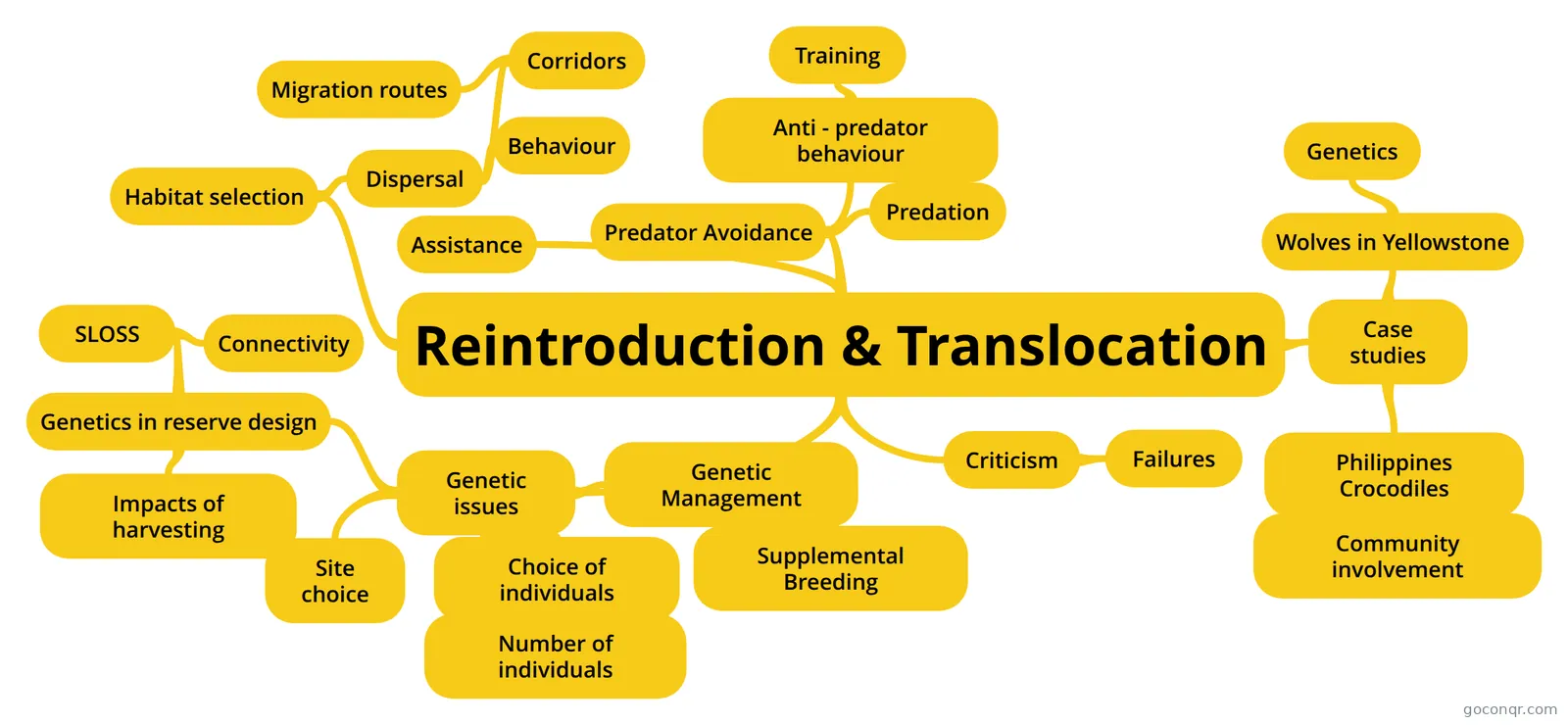
Mind map: Reintroduction & Translocation
Conteúdo do mapa
Reintroduction & Translocation
- Ultimate goal of conservation is to restore damaged, fragmented ecosystems to their previous balance and functional state, including the organisms that form part of that ecosystem. Ecosystem functionality - need to consider if another species has taken up the ecological role of the species that has been extirpated from the wild, before reintroducing them. Do they still have an available niche?Supplementing populations through reintroduction and translocation aim to increase the size of existing natural populations when levels of natural recruitment are not sufficient to ensure long term population viability.
- Reintroduction - returning a species to a part of its historical range where it has been extirpated, either from a captive bred or wild caught population. Introduction - putting animals into an area/habitat where there has not bee a population before. Translocation - moving wild animals from one place to another.
Case studies
- Philippines Crocodiles
- Mabuwaya Foundation Inc. Philippine crocodile is the rarest species of crocodile in the world. Crocodylus mindorensis. Endemic to the Philippines. Critically endangered. Range has contracted massively, now only exists in a few isolated areas. Threats include hunting, habitat loss and destructive fishing practices.
- Aims to protect and conserve the crocodile and its habitat. Crocdiles nest near lakes or marshes but a lot of these turned into rice fields. Crocodiles instead build nests near fast flowing rivers - juveniles get washed away. Populations of wild crocdiles are scattered. Project aims to assist Philippine crocodile population re-enforcement and recovery. Project started in 2001 with a very small population - 5 adults, 12 juveniles, 1 nest. Thought may not be viable but group did not want to give up. Telemetry used to find home ranges and what areas of habitat were important to crocodiles - need to know this information in order to conserve. Need to conserve all habitats that are importnant to crocodiles at each life history stage, riverbanks/riparian areas, marshes, rivers, deeper lakes.
- "Head starting program" - take hatchlings out of the wild (hatchling mortality in wild 95%), rear them in captivity until they are 2 years old. 82% survival in captivity. Kept in semi-natural conditions with live prey species so that they learn to hunt. Put in "soft release" ponds before full release, so they can get acclimatised and disassociate from humans. Project also enhances natural habitat by creating ponds in the wild to increase chances of survival. Post release monitroing program, surveys of rivers every 3 months. Also recapture juveniles after one year, weigh them and measure them. Estimated 35% of head started juveniles survive their first year, probably more but can't catch them all.
- Community involvement
- With any reintroduction where the species is likely to come into contact with humans involvement of the local community is key to its success. As the crocodile population slowly grows the human population is also growing, the project found that crocodiles and humans can coexist if efforts are made to change people's negative views of the crocodiles. Community outreach means that less crocodiles are killed by local people. Envrionmental education is key and long term investment in educating the public. Changing attitudes. Getting local people involved with releases etc. In any successful relocation the engagement of the local community and stakeholders is key to it's success.
- Wolves in Yellowstone
- Species can impact whole ecosystems. Until 1995 the ecosystem of Yellowstone National Park was out of balance, largely to the systematic extermination of the top predator and keystone species, the grey wolf (Canis lupus). Without the wolves herbivore populations quickly grew and damaged vegetation. Reintroduction of wolves was necessary to restore ecological balance. The reintorduction was met with much resistance especially from local ranchers who said that the wolves would kill livestock. Hunters argues that they would reduce the supply of game animals. Logging companies were concerned that protected animals in the area may mean that they could not access certain areas. Wolf not under threat of extinction, 50,000 in Canada alone, these arguments did not understand the ecological reasons behind the reintroduction.
- The wolves are reshaping the ecological structure of the park. Elk congregating in larger herds, wolves interacting with other pedators - grizzlies and coyotes. Carrion from wolf kills effecting the dynamics of scavengers, grizzlies to carrion beetles. Tree species recovering from reduced grazing pressure. Positive economic impacts as wolves are a main attraction to visitors. Rivers - watch George Monbiot!
- Wolves successfully adapted to their new environment. Population growing. Great ecological value of the wolves. Do come into contact with humans and do kill livestock but is said to be insignificant in comparison to the number of livestock in the area. Wolves are killed by park officials, allowed as population was said to be reintroduced as "experimental and non-essential". Used to release them to government lands far away but population grown so much everywhere already has wolves. As wolves roam outside the aprk come into contact with more humans. Killed on private land. Next challenge is to find a compromise that moves ranchers and other private landowners from opposing to supporting the project.
- Genetics
- Wolves are wide ranging so need a large area, 100 wolves need a reserve 1000s sq km. Wolves reintroduced to the park were genetically healthy (low inbreeding, high heterozygosity). Recommended that 10 breeding pairs and at least 100 wolves per state. Although if these populations remain isolated genetic variation lost due to inbreeding. Inbreeding increases heterozygosity decreases. Important that populations are connected and dispersal is possible between the populations - gene flow.
- Philippines Crocodiles
Habitat selection
- How animals select their habitat may cause problems for conservation/reintroduction. What makes a suitable habitat for a species needs careful consideration before reintroduction. Animals may move away from release site and pass over high quality territories that are familiar to them but in which they may not actually survive as well. Red squirrels, caribou. Some animals may settle in more urban areas after a captive breeding program - used to humans? Where you breed them might have a significant impact on where they breed.
- Compare wild and captive bred wild golden tamarins? Animals need to be kept in as natural a habitat as possible so when they are released they can quickly integrate with their new surroundings. Golden lion tamarinds captive bred in captivity have been shown to be deficient in foraging and locomotor skills.
- Animals may base habitat choice on a variety of different things; food, type of habitat, nesting materials, sites and sounds.
- Dispersal
- Corridors
- How do species disperse in fragmented habitat? Gilbert-Norton review. Found natural corridors the best e.g., hedgerows. Dormice are usually arboreal and use hedgerows to move between woodland habitat. But hedgerows need to be connected to be effective dispersal routes for dormice- will cross a small gap but not a large one.
- Migration routes
- Behaviour
- Effects of natal experience; Dispersers select habitat similar to that experienced when young - can cause problems for reintroductions and translocations. May reject habitat in the release area and travel long distances to what are actually poorer areas where they may stand less chance of survivial. Common across many taxa but not all - for others it is about the nature of dispersal.
- Need to make animals feel more "at home" in the habitat they are reintroduced. Manipulate behaviour and habitat preferences. Introduce them in pens at first to get them used to their new habitat and to allow them to disassociate from human contact. Captive animals, particularly those that are hand reared, can become used to humans which can put them in danger when they are released into the wild. Could release in family groups so that naive youngsters can learn from older individuals. Feel more relaxed in presence of conspecifics. Animals may need post release support - feeding etc. Relocations need to be managed in the short and long term
- Compare wild and captive bred wild golden tamarins? Animals need to be kept in as natural a habitat as possible so when they are released they can quickly integrate with their new surroundings. Golden lion tamarinds captive bred in captivity have been shown to be deficient in foraging and locomotor.
- Sexes disperse differently. In mammals males usually range wider, in birds females usually disperse further. Need to consider which sex to release, which individuals? Differential dispersal of sexes. Most release programs try to make good family groups. Social factor important to many animals when they select habitat.
- Animals individual characteristics may influence how well it will do in a new habitat. Animals differ in their shyness/boldness, naivity/experience, exploratory behaviour and temeprament.
- Corridors
Predator Avoidance
- Mortality due to predation is the principal cause of failure in animal reintroduction and translocation programs. Prey fail to recognise predator, or recognise but act inappropriately or they recognise the predator and show appropriate response but the predator exhibits superior hunting behaviour. Some animals may fully lose their anti-predator system due to captivity/evolutionary time.
- Predation
- Introducing new predators/prey into an environment during reintroduction/translocation can have negative effect. How to mitigate?
- Anti - predator behaviour
- Animals raised in captivity may have lost learned behaviours but also the genetic underpinning of these. Animals that have been isolated from predators due to being in captivity or over evolutionary time may have lost predator avoidance behaviour.
- Training
- Pre-release training can teach animals to avoid predators but how successful this is depends on how much of their anti predator system/ response has been lost. Condition animals to be scared of predators, associate the presence of predator with something negative such as a loud noise or water squirts, conspecific alarm calls. Can potentially learn from conspecifics. Examples of where this has worked and where this hasn't.
- Some captive animals have to be trained how to become a predator. Influence of pre-release experience. Exposure to live prey - ethical? Morphological changes in captive bred animals can be detrimental. Aversive conditioning - training predators not to take rare prey. Stops animals causing damage and having a negative impact in the wild. Taste aversion - pairing food with something that makes them sick.
Genetic issues
- Goal of captive breeding programs is to produce individuals to reintroduce to the wild. Want to add genetic variability to the wild population. Several genetic issues need to be considered.
- Captive breeding or cultivation can impact the genetic characteristics of these populations. For example, a higher nutritional regime and lack of predators is associated with higher fecundity and survivorship. May negatively effect performance in natural conditions. Could undermine the relocation program. For example the genetic underpinning of predator avoidance behaviour may be lost in wild bred populations. If captive bred population breed with wild population certain undesirable characteristics may be transferred to the natural population and be detrimental to them. Compromise the natural population because of so much genetic mixing. Interbreeding may cause the disruption of local adaptations in a target population during a translocation. Could lead to outbreeding depression resulting in offspring that are not suitably adapted to the environment (outbreeding - breeding between individuals from different populations). Reduces fitness of individuals and could effect population viability.
- Need to balance the needs of the captive and wild population.
- Site choice
- To minimise the amount of adaptive evolution required for a population need to consider the environment that the species was adapted to prior to captive breeding. Reintroductions - site should be within historic range of species. Should be prime rather than marginal habitat.
- Choice of individuals
- WHO WHERE and WHEN Want to release healthy individuals with a high reproductive potential, high genetic diversity. But this could mean removing the "best" individuals from the secure captive population.
- Different individuals will have a different effect on the heterozygosity of captive and wild populations. When survival and reintroduction have improved in wild population more viable animals can be addedd until full range of genetic diversity in captive population is mirrored in the wild population. Increases reproductive fitness of population overall which is the ultimate goal. Requires careful monitoring of reintroduced population. Need to keep a careful record of the relatedness of each individuals in captive population so you know what genes you are introducing to the wild. Need to know good genetic history of source population. If not enough individuals for a viable founder population can select indivuals for release from different populations.
- Number of individuals
- When reintroducing a population to an area where they have previously been extirpated conservation geneticists are usually concerned with most with maintaining the diversity of the founder population and in the rate of growth of the reintroduced population. Generally introduction of large numbers of individuals is favoured to promote higher genetic diversity. Several releases may improve the long term probability of maintaining genetic variation. Critical to monitor as well as assess the potential genetic effects of introducing new individuals into a wild population.
- Should aim to establish as many reintroduced populations as is practically possible - reduce risk of extinction.
- Genetic Management
- Different individuals will have a different effect on the heterozygosity of captive and wild populations. When survival and reintroduction have improved in wild population more viable animals can be addedd until full range of genetic diversity in captive population is mirrored in the wild population. Increases reproductive fitness of population overall which is the ultimate goal. Requires careful monitoring of reintroduced population.
- After a high level of genetic diversity has been established in the wild population monitoring and human intervention can be relaxed.
- Supplemental Breeding
- May be necessary in some situations to sustain an introduced or wild population. Take adults from wild, breed them, rear the chicks and then release.
- Genetics in reserve design
- Many biological, ecological, political and genetic considerations to balance when considering a reserve design. Need to identify species you are trying to conserve e.,g keystone organisms whose loss would decrease the value of biodiversity within the reserve area. Need to determine minimum population size needed to ensure high probability of long term survival of the species. Using known population densities of these species estimate the area required to sustain minimum numbers. Ne = effective/viable population size. Key question = is the reserve large enough to support a viable population?
- MVP - minimum viable population. A commonly used, but somewhat arbitrary definition is > 95% probability of persistence over 100 years. Estimated using knowledge of other populations and PVA. Criticism of the MVP concept hinge mainly on the precision and accuracy of the estimates, and its real-world applicability, especially given long-term projections into an uncertain future. Controverisal - is it actually useful? May need to look wider than conserving one species in a reserve to stem the loss of biodiversity. Depending on what the conservation aim is may be more useful to consider species populations that are large enough to fulfil their ecological role.EFP - ecologically functional populations. Definition includes that as a species density decreases so does it's function. Conner (1988) introduced EFP and contended that MVP should only be focussed on as a last resort. MVP may be off insufficient size to maintain full functionality of that species within the ecosystem.Severe declines, particularly of harvested species, can cause trophic cascades leading to degradation of ecosystems and communities.
- Extrinsic and intrinsic factors influencing extinction rates also need to be considered. Extrinsic - deleterious interactions with other species e.g., predation, parasitism, disease, etc. Deleterious events e.g., freak weather events, climate change. Intrinsic - maladaptive behaviours and social dysfunction, genetic deterioration.
- Impacts of harvesting
- Many species are harvested or poached from reserves. May reduce Ne, genetic diversity and generation length. The effects of harvesting from a population, particularly over exploitation, usually have genetically deleterious outcomes. Marine example - fisheries, massive difference in sex ratios due to overfishing. Even in game reserves where animals are bred to be hunted can have negative effects. Some species selectively poached due to a certain phenotypes# e.g., big horns. May result in alteration of phenotype of the species.
- How to mitigate? One option may be to preserve a proportion of the population from harvest i.e., "cod blocks". The fully wild stock is maintained to introduce into harvested areas so that the genetic impacts of the harvest are reduced.
- SLOSS
- Many reserves designed on the principals of island biogeography theory and the species-area relationship (MacArthur & Wilson 1967). Key principles are that larger reserves are better than small and that reserves should be connected. Simberloff and Abele (1986) challenged this saying that there was no empirical evidence that single smaller reserves would increase extinction rates and they could infact protect against catastrophe if a detrimental event occured in another reserve. From a genetic point of view one large reserve is better if there is a risk of extinction in smaller reserves, one large reserves may contain more genetic variation as it should in theory hold more individuals of a species. Compromise - more than one sizeable reserve but should be gene flow between them - use of corridors to maintain viability within metapopulations. In reality reserve size often determined by local politics, alternative land use as the needs of various local stakeholders.
- Dog whelks - marine reserves often small and isolated for ease of management, can lead to populations being genetically differentiated, isolated, inbred ans reduced genetic diversity. Long term genetic consequences of selecting reserves based on ease of management and isolation. These populations are also susceptible to envrionmental change.
- Connectivity
- Environment outside a reserve may influence what happens in a reserve. Ecological coherence of a connected network of MPAs is going to be dependent on the habitat outside of it. Genetic variation inside and outside a reserve may be significant. Mesoscale variation in topography etc., may mean that organisms have developed different adaptations. Network of MPAs can be effective at building and maintaining populations - organisms can disperse. Increase genetic variability and may result in greater numbers of commercially important species.
- Importance of corridors. Beier (1993) demonstrated that it was important to protect riparian habitats in the Santa Ana Mountains of Southern California as they were crucial to the dispersal of cougars (Felis concolor), this disperal maintained the metapopulation within the area.More genetic based example? Corridors could faciliate the movement of pest species and disease, will they be useful in the face of climate change as species ranges shift?
Criticism
- Failures
Assistance
- Need to remove threats and may need to restore habitat before reintroduction. Soft reintroduction - in pens at first to get them used to new environment. Also supplementing diet etc.
Informações
- Descrição
- Mapa Mental sobre Reintroduction & Translocation, criado por amyycartwright em 13-04-2015.
- Criado por
- amyycartwright
- Visualizações
- 3
- Avaliação