
Mapa mental
Subject-matter
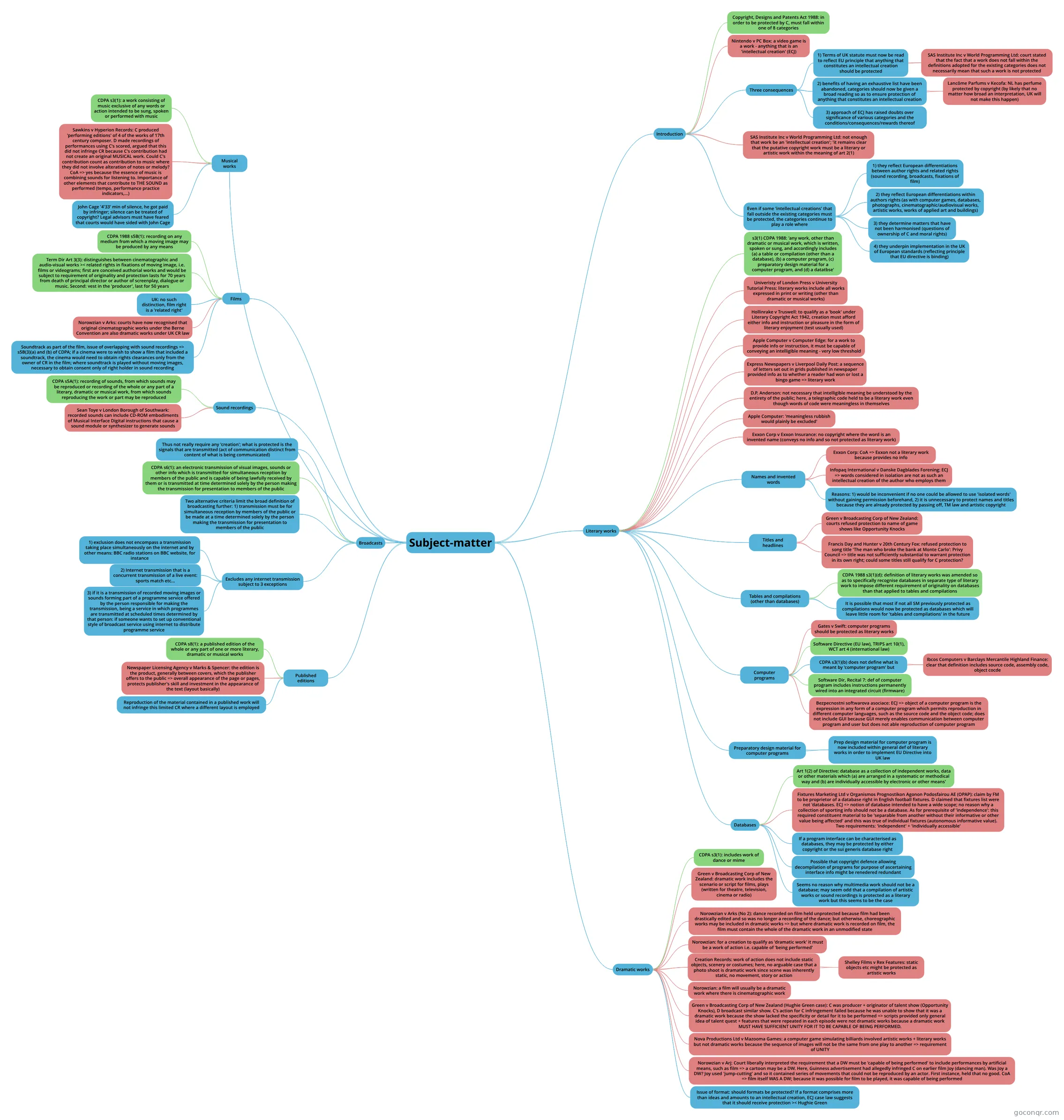
Mind map: copyright subject-matter
Conteúdo do mapa
Subject-matter
Introduction
- Copyright, Designs and Patents Act 1988: in order to be protected by C, must fall within one of 8 categories
- Nintendo v PC Box: a video game is a work - anything that is an 'intellectual creation' (ECJ)
- Three consequences
- 1) Terms of UK statute must now be read to reflect EU principle that anything that constitutes an intellectual creation should be protected
- SAS Institute Inc v World Programming Ltd: court stated that the fact that a work does not fall within the definitions adopted for the existing categories does not necessarily mean that such a work is not protected
- 2) benefits of having an exhaustive list have been abandoned, categories should now be given a broad reading so as to ensure protection of anything that constitutes an intellectual creation
- Lancôme Parfums v Kecofa: NL has perfume protected by copyright (by likely that no matter how broad an interpretation, UK will not make this happen)
- 3) approach of ECJ has raised doubts over significance of various categories and the conditions/consequences/rewards thereof
- 1) Terms of UK statute must now be read to reflect EU principle that anything that constitutes an intellectual creation should be protected
- SAS Institute Inc v World Programming Ltd: not enough that work be an 'intellectual creation'; 'it remains clear that the putative copyright work must be a literary or artistic work within the meaning of art 2(1)
- Even if some 'intellectual creations' that fall outside the existing categories must be protected, the categories continue to play a role where
- 1) they reflect European differentiations between author rights and related rights (sound recording, broadcasts, fixations of film)
- 2) they reflect European differentiations within authors rights (as with computer games, databases, photographs, cinematographic/audiovisual works, artistic works, works of applied art and buildings)
- 3) they determine matters that have not been harmonised (questions of ownership of C and moral rights)
- 4) they underpin implementation in the UK of European standards (reflecting principle that EU directive is binding)
Literary works
- s3(1) CDPA 1988: 'any work, other than dramatic or musical work, which is written, spoken or sung, and accordingly includes (a) a table or compilation (other than a database), (b) a computer program, (c) preparatory design material for a computer program, and (d) a datatbse'
- Univeristy of London Press v University Tutorial Press: literary works include all works expressed in print or writing (other than dramatic or musical works)
- Hollinrake v Truswell: to qualify as a 'book' under Literary Copyright Act 1942, creation must afford either info and instruction or pleasure in the form of literary enjoyment (test usually used)
- Apple Computer v Computer Edge: for a work to provide info or instruction, it must be capable of conveying an intelligible meaning - very low threshold
- Express Newspapers v Liverpool Daily Post: a sequence of letters set out in grids published in newspaper provided info as to whether a reader had won or lost a bingo game => literary work
- D.P. Anderson: not necessary that intelligible meaning be understood by the entirety of the public; here, a telegraphic code held to be a literary work even though words of code were meaningless in themselves
- Apple Computer: 'meaningless rubbish would plainly be excluded'
- Exxon Corp v Exxon Insurance: no copyright where the word is an invented name (conveys no info and so not protected as literary work)
- Names and invented words
- Exxon Corp: CoA => Exxon not a literary work because provides no info
- Infopaq International v Danske Dagblades Forening: ECJ => words considered in isolation are not as such an intellectual creation of the author who employs them
- Reasons: 1) would be inconvenient if no one could be allowed to use 'isolated words' without gaining permission beforehand, 2) it is unnecessary to protect names and titles because they are already protected by passing off, TM law and artistic copyright
- Titles and headlines
- Green v Broadcasting Corp of New Zealand: courts refused protection to name of game shows like Opportunity Knocks
- Francis Day and Hunter v 20th Century Fox: refused protection to song title 'The man who broke the bank at Monte Carlo': Privy Council => title was not sufficiently substantial to warrant protection in its own right; could some titles still qualify for C protection?
- Tables and compilations (other than databases)
- CDPA 1988 s3(1)(d): definition of literary works was amended so as to specifically recognise databases in separate type of literary work to impose different requirement of originality on databases than that applied to tables and compilations
- It is possible that most if not all SM previously protected as compilations would now be protected as databases which will leave little room for 'tables and compilations' in the future
- Computer programs
- Gates v Swift: computer programs should be protected as literary works
- Software Directive (EU law), TRIPS art 10(1), WCT art 4 (international law)
- CDPA s3(1)(b) does not define what is meant by 'computer program' but
- Ibcos Computers v Barclays Mercantile Highland Finance: clear that definition includes source code, assembly code, object cocde
- Software Dir, Recital 7: def of computer program includes instructions permanently wired into an integrated circuit (firmware)
- Bezpecnostni softwarova asociace: ECJ => object of a computer program is the expression in any form of a computer program which permits reproduction in different computer languages, such as the source code and the object code; does not include GUI because GUI merely enables communication between computer program and user but does not able reproduction of computer program
- Preparatory design material for computer programs
- Prep design material for computer program is now included within general def of literary works in order to implement EU Directive into UK law
- Databases
- Art 1(2) of Directive: database as a collection of independent works, data or other materials which (a) are arranged in a systematic or methodical way and (b) are individually accessible by electronic or other means'
- Fixtures Marketing Ltd v Organismos Prognostikon Agonon Podosfairou AE (OPAP): claim by FM to be proprietor of a database right in English football fixtures. D claimed that fixtures list were not 'databases. ECJ => notion of database intended to have a wide scope; no reason why a collection of sporting info should not be a database. As for prerequisite of 'independence': this required constituent material to be 'separable from another without their informative or other value being affected' and this was true of individual fixtures (autonomous informative value). Two requirements: 'independent' + 'individually accessible'
- If a program interface can be characterised as databases, they may be protected by either copyright or the sui generis database right
- Possible that copyright defence allowing decompilation of programs for purpose of ascertaining interface info might be renedered redundant
- Seems no reason why multimedia work should not be a database; may seem odd that a compilation of artistic works or sound recordings is protected as a literary work but this seems to be the case
Dramatic works
- CDPA s3(1): includes work of dance or mime
- Green v Broadcasting Corp of New Zealand: dramatic work includes the scenario or script for films, plays (written for theatre, television, cinema or radio)
- Norowzian v Arks (No 2): dance recorded on film held unprotected because film had been drastically edited and so was no longer a recording of the dance; but otherwise, choreographic works may be included in dramatic works => but where dramatic work is recorded on film, the film must contain the whole of the dramatic work in an unmodified state
- Norowzian: for a creation to qualify as 'dramatic work' it must be a work of action i.e. capable of 'being performed'
- Creation Records: work of action does not include static objects, scenery or costumes; here, no arguable case that a photo shoot is dramatic work since scene was inherently static, no movement, story or action
- Shelley Films v Rex Features: static objects etc might be protected as artistic works
- Norowzian: a film will usually be a dramatic work where there is cinematographic work
- Green v Broadcasting Corp of New Zealand (Hughie Green case): C was producer + originator of talent show (Opportunity Knocks), D broadcast similar show. C's action for C infringement failed because he was unable to show that it was a dramatic work because the show lacked the specificity or detail for it to be performed => scripts provided only general idea of talent quest + features that were repeated in each episode were not dramatic works because a dramatic work MUST HAVE SUFFICIENT UNITY FOR IT TO BE CAPABLE OF BEING PERFORMED.
- Nova Productions Ltd v Mazooma Games: a computer game simulating billiards involved artistic works + literary works but not dramatic works because the sequence of images will not be the same from one play to another => requirement of UNITY
- Norowzian v Arj: Court liberally interpreted the requirement that a DW must be 'capable of being performed' to include performances by artificial means, such as film => a cartoon may be a DW. Here, Guinness advertisement had allegedly infringed C on earlier film Joy (dancing man). Was Joy a DW? Joy used 'jump-cutting' and so it contained series of movements that could not be reproduced by an actor. First instance, held that no good. CoA => film itself WAS A DW; because it was possible for film to be played, it was capable of being performed
- Issue of format: should formats be protected? If a format comprises more than ideas and amounts to an intellectual creation, ECJ case law suggests that it should receive protection >< Hughie Green
Musical works
- CDPA s3(1): a work consisting of music exclusive of any words or action intended to be sung, spoken or performed with music
- Sawkins v Hyperion Records: C produced 'performing editions' of 4 of the works of 17th century composer. D made recordings of performances using C's scored, argued that this did not infringe CR because C's contribution had not create an original MUSICAL work. Could C's contribution count as contribution to music where they did not involve alteration of notes or melody? CoA => yes because the essence of music is combining sounds for listening to. Importance of other elements that contribute to THE SOUND as performed (tempo, performance practice indicators,...)
- John Cage '4'33' min of silence, he got paid by infringer; silence can be treated of copyright? Legal advisors must have feared that courts would have sided with John Cage
Films
- CDPA 1988 s5B(1): recording on any medium from which a moving image may be produced by any means
- Term Dir Art 3(3): distinguishes between cinematographic and audio-visual works >< related rights in fixations of moving image, i.e. films or videograms; first are conceived authorial works and would be subject to requirement of originality and protection lasts for 70 years from death of principal director or author of screenplay, dialogue or music. Second: vest in the 'producer', last for 50 years
- Norowzian v Arks: courts have now recognised that original cinematographic works under the Berne Convention are also dramatic works under UK CR law
- UK: no such distinction, film right is a 'related right'
- Soundtrack as part of the film, issue of overlapping with sound recordings => s5B(3)(a) and (b) of CDPA; if a cinema were to wish to show a film that included a soundtrack, the cinema would need to obtain rights clearances only from the owner of CR in the film; where soundtrack is played without moving images, necessary to obtain consent only of right holder in sound recording
Sound recordings
- CDPA s5A(1): recording of sounds, from which sounds may be reproduced or recording of the whole or any part of a literary, dramatic or musical work, from which sounds reproducing the work or part may be reproduced
- Sean Toye v London Borough of Southwark: recorded sounds can include CD-ROM embodiments of Musical Interface Digital instructions that cause a sound module or synthesizer to generate sounds
Broadcasts
- Thus not really require any 'creation'; what is protected is the signals that are transmitted (act of communication distinct from content of what is being communicated)
- CDPA s6(1): an electronic transmission of visual images, sounds or other info which is transmitted for simultaneous reception by members of the public and is capable of being lawfully received by them or is transmitted at time determined solely by the person making the transmission for presentation to members of the public
- Two alternative criteria limit the broad definition of broadcasting further: 1) transmission must be for simultaneous reception by members of the public or be made at a time determined solely by the person making the transmission for presentation to members of the public
- Excludes any internet transmission subject to 3 exceptions
- 1) exclusion does not encompass a transmission taking place simultaneously on the internet and by other means: BBC radio stations on BBC website, for instance
- 2) Internet transmission that is a concurrent transmission of a live event: sports match etc...
- 3) if it is a transmission of recorded moving images or sounds forming part of a programme service offered by the person responsible for making the transmission, being a service in which programmes are transmitted at scheduled times determined by that person: if someone wants to set up conventional style of broadcast service using internet to distribute programme service
Published editions
- CDPA s8(1): a published edition of the whole or any part of one or more literary, dramatic or musical works
- Newspaper Licensing Agency v Marks & Spencer: the edition is the product, generally between covers, which the publisher offers to the public => overall appearance of the page or pages, protects publisher's skill and investment in the appearance of the text (layout basically)
- Reproduction of the material contained in a published work will not infringe this limited CR where a different layout is employed
Informações
- Descrição
- Law second year Intellectual property law (Copyright - subject matter) Mapa Mental sobre Subject-matter, criado por Emilie Schou em 19-04-2015.
- Criado por
- Emilie Schou
- Visualizações
- 1
- Avaliação
Mais sobre Copyright eligibility, subject matter and duration