
Mapa mental
CR - Defences
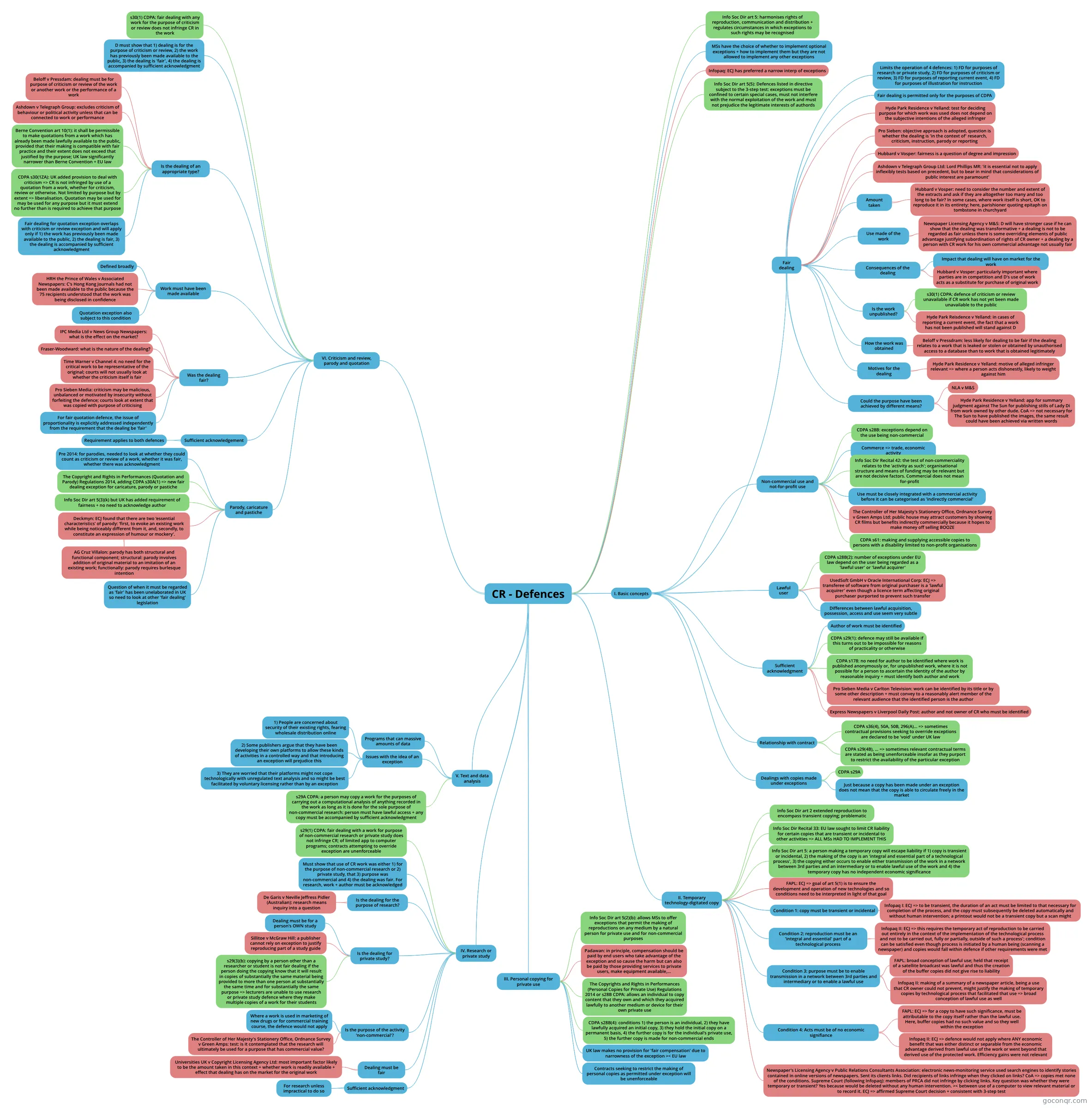
Mind map: Copyright defences
Conteúdo do mapa
CR - Defences
Info Soc Dir art 5: harmonises rights of reproduction, communication and distribution + regulates circumstances in which exceptions to such rights may be recognised
MSs have the choice of whether to implement optional exceptions + how to implement them but they are not allowed to implement any other exceptions
Infopaq: ECJ has preferred a narrow interp of exceptions
Info Soc Dir art 5(5): Defences listed in directive subject to the 3-step test: exceptions must be confined to certain special cases, must not interfere with the normal exploitation of the work and must not prejudice the legitimate interests of authords
I. Basic concepts
- Fair dealing
- Limits the operation of 4 defences: 1) FD for purposes of research or private study, 2) FD for purposes of criticism or review, 3) FD for purposes of reporting current event, 4) FD for purposes of illustration for instruction
- Fair dealing is permitted only for the purposes of CDPA
- Hyde Park Residence v Yelland: test for deciding purpose for which work was used does not depend on the subjective intentions of the alleged infringer
- Pro Sieben: objective approach is adopted, question is whether the dealing is 'in the context of' research, criticism, instruction, parody or reporting
- Hubbard v Vosper: fairness is a question of degree and impression
- Ashdown v Telegraph Group Ltd: Lord Phillips MR: 'it is essential not to apply inflexibly tests based on precedent, but to bear in mind that considerations of public interest are paramount'
- Amount taken
- Hubbard v Vosper: need to consider the number and extent of the extracts and ask if they are altogether too many and too long to be fair? In some cases, where work itself is short, OK to reproduce it in its entirety; here, parishioner quoting epitaph on tombstone in churchyard
- Use made of the work
- Newspaper Licensing Agency v M&S: D will have stronger case if he can show that the dealing was transformative + a dealing is not to be regarded as fair unless there is some overriding elements of public advantage justifying subordination of rights of CR owner + a dealing by a person with CR work for his own commercial advantage not usually fair
- Consequences of the dealing
- Impact that dealing will have on market for the work
- Hubbard v Vosper: particularly important where parties are in competition and D's use of work acts as a substitute for purchase of original work
- Is the work unpublished?
- s30(1) CDPA: defence of criticism or review unavailable if CR work has not yet been made unavailable to the public
- Hyde Park Reisdence v Yelland: in cases of reporting a current event, the fact that a work has not been published will stand against D
- How the work was obtained
- Beloff v Pressdram: less likely for dealing to be fair if the dealing relates to a work that is leaked or stolen or obtained by unauthorised access to a database than to work that is obtained legitimately
- Motives for the dealing
- Hyde Park Residence v Yelland: motive of alleged infringer relevant => where a person acts dishonestly, likely to weight against him
- Could the purpose have been achieved by different means?
- NLA v M&S
- Hyde Park Residence v Yelland: app for summary judgment against The Sun for publishing stills of Lady Di from work owned by other dude. CoA => not necessary for The Sun to have published the images, the same result could have been achieved via written words
- Non-commercial use and not-for-profit use
- CDPA s28B: exceptions depend on the use being non-commercial
- Commerce => trade, economic activity
- Info Soc Dir Recital 42: the test of non-commerciality relates to the 'activity as such'; organisational structure and means of funding may be relevant but are not decisive factors. Commercial does not mean for-profit
- Use must be closely integrated with a commercial activity before it can be categorised as 'indirectly commercial'
- The Controller of Her Majesty's Stationery Office, Ordnance Survey v Green Amps Ltd: public house may attract customers by showing CR films but benefits indirectly commercially because it hopes to make money off selling BOOZE
- CDPA s61: making and supplying accessible copies to persons with a disability limited to non-profit organisations
- Lawful user
- CDPA s28B(2): number of exceptions under EU law depend on the user being regarded as a 'lawful user' or 'lawful acquirer'
- UsedSoft GmbH v Oracle International Corp: ECJ => transferee of software from original purchaser is a 'lawful acquirer' even though a licence term affecting original purchaser purported to prevent such transfer
- Differences between lawful acquisition, possession, access and use seem very subtle
- Sufficient acknowledgment
- Author of work must be identified
- CDPA s29(1): defence may still be available if this turns out to be impossible for reasons of practicality or otherwise
- CDPA s178: no need for author to be identified where work is published anonymously or, for unpublished work, where it is not possible for a person to ascertain the identity of the author by reasonable inquiry + must identify both author and work
- Pro Sieben Media v Carlton Television: work can be identified by its title or by some other description + must convey to a reasonably alert member of the relevant audience that the identified person is the author
- Express Newspapers v Liverpool Daily Post: author and not owner of CR who must be identified
- Relationship with contract
- CDPA s36(4), 50A, 50B, 296(A)... => sometimes contractual provisions seeking to override exceptions are declared to be 'void' under UK law
- CDPA s29(4B), ... => sometimes relevant contractual terms are stated as being unenforceable insofar as they purport to restrict the availability of the particular exception
- Dealings with copies made under exceptions
- CDPA s29A
- Just because a copy has been made under an exception does not mean that the copy is able to circulate freely in the market
- Fair dealing
II. Temporary technology-digitated copy
- Info Soc Dir art 2 extended reproduction to encompass transient copying; problematic
- Info Soc Dir Recital 33: EU law sought to limit CR liability for certain copies that are transient or incidental to other activities => ALL MSs HAD TO IMPLEMENT THIS
- Info Soc Dir art 5: a person making a temporary copy will escape liability if 1) copy is transient or incidental, 2) the making of the copy is an 'integral and essential part of a technological process', 3) the copying either occurs to enable either transmission of the work in a network between 3rd parties and an intermediary or to enable lawful use of the work and 4) the temporary copy has no independent economic significance
- FAPL: ECJ => goal of art 5(1) is to ensure the development and operation of new technologies and so conditions need to be interpreted in light of that goal
- Condition 1: copy must be transient or incidental
- Infopaq I: ECJ => to be transient, the duration of an act must be limited to that necessary for completion of the process, and the copy must subsequently be deleted automatically and without human intervention; a printout would not be a transient copy but a scan might
- Condition 2: reproduction must be an 'integral and essential' part of a technological process
- Infopaq II: ECJ => this requires the temporary act of reproduction to be carried out entirely in the context of the implementation of the technological process and not to be carried out, fully or partially, outside of such a process'; condition can be satisfied even though process is initiated by a human being (scanning a newspaper) and copies would fall within defence if other requirements were met
- Condition 3: purpose must be to enable transmission in a network between 3rd parties and intermediary or to enable a lawful use
- FAPL: broad conception of lawful use; held that receipt of a satellite broadcast was lawful and thus the creation of the buffer copies did not give rise to liability
- Infopaq II: making of a summary of a newspaper article, being a use that CR owner could not prevent, might justify the making of temporary copies by technological process that facilitated that use => broad conception of lawful use as well
- Condition 4: Acts must be of no economic signifiance
- FAPL: ECJ => for a copy to have such significance, must be attributable to the copy itself rather than the lawful use. Here, buffer copies had no such value and so they well within the exception
- Infopaq II: ECJ => defence would not apply where ANY economic benefit that was either distinct or separable from the economic advantage derived from lawful use of the work or went beyond that derived use of the protected work. Efficiency gains were not relevant
- Newspaper's Licensing Agency v Public Relations Consultants Association: electronic news-monitoring service used search engines to identify stories contained in online versions of newspapers. Sent its clients links. Did recipients of links infringe when they clicked on links? CoA => copies met none of the conditions. Supreme Court (following Infopaq): members of PRCA did not infringe by clicking links. Key question was whether they were temporary or transient? Yes because would be deleted without any human intervention. >< between use of a computer to view relevant material or to record it. ECJ => affirmed Supreme Court decision + consistent with 3-step test
III. Personal copying for private use
- Info Soc Dir art 5(2)(b): allows MSs to offer exceptions that permit the making of reproductions on any medium by a natural person for private use and for non-commercial purposes
- Padawan: in principle, compensation should be paid by end users who take advantage of the exception and so cause the harm but can also be paid by those providing services to private users, make equipment available,...
- The Copyrights and Rights in Performances (Personal Copies for Private Use) Regulations 2014 or s28B CDPA: allows an individual to copy content that they own and which they acquired lawfully to another medium or device for their own private use
- CDPA s28B(4): conditions 1) the person is an individual, 2) they have lawfully acquired an initial copy, 3) they hold the initial copy on a permanent basis, 4) the further copy is for the individual's private use, 5) the further copy is made for non-commercial ends
- UK law makes no provision for 'fair compensation' due to narrowness of the exception >< EU law
- Contracts seeking to restrict the making of personal copies as permitted under exception will be unenforceable
IV. Research or private study
- s29(1) CDPA: fair dealing with a work for purpose of non-commercial research or private study does not infringe CR; of limited app to computer programs; contracts attempting to override exception are unenforceable
- Must show that use of CR work was either 1) for the purpose of non-commercial research or 2) private study, that 3) purpose was non-commercial and 4) the dealing was fair. For research, work + author must be acknowledged
- Is the dealing for private study?
- Dealing must be for a person's OWN study
- Sillitoe v McGraw Hill: a publisher cannot rely on exception to justify reproducing part of a study guide
- s29(3)(b): copying by a person other than a researcher or student is not fair dealing if the person doing the copying know that it will result in copies of substantially the same material being provided to more than one person at substantially the same time and for substantially the same purpose => lecturers are unable to use research or private study defence where they make multiple copies of a work for their students
- Is the dealing for the purpose of research?
- De Garis v Neville Jeffress Pidler (Australian): research means inquiry into a question
- Is the purpose of the activity 'non-commercial'?
- Where a work is used in marketing of new drugs or for commercial training course, the defence would not apply
- The Controller of Her Majesty's Stationery Office, Ordnance Survey v Green Amps: test: is it contemplated that the research will ultimately be used for a purpose that has commercial value?
- Dealing must be fair
- Universities UK v Copyright Licensing Agency Ltd: most important factor likely to be the amount taken in this context + whether work is readily available + effect that dealing has on the market for the original work
- Sufficient acknowledgment
- For research unless impractical to do so
V. Text and data analysis
- Programs that can massive amounts of data
- Issues with the idea of an exception
- 1) People are concerned about security of their existing rights, fearing wholesale distribution online
- 2) Some publishers argue that they have been developing their own platforms to allow these kinds of activities in a controlled way and that introducing an exception will prejudice this
- 3) They are worried that their platforms might not cope technologically with unregulated text analysis and so might be best facilitated by voluntary licensing rather than by an exception
- s29A CDPA: a person may copy a work for the purposes of carrying out a computational analysis of anything recorded in the work as long as it is done for the sole purpose of non-commercial research: person must have lawful access + any copy must be accompanied by sufficient acknowledgment
VI. Criticism and review, parody and quotation
- s30(1) CDPA: fair dealing with any work for the purpose of criticism or review does not infringe CR in the work
- D must show that 1) dealing is for the purpose of criticism or review, 2) the work has previously been made available to the public, 3) the dealing is 'fair', 4) the dealing is accompanied by sufficient acknowledgment
- Is the dealing of an appropriate type?
- Beloff v Pressdam: dealing must be for purpose of criticism or review of the work or another work or the performance of a work
- Ashdown v Telegraph Group: excludes criticism of behaviour or political activity unless that can be connected to work or performance
- Berne Convention art 10(1): it shall be permissible to make quotations from a work which has already been made lawfully available to the public, provided that their making is compatible with fair practice and their extent does not exceed that justified by the purpose; UK law significantly narrower than Berne Convention + EU law
- CDPA s30(1ZA): UK added provision to deal with criticism => CR is not infringed by use of a quotation from a work, whether for criticism, review or otherwise. Not limited by purpose but by extent => liberalisation. Quotation may be used for may be used for any purpose but it must extend no further than is required to achieve that purpose
- Fair dealing for quotation exception overlaps with criticism or review exception and will apply only if 1) the work has previously been made available to the public, 2) the dealing is fair, 3) the dealing is accompanied by sufficient acknowledgment
- Work must have been made available
- Defined broadly
- HRH the Prince of Wales v Associated Newspapers: C's Hong Kong Journals had not been made available to the public because the 75 recipients understood that the work was being disclosed in confidence
- Quotation exception also subject to this condition
- Was the dealing fair?
- IPC Media Ltd v News Group Newspapers: what is the effect on the market?
- Fraser-Woodward: what is the nature of the dealing?
- Time Warner v Channel 4: no need for the critical work to be representative of the original; courts will not usually look at whether the criticism itself is fair
- Pro Sieben Media: criticism may be malicious, unbalanced or motivated by insecurity without forfeiting the defence; courts look at extent that was copied with purpose of criticising
- For fair quotation defence, the issue of proportionality is explicitly addressed independently from the requirement that the dealing be 'fair'
- Sufficient acknowledgement
- Requirement applies to both defences
- Parody, caricature and pastiche
- Pre 2014: for parodies, needed to look at whether they could count as criticism or review of a work, whether it was fair, whether there was acknowledgment
- The Copyright and Rights in Performances (Quotation and Parody) Regulations 2014, adding CDPA s30A(1) => new fair dealing exception for caricature, parody or pastiche
- Info Soc Dir art 5(3)(k) but UK has added requirement of fairness + no need to acknowledge author
- Deckmyn: ECJ found that there are two ‘essential characteristics’ of parody: ‘first, to evoke an existing work while being noticeably different from it, and, secondly, to constitute an expression of humour or mockery’.
- AG Cruz Villalon: parody has both structural and functional component; structural: parody involves addition of original material to an imitation of an existing work; functionally: parody requires burlesque intention
- Question of when it must be regarded as 'fair' has been unelaborated in UK so need to look at other 'fair dealing' legislation
Informações
- Descrição
- Law second year Intellectual property law (Copyright - defences) Mapa Mental sobre CR - Defences, criado por Emilie Schou em 24-04-2015.
- Criado por
- Emilie Schou
- Visualizações
- 3
- Avaliação
Mais sobre Fair use, fair dealing and copyright defences