
Mapa mental
How can we plan a lesson?
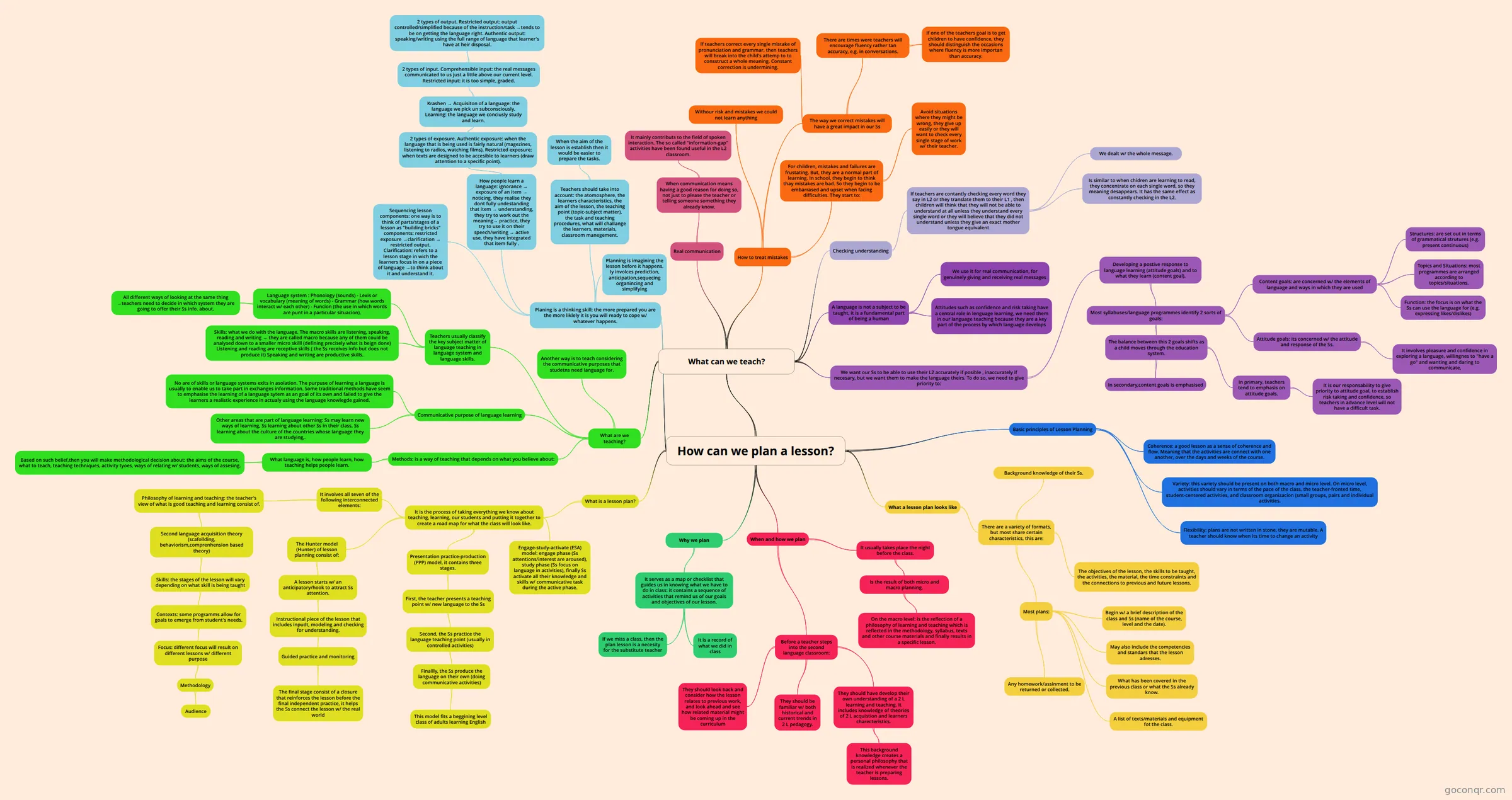
Mind map: How can we plan a lesson
Conteúdo do mapa
How can we plan a lesson?
Why we plan
- It serves as a map or checklist that guides us in knowing what we have to do in class: it contains a sequence of activities that remind us of our goals and objectives of our lesson.
- It is a record of what we did in class
- If we miss a class, then the plan lesson is a necesity for the substitute teacher
- It serves as a map or checklist that guides us in knowing what we have to do in class: it contains a sequence of activities that remind us of our goals and objectives of our lesson.
When and how we plan
- It usually takes place the night before the class.
- Is the result of both micro and macro planning.
- On the macro level: is the reflection of a philosophy of learning and teaching which is reflected in the methodology, syllabus, texts and other course materials and finally results in a specific lesson.
- Is the result of both micro and macro planning.
- Before a teacher steps into the second language classroom:
- They should have develop their own understanding of a 2 L learning and teaching. It includes knowledge of theories of 2 L acquistion and learners charecteristics.
- This background knowledge creates a personal philosophy that is realized whenever the teacher is preparing lessons.
- They should be familiar w/ both historical and current trends in 2 L pedagogy.
- They should look back and consider how the lesson relates to previous work, and look ahead and see how related material might be coming up in the curriculum
- They should have develop their own understanding of a 2 L learning and teaching. It includes knowledge of theories of 2 L acquistion and learners charecteristics.
- It usually takes place the night before the class.
What a lesson plan looks like
- There are a variety of formats, but most share certain characteristics, this are:
- Background knowledge of their Ss.
- The objectives of the lesson, the skills to be taught, the activities, the material, the time constraints and the connections to previous and future lessons.
- Most plans:
- Begin w/ a brief description of the class and Ss (name of the course, level and the date).
- May also include the competencies and standars that the lesson adresses.
- What has been covered in the previous class or what the Ss already know.
- A list of texts/materials and equipment fot the class.
- Any homework/assinment to be returned or collected.
- There are a variety of formats, but most share certain characteristics, this are:
Basic principles of Lesson Planning
- Coherence: a good lesson as a sense of coherence and flow. Meaning that the activities are connect with one another, over the days and weeks of the course.
- Variety: this variety should be present on both macro and micro level. On micro level, activities should vary in terms of the pace of the class, the teacher-fronted time, student-centered activities, and classroom organizacion (small groups, pairs and individual activities.
- Flexibility: plans are not written in stone, they are mutable. A teacher should know when its time to change an activity
What can we teach?
- We want our Ss to be able to use their L2 accurately if posible , inaccurately if necesary, but we want them to make the language theirs. To do so, we need to give priority to:
- Developing a postive response to language learning (attitude goals) and to what they learn (content goal).
- Most syllabuses/language programmes identify 2 sorts of goals:
- Content goals: are concerned w/ the elements of language and ways in which they are used
- Structures: are set out in terms of grammatical strutures (e.g. present continuous)
- Topics and Situations: most programmes are arranged according to topics/situations.
- Function: the focus is on what the Ss can use the language for (e.g. expressing likes/dislikes)
- Attitude goals: its concerned w/ the attitude and response of the Ss.
- It involves pleasure and confidence in exploring a language, willingnes to "have a go" and wanting and daring to communicate,
- The balance between this 2 goals shifts as a child moves through the education system.
- In primary, teachers tend to emphasis on attitude goals.
- It is our responsability to give priority to attitude goal, to establish risk taking and confidence, so teachers in advance level will not have a difficult task.
- In secondary,content goals is emphasised
- In primary, teachers tend to emphasis on attitude goals.
- Content goals: are concerned w/ the elements of language and ways in which they are used
- Most syllabuses/language programmes identify 2 sorts of goals:
- Developing a postive response to language learning (attitude goals) and to what they learn (content goal).
- A language is not a subject to be taught, it is a fundamental part of being a human
- We use it for real communication, for genuinely giving and receiving real messages
- Attitudes such as confidence and risk taking have a central role in lenguage learning, we need them in our language teaching because they are a key part of the process by which language develops
- Checking understanding
- If teachers are contantly checking every word they say in L2 or they translate them to their L1 , then children will think that they will not be able to understand at all unless they understand every single word or they will believe that they did not understand unless they give an exact mother tongue equivalent
- We dealt w/ the whole message.
- Is similar to when chidren are learning to read, they concentrate on each single word, so they meaning desappears. It has the same effect as constantly checking in the L2.
- If teachers are contantly checking every word they say in L2 or they translate them to their L1 , then children will think that they will not be able to understand at all unless they understand every single word or they will believe that they did not understand unless they give an exact mother tongue equivalent
- How to treat mistakes
- For children, mistakes and failures are frustating. But, they are a normal part of learning. In school, they begin to think thay mistakes are bad. So they begin to be embarrased and upset when facing difficulties. They start to:
- Avoid situations where they might be wrong, they give up easily or they will want to check every single stage of work w/ their teacher.
- Withour risk and mistakes we could not learn anything
- The way we correct mistakes will have a great impact in our Ss
- If teachers correct every single mistake of pronunciation and grammar, then teachers will break into the child's attemp to to consstruct a whole meaning. Constant correction is undermining.
- There are times were teachers will encourage fluency rather tan accuracy, e.g. in conversations.
- If one of the teachers goal is to get children to have confidence, they should distinguish the occasions where fluency is more importan than accuracy.
- For children, mistakes and failures are frustating. But, they are a normal part of learning. In school, they begin to think thay mistakes are bad. So they begin to be embarrased and upset when facing difficulties. They start to:
- Real communication
- When communication means having a good reason for doing so, not just to please the teacher or telling someone something they already know.
- It mainly contributs to the field of spoken interaction. The so called "information-gap" activities have been found useful in the L2 classroom.
- When communication means having a good reason for doing so, not just to please the teacher or telling someone something they already know.
- What are we teaching?
- Teachers usually classify the key subject matter of language teaching in language system and language skills.
- Language system : Phonology (sounds) - Lexis or vocabulary (meaning of words) - Grammar (how words interact w/ each other) - Funcion (the use in which words are punt in a particular situacion).
- All different ways of looking at the same thing →teachers need to decide in which system they are going to offer their Ss info. about.
- Skills: what we do with the language. The macro skills are listening, speaking, reading and writing → they are called macro because any of them could be analysed down to a smaller micro skilll (defining precisely what is beign done) Listening and reading are receptive skills ( the Ss receives info but does not produce it) Speaking and writing are productive skills.
- Language system : Phonology (sounds) - Lexis or vocabulary (meaning of words) - Grammar (how words interact w/ each other) - Funcion (the use in which words are punt in a particular situacion).
- Another way is to teach considering the communicative purposes that studetns need language for.
- Communicative purpose of language learning
- No are of skills or language systems exits in asolation. The purpuse of learning a language is usually to enable us to take part in exchanges information. Some traditional methods have seem to emphasise the learning of a language sytem as an goal of its own and failed to give the learners a realistic experience in actualy using the language knowlegde gained.
- Other areas that are part of language learning: Ss may learn new ways of learning, Ss learning about other Ss in their class, Ss learning about the culture of the countries whose language they are studying,.
- Methods: is a way of teaching that depends on what you believe about:
- What language is, how people learn, how teaching helps people learn.
- Based on such belief,then you will make methodological decision about: the aims of the course, what to teach, teaching techniques, activity tyoes, ways of relating w/ students, ways of assesing.
- What language is, how people learn, how teaching helps people learn.
- Teachers usually classify the key subject matter of language teaching in language system and language skills.
- We want our Ss to be able to use their L2 accurately if posible , inaccurately if necesary, but we want them to make the language theirs. To do so, we need to give priority to:
Planing is a thinking skill: the more prepared you are the more liklely it is you will ready to cope w/ whatever happens.
- Planning is imagining the lesson before it happens. Iy involces prediction, anticipation,sequecing organincing and simplifying
- Teachers should take into account: the atomosphere, the learners characteristics, the aim of the lesson, the teaching point (topic-subject matter), the task and teaching procedures, what will challange the learners, materials, classroom manegement.
- When the aim of the lesson is establish then it would be easier to prepare the tasks.
- How people learn a language: ignorance → exposure of an item → noticing, they realise they dont fully undestanding that item → understanding, they try to work out the meaning→ practice, they try to use it on their speech/writing → active use, they have integrated that item fully .
- 2 types of exposure. Authentic exposure: when the language that is being used is fairly natural (magezines, listening to radios, watching films). Restricted exposure: when texts are designed to be accesible to learners (draw attention to a specific point).
- Krashen → Acquisiton of a language: the language we pick un subconsciously. Learning: the language we conciusly study and learn.
- 2 types of input. Comprehensible input: the real messages communicated to us just a little above our current level. Restricted input: it is too simple, graded.
- 2 types of output. Restricted output: output controlled/simplified because of the instruction/task →tends to be on getting the language right. Authentic output: speaking/writing using the full range of language that learner's have at heir disposal.
- 2 types of input. Comprehensible input: the real messages communicated to us just a little above our current level. Restricted input: it is too simple, graded.
- Krashen → Acquisiton of a language: the language we pick un subconsciously. Learning: the language we conciusly study and learn.
- 2 types of exposure. Authentic exposure: when the language that is being used is fairly natural (magezines, listening to radios, watching films). Restricted exposure: when texts are designed to be accesible to learners (draw attention to a specific point).
- Sequencing lesson components: one way is to think of parts/stages of a lesson as "building bricks" components: restricted exposure →clarification → restricted output. Clarification: refers to a lesson stage in wich the learners focus in on a piece of language →to think about it and understand it.
What is a lesson plan?
- It is the process of taking everything we know about teaching, learning, our students and putting it together to create a road map for what the class will look like.
- It involves all seven of the following interconnected elements:
- Philosophy of learning and teaching: the teacher's view of what is good teaching and learning consist of.
- Second language acquisition theory (scafollding, behaviorism,comprenhension based theory)
- Skills: the stages of the lesson will vary depending on what skill is being taught
- Contexts: some programms allow for goals to emerge from student's needs.
- Focus: different focus will result on different lessons w/ different purpose
- Methodology
- Audience
- Methodology
- Focus: different focus will result on different lessons w/ different purpose
- Contexts: some programms allow for goals to emerge from student's needs.
- Skills: the stages of the lesson will vary depending on what skill is being taught
- Second language acquisition theory (scafollding, behaviorism,comprenhension based theory)
- Philosophy of learning and teaching: the teacher's view of what is good teaching and learning consist of.
- The Hunter model (Hunter) of lesson planning consist of:
- A lesson starts w/ an anticipatory/hook to attract Ss attention.
- Instructional piece of the lesson that includes inpudt, modeling and checking for understanding.
- Guided practice and monitoring
- The final stage consist of a closure that reinforces the lesson before the final independent practice, it helps the Ss connect the lesson w/ the real world
- Guided practice and monitoring
- Instructional piece of the lesson that includes inpudt, modeling and checking for understanding.
- A lesson starts w/ an anticipatory/hook to attract Ss attention.
- Presentation practice-production (PPP) model, it contains three stages.
- First, the teacher presents a teaching point w/ new language to the Ss
- Second, the Ss practice the language teaching point (usually in controlled activities)
- Finallly, the Ss produce the language on their own (doing communicative activities)
- This model fits a beggining level class of adults learning English
- Finallly, the Ss produce the language on their own (doing communicative activities)
- Second, the Ss practice the language teaching point (usually in controlled activities)
- First, the teacher presents a teaching point w/ new language to the Ss
- Engage-study-activate (ESA) model: engage phase (Ss attentions/interest are aroused), study phase (Ss focus on language in activities), finally Ss activate all their knowledge and skills w/ communicative task during the active phase.
- It involves all seven of the following interconnected elements:
- It is the process of taking everything we know about teaching, learning, our students and putting it together to create a road map for what the class will look like.
Informações
- Descrição
- Profesorado de Inglés Mapa Mental sobre How can we plan a lesson?, criado por Micaela Magali Aguirres em 01-10-2020.
- Criado por
- Micaela Magali Aguirres
- Visualizações
- 0
- Histórico
-
- Criado por Micaela Magali Aguirres · 27 set 2020
- Copiado por Micaela Magali Aguirres · 30 set 2020
- Copiado por Micaela Magali Aguirres · 1 out 2020
- Avaliação